
We read your photo as:
A factory produces two pesticides, A and B. Pesticide A produces 0.25 kg CO and 0.60 kg SO2 per barrel. Pesticide B produces 0.60 kg CO and 0.20 kg SO2 per barrel. The factory has a maximum of 75 kg C
ScanSolve AI Answer
Step-by-step solution
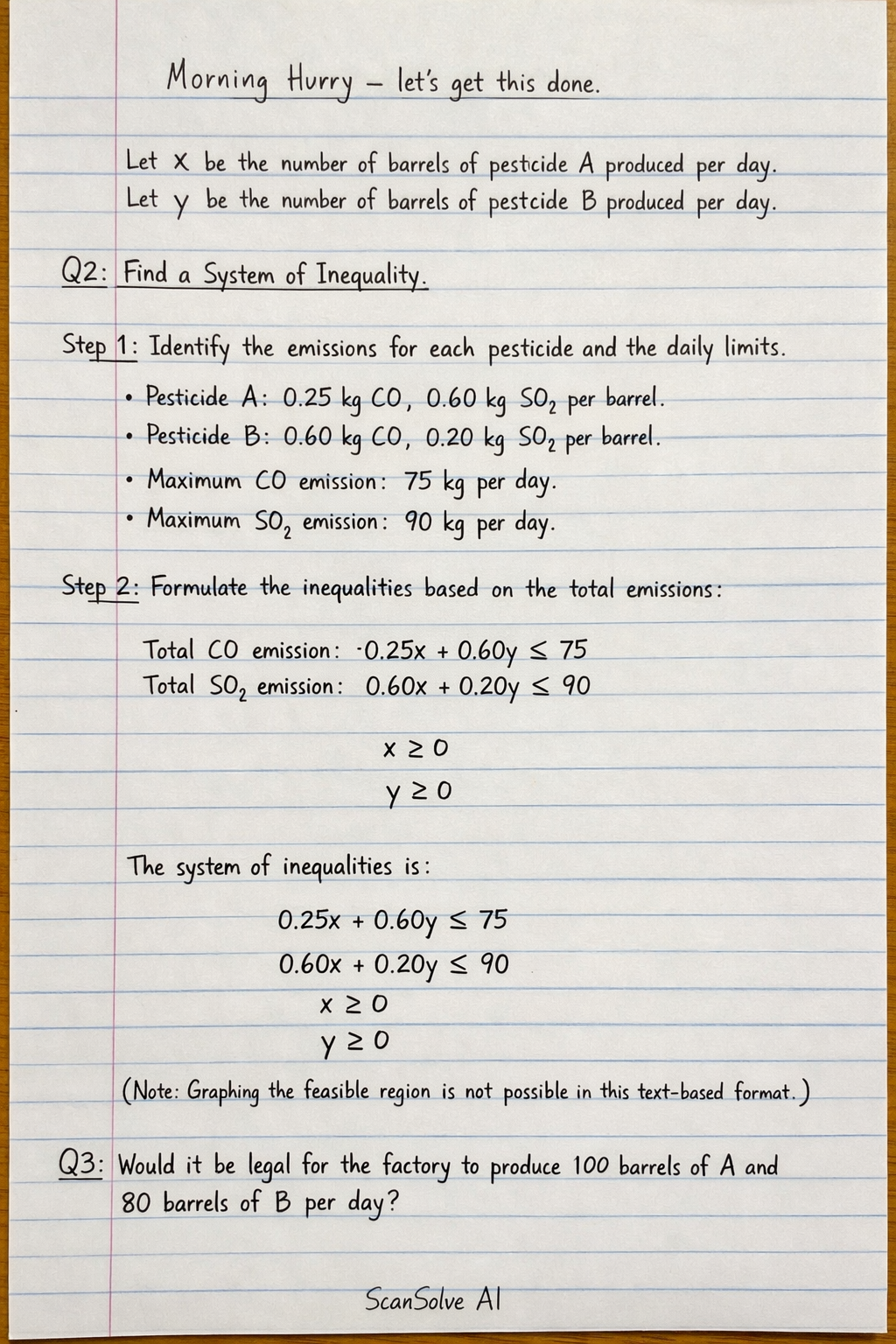
6 stepsLet be the number of barrels of pesticide A produced per day.
Let be the number of barrels of pesticide B produced per day.
Q2: Find a System of inequality
Identify the emissions for each pesticide and the daily limits.
- Pesticide A: 0.25 kg CO, 0.60 kg SO₂ per barrel.
- Pesticide B: 0.60 kg CO, 0.20 kg SO₂ per barrel.
- Maximum CO emission: 75 kg per day.
- Maximum SO₂ emission: 90 kg per day.
Formulate the inequalities based on the total emissions.
The total CO emission must be less than or equal to 75 kg:
The total SO₂ emission must be less than or equal to 90 kg:
Since the number of barrels cannot be negative:
The system of inequalities is:
(Note: Graphing the feasible region is not possible in this text-based format.)
Q3: Would it be legal for the factory to produce 100 barrels of A and 80 barrels of B per day?
Substitute and into the CO emission inequality.
This inequality holds true.
Substitute and into the SO₂ emission inequality.
This inequality also holds true.
Since both pollution constraints are satisfied, it would be legal.
The answer is:Q4: Would it be legal for the factory to produce 60 barrels of A and 160 barrels of B per day?
Substitute and into the CO emission inequality.
This inequality is false (111 is not less than or equal to 75).
Substitute and into the SO₂ emission inequality.
This inequality holds true.
Since the CO emission constraint is violated, it would not be legal.
The answer is:
Still stuck on this one?
Ask a follow-up, and the answer starts from this question.
More Mathematics Questions
Handwritten Step-by-Step Solution
Get this as a handwritten image on WhatsApp — like a tutor wrote it for you.
Try on WhatsApp