
We read your photo as:
A figure consists of a large semicircle with two smaller semicircles removed from its base. The base of the large semicircle is 28 cm. Find the area of the shaded region.
ScanSolve AI Answer
Answer
Step-by-step solution
5 stepsTo find the area of the shaded part, we need to calculate the area of the large semicircle and subtract the areas of the two smaller unshaded semicircles.
Determine the radii of the semicircles.
The total base length of the figure is . This is the diameter of the large semicircle.
Radius of the large semicircle, .Each of the two smaller semicircles has a diameter of .
Radius of each small semicircle, .Calculate the area of the large semicircle.
The formula for the area of a semicircle is .
Area of large semicircle () =Calculate the total area of the two small semicircles (unshaded parts).
Area of one small semicircle () =
Total area of two small semicircles () =
Calculate the shaded area.
The shaded area is the area of the large semicircle minus the total area of the two small semicircles.
Shaded Area () =Provide the numerical approximation (using ).
The area of the shaded part is or approximately .
Try one yourself
A new problem that tests the same skill.
Still stuck on this one?
Ask a follow-up, and the answer starts from this question.
More Mathematics Questions
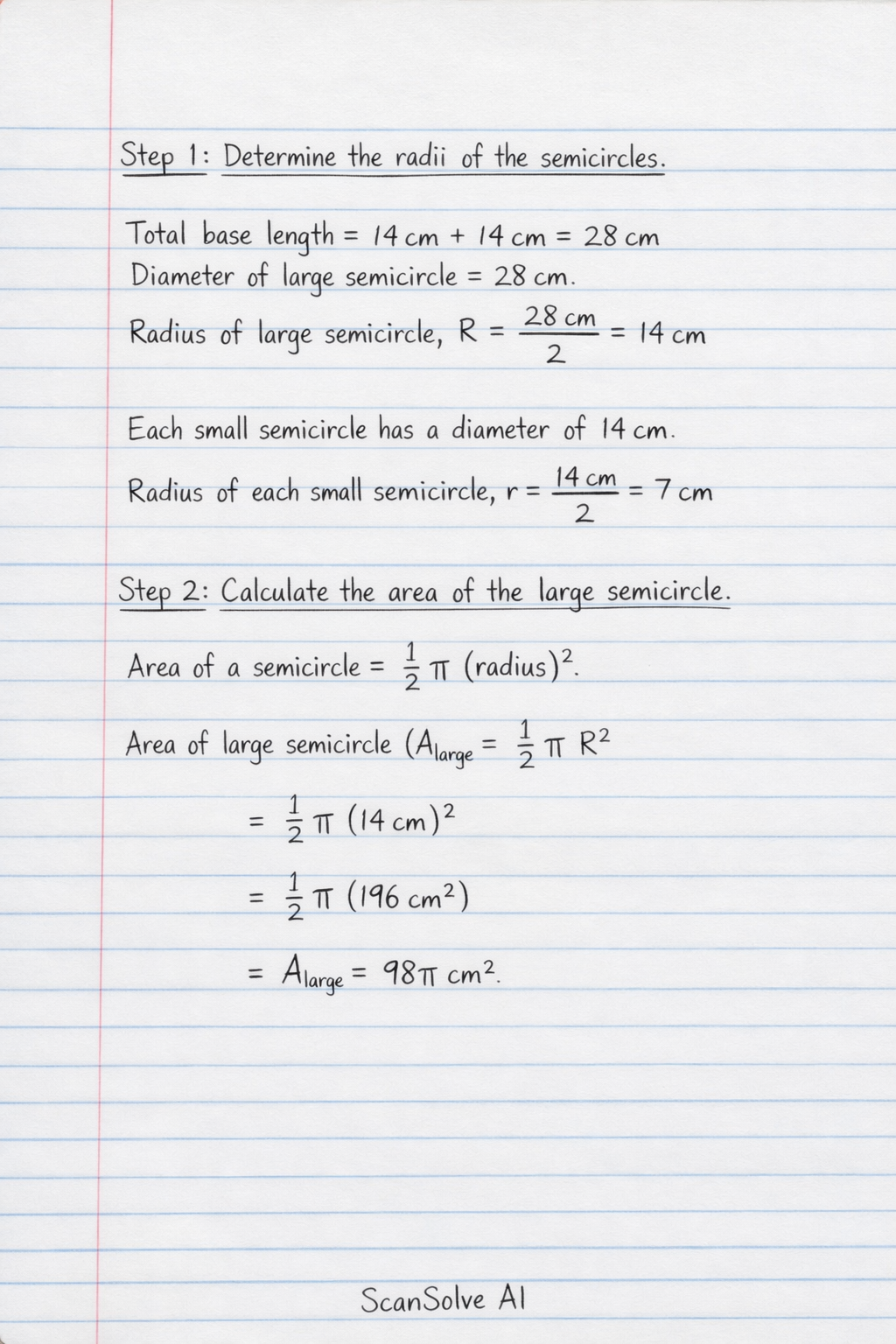
Handwritten Step-by-Step Solution
Get this as a handwritten image on WhatsApp — like a tutor wrote it for you.
Try on WhatsApp