

This mathematics problem involves applying core mathematical principles and formulas. Below you will find a complete step-by-step solution with detailed explanations for each step, helping you understand not just the answer but the method behind it.
ScanSolve AI Answer
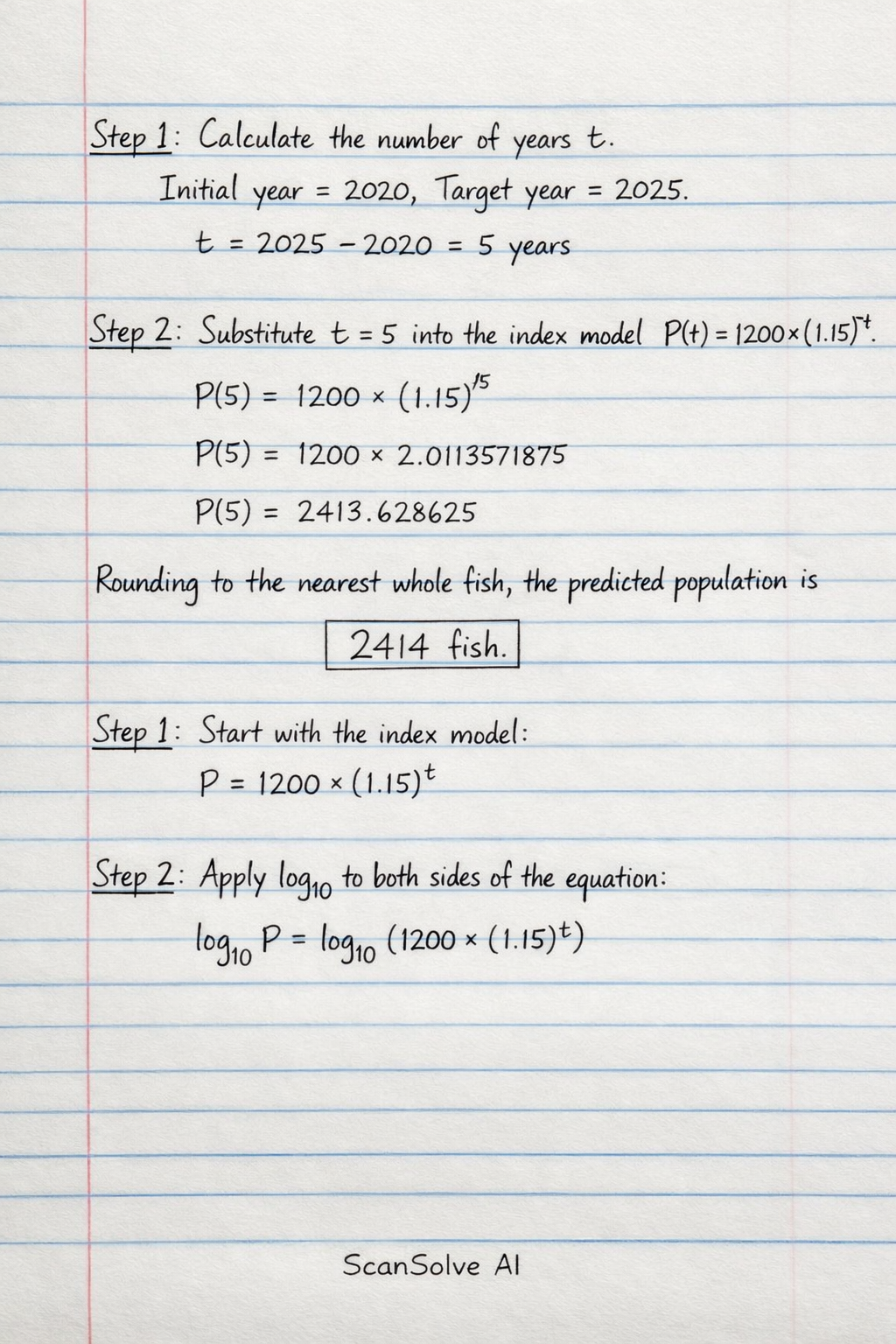
a) To calculate the predicted fish population in the year 2025 using the index model, we first determine the number of years t from the initial year 2020. Step 1: Calculate the number of years t. The initial year is 2020, and the target year is 2025. t = 2025 - 2020 = 5 years Step 2: Substitute t=5 into the index model P(t) = 1200 × (1.15)^t. P(5) = 1200 × (1.15)^5 P(5) = 1200 × 2.0113571875 P(5) = 2413.628625 Rounding to the nearest whole fish, the predicted population is 2414 fish. 2414 fish b) To show that the logarithmic model is equivalent to the index model, we start with the index model and apply the logarithm. Step 1: Start with the index model. P = 1200 × (1.15)^t Step 2: Apply _10 to both sides of the equation. _10 P = _10 (1200 × (1.15)^t) Step 3: Use the logarithm properties (AB) = A + B and (A^B) = B A. _10 P = _10 1200 + _10 (1.15)^t _10 P = _10 1200 + t _10 1.15 This matches the given logarithmic model, thus showing their equivalence. c) To determine the approximate number of years (t) it will take for the fish population to reach 5,000, we use the index model and solve for t using logarithms. Step 1: Set P(t) = 5000 in the index model. 5000 = 1200 × (1.15)^t Step 2: Isolate the exponential term. (5000)/(1200) = (1.15)^t (50)/(12) = (1.15)^t (25)/(6) = (1.15)^t Step 3: Take the logarithm (base 10 or natural logarithm) of both sides. _10((25)/(6)) = _10((1.15)^t) Step 4: Use the logarithm property (A^B) = B A to solve for t. _10((25)/(6)) = t _10(1.15) t = _10((25)/(6))_10(1.15) t ≈ (0.619789)/(0.060698) t ≈ 10.21 The approximate number of years is 10.21 years. 10.21 years Send me the next one 📸