We read your photo as:

A flow diagram has an input value x and an output value y. The rule is to multiply by 9 and then add 8. If the input is 3, what is the output?

Mathematics

ScanSolve AI Answer

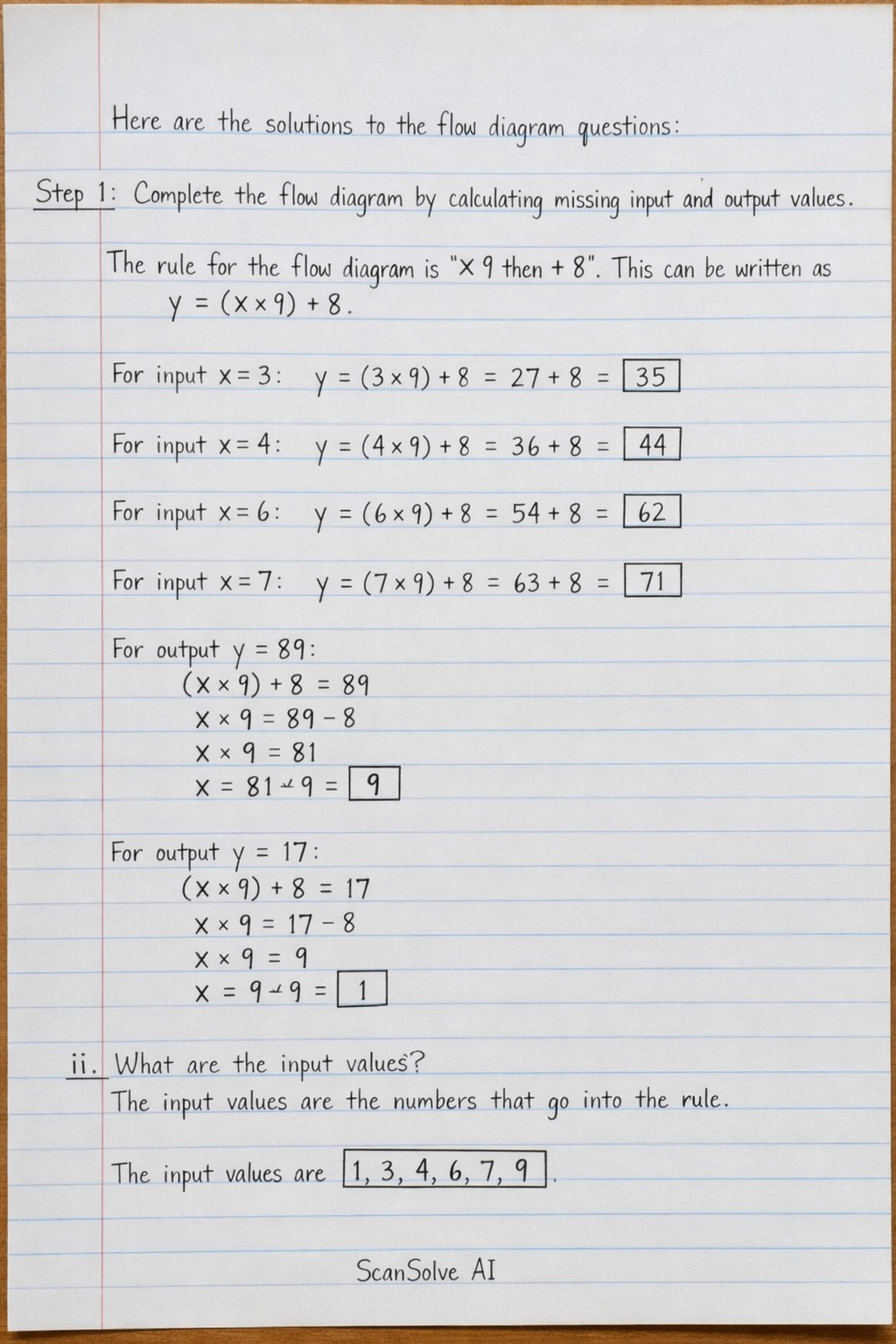
Here are the solutions to the flow diagram questions:

Step 1: Complete the flow diagram by calculating missing input and output values.
The rule for the flow diagram is "×9\times 9" then "+8+ 8". This can be written as y=(x×9)+8y = (x \times 9) + 8.

  • For input x=3x=3: y=(3×9)+8=27+8=35y = (3 \times 9) + 8 = 27 + 8 = \boxed{\textbf{35}}
  • For input x=4x=4: y=(4×9)+8=36+8=44y = (4 \times 9) + 8 = 36 + 8 = \boxed{\textbf{44}}
  • For input x=6x=6: y=(6×9)+8=54+8=62y = (6 \times 9) + 8 = 54 + 8 = \boxed{\textbf{62}}
  • For input x=7x=7: y=(7×9)+8=63+8=71y = (7 \times 9) + 8 = 63 + 8 = \boxed{\textbf{71}}
  • For output y=89y=89: (x×9)+8=89(x \times 9) + 8 = 89 x×9=89−8x \times 9 = 89 - 8 x×9=81x \times 9 = 81 x=81÷9=9x = 81 \div 9 = \boxed{\textbf{9}}
  • For output y=17y=17: (x×9)+8=17(x \times 9) + 8 = 17 x×9=17−8x \times 9 = 17 - 8 x×9=9x \times 9 = 9 x=9÷9=1x = 9 \div 9 = \boxed{\textbf{1}}

ii. What are the input values?
The input values are the numbers that go into the rule.
The input values are 1, 3, 4, 6, 7, 9\boxed{\textbf{1, 3, 4, 6, 7, 9}}.

iii. What are the output values?
The output values are the results after applying the rule to the inputs.
The output values are 17, 35, 44, 62, 71, 89\boxed{\textbf{17, 35, 44, 62, 71, 89}}.

iv. What is the rule?
The rule is explicitly stated in the flow diagram.
The rule is multiply by 9, then add 8\boxed{\textbf{multiply by 9, then add 8}}.

vi. What will the output values be if the rule is "+2×7+ 2 \times 7"?
We will use the input values from the completed flow diagram: 1,3,4,6,7,91, 3, 4, 6, 7, 9.
The rule "+2×7+ 2 \times 7" means add the input to the product of 2 and 7. So, y=x+(2×7)=x+14y = x + (2 \times 7) = x + 14.

  • For input x=1x=1: y=1+(2×7)=1+14=15y = 1 + (2 \times 7) = 1 + 14 = \boxed{\textbf{15}}
  • For input x=3x=3: y=3+(2×7)=3+14=17y = 3 + (2 \times 7) = 3 + 14 = \boxed{\textbf{17}}
  • For input x=4x=4: y=4+(2×7)=4+14=18y = 4 + (2 \times 7) = 4 + 14 = \boxed{\textbf{18}}
  • For input x=6x=6: y=6+(2×7)=6+14=20y = 6 + (2 \times 7) = 6 + 14 = \boxed{\textbf{20}}
  • For input x=7x=7: y=7+(2×7)=7+14=21y = 7 + (2 \times 7) = 7 + 14 = \boxed{\textbf{21}}
  • For input x=9x=9: y=9+(2×7)=9+14=23y = 9 + (2 \times 7) = 9 + 14 = \boxed{\textbf{23}}

The output values would be 15, 17, 18, 20, 21, 23\boxed{\textbf{15, 17, 18, 20, 21, 23}}.

Was this helpful?

Still stuck on this one?

Ask a follow-up, and the answer starts from this question.

Got a different question?Ask your own question
Handwritten step-by-step solution preview

Handwritten Step-by-Step Solution

Get this as a handwritten image on WhatsApp — like a tutor wrote it for you.

Try on WhatsApp