
We read your photo as:
A frustum is formed by removing a small square-based pyramid from a similar, larger one, as shown below. Each trapezium-shaped face of the frustum is the same size. Work out the surface area of the frustum.
ScanSolve AI Answer
Answer
Step-by-step solution
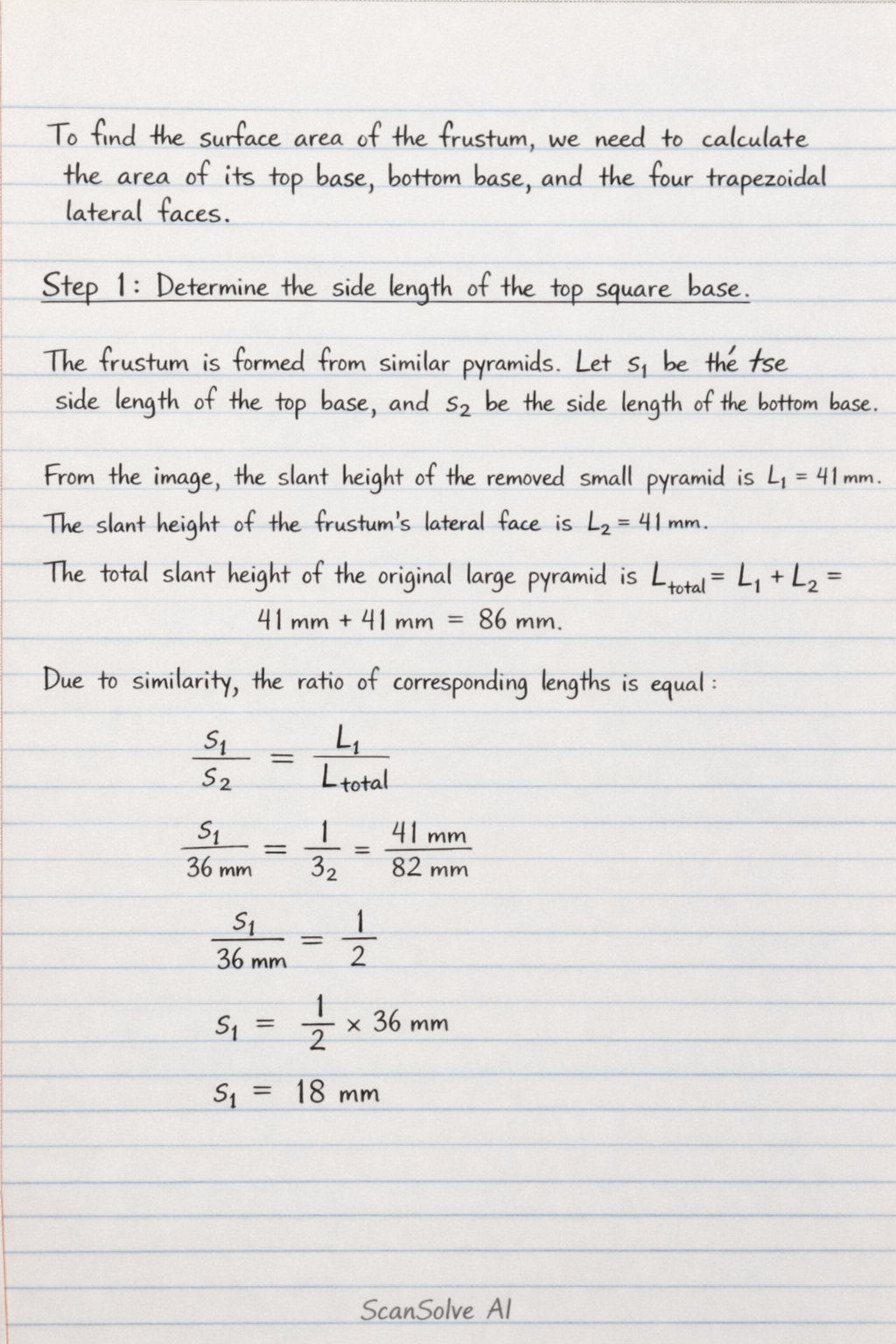
5 stepsTo find the surface area of the frustum, we need to calculate the area of its top base, bottom base, and the four trapezoidal lateral faces.
Determine the side length of the top square base.
The frustum is formed from similar pyramids. Let be the side length of the top base, and be the side length of the bottom base.
From the image, the slant height of the removed small pyramid is .
The slant height of the frustum's lateral face is .
The total slant height of the original large pyramid is .
The side length of the bottom base is .
Due to similarity, the ratio of corresponding lengths is equal:Calculate the areas of the top and bottom square bases.
Area of top base () =
Area of bottom base () =
Calculate the area of one trapezoidal lateral face.
Each lateral face is a trapezoid with parallel sides and , and height (slant height of the frustum) .
The area of one trapezoid () is given by the formula .Calculate the total area of the four trapezoidal lateral faces.
Since there are four identical lateral faces:
Calculate the total surface area of the frustum.
The total surface area () is the sum of the areas of the top base, bottom base, and the four lateral faces.
The surface area of the frustum is .
Try one yourself
A new problem that tests the same skill.
Still stuck on this one?
Ask a follow-up, and the answer starts from this question.
More Mathematics Questions
Handwritten Step-by-Step Solution
Get this as a handwritten image on WhatsApp — like a tutor wrote it for you.
Try on WhatsApp