
We read your photo as:
A geometric progression has its first term a and common ratio r. Given that U1 + U3 = 40 and U4/U6 = 1/4. Find the common ratio and the fifth term.
ScanSolve AI Answer
Step-by-step solution
7 stepsPart 11(a): Geometric Progression
Let the first term of the geometric progression be and the common ratio be .
The -th term of a G.P. is given by .
Given information:
-
The sum of the first and third terms is 40.
-
The fourth and the sixth terms are in the ratio 1:4.
i. Common ratio
Solve for .
Solve for .
The common ratio is .
ii. Fifth term
Find the value of using equation and the common ratio.
If :
If :
In both cases, the first term .Calculate the fifth term .
Using and :
Using and :
The fifth term is .
Part 11(b): Work Rate Problem
Let the total work be .
A can finish the work in 10 days, so A's rate is per day.
B can finish the work in 15 days, so B's rate is per day.
C can finish the work in 30 days, so C's rate is per day.Calculate the combined work rate of A, B, and C.
Combined rate
Find a common denominator for the fractions (which is 30).
Calculate the number of days required for them to finish the work together.
Time =
The number of days required if A, B, and C work together is .
Part 12(a): Geometric Construction
i. Construct in which , and .
- Draw a line segment of length 7 cm.
- At point , construct an angle of . (This can be done by constructing a angle and a angle, then bisecting the angle between them).
- Along the arm of the angle from , measure 8 cm and mark point .
- Join to to complete .
ii. The Locus of points equidistant from and .
This locus is the angle bisector of .- Place the compass at point and draw an arc that intersects both line segments and .
- From the two intersection points on and , draw two new arcs that intersect each other inside .
- Draw a straight line from through the intersection point of these two arcs. This line is .
iii. The Locus of points equidistant from and .
This locus is the perpendicular bisector of the line segment .- Place the compass at point and open it to a radius greater than half the length of . Draw an arc above and an arc below .
- With the same compass opening, place the compass at point and draw arcs above and below that intersect the previously drawn arcs.
- Draw a straight line through the two points where the arcs intersect. This line is .
Part 12(b): Locate the point K, the intersection of and .
The point is where the line (angle bisector of ) and the line (perpendicular bisector of ) intersect. Mark this intersection point as .Part 12(c): Measure...
The question is incomplete, so this part cannot be answered.
Still stuck on this one?
Ask a follow-up, and the answer starts from this question.
More Mathematics Questions
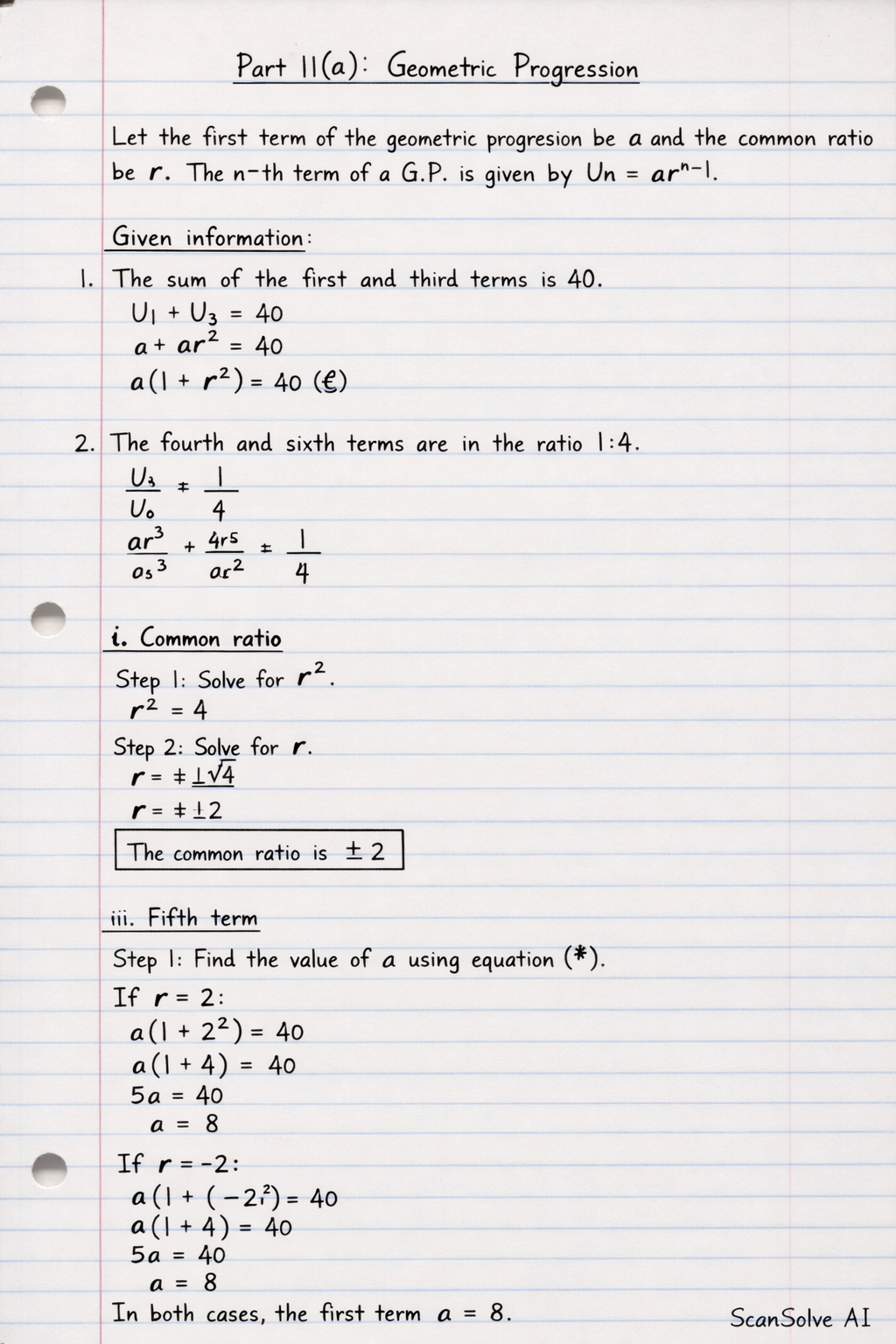
Handwritten Step-by-Step Solution
Get this as a handwritten image on WhatsApp — like a tutor wrote it for you.
Try on WhatsApp