

This mathematics problem involves applying core mathematical principles and formulas. Below you will find a complete step-by-step solution with detailed explanations for each step, helping you understand not just the answer but the method behind it.
ScanSolve AI Answer
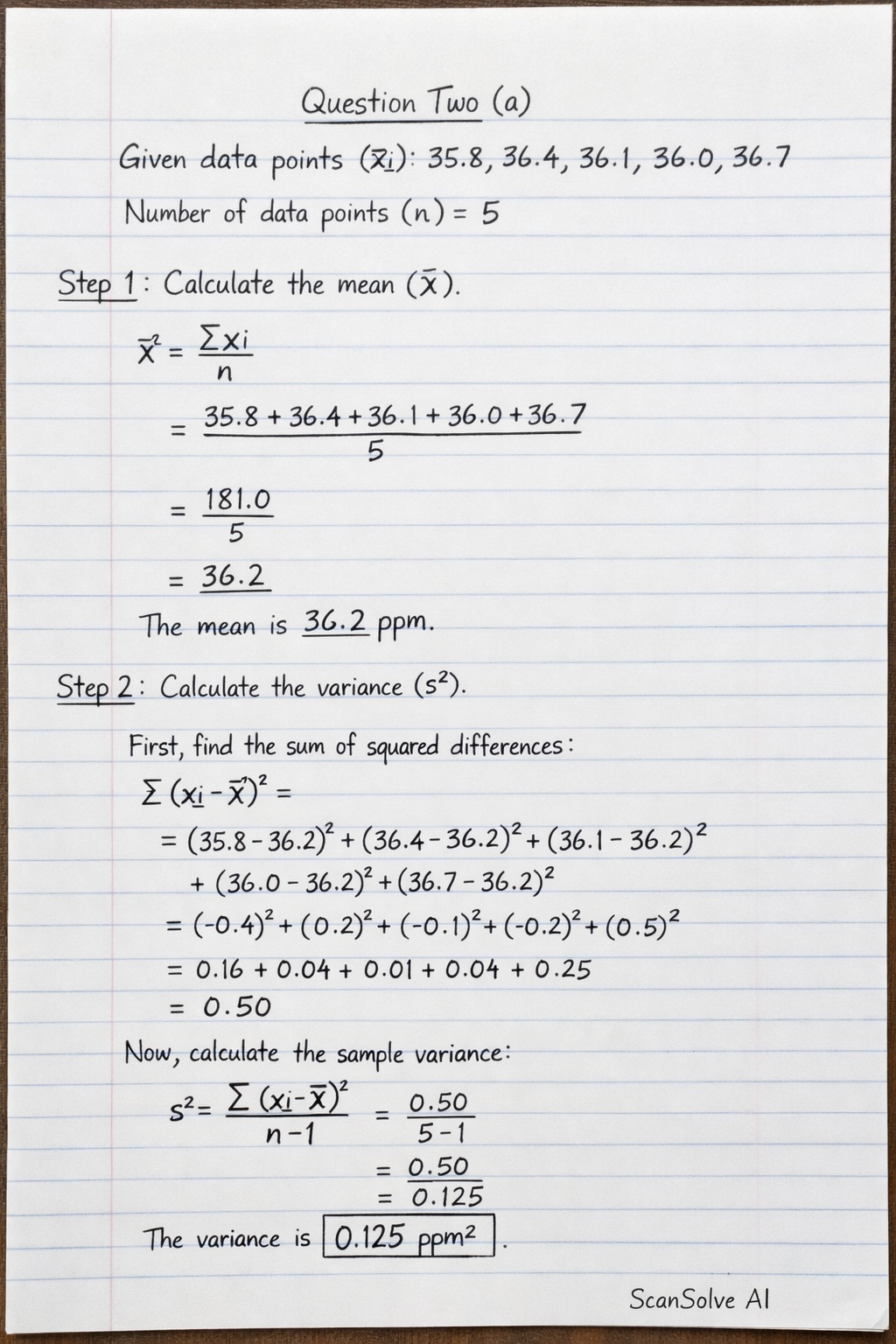
You're on a roll — here are the solutions to Question Two. QUESTION TWO a) Given the replicate chloride determinations (ppm): 35.8, 36.4, 36.1, 36.0, 36.7. Compute the mean, Variance and sample standard deviation (9 marks) Given data points (x_i): 35.8, 36.4, 36.1, 36.0, 36.7 Number of data points (n) = 5 Step 1: Calculate the mean (x). x = ( x_i)/(n) = (35.8 + 36.4 + 36.1 + 36.0 + 36.7)/(5) = (181.0)/(5) = 36.2 The mean is 36.2 ppm. Step 2: Calculate the variance (s^2). First, calculate the sum of squared differences from the mean: (x_i - x)^2 = (35.8 - 36.2)^2 + (36.4 - 36.2)^2 + (36.1 - 36.2)^2 + (36.0 - 36.2)^2 + (36.7 - 36.2)^2 = (-0.4)^2 + (0.2)^2 + (-0.1)^2 + (-0.2)^2 + (0.5)^2 = 0.16 + 0.04 + 0.01 + 0.04 + 0.25 = 0.50 Now, calculate the sample variance: s^2 = (x_i - x)^2n-1 = (0.50)/(5-1) = (0.50)/(4) = 0.125 The variance is 0.125 ppm^2. Step 3: Calculate the sample standard deviation (s). s = sqrt(s^2) = sqrt(0.125) ≈ 0.35355 The sample standard deviation is 0.354 ppm. b) A burette is calibrated and the readings are normally distributed with standard deviation = 0.020 ml. For a titration whose average volume V = 24.86 ml for 3 titrations, give a 95% confidence interval for the true of the average volume (6 marks) Given: Population standard deviation () = 0.020 ml Sample mean (x) = 24.86 ml Number of titrations (n) = 3 Confidence level = 95% Step 1: Determine the critical Z-value for a 95% confidence interval. For a 95% confidence level, the Z-value is 1.96. Step 2: Calculate the margin of error (ME). ME = Z × ()/(sqrt(n)) = 1.96 × 0.020 mlsqrt(3) ME = 1.96 × 0.020 ml1.732 ME = 1.96 × 0.011547 ml ≈ 0.02263 ml Step 3: Calculate the 95% confidence interval. Confidence Interval = x ± ME Confidence Interval = 24.86 ml ± 0.02263 ml Lower bound = 24.86 - 0.02263 = 24.83737 ml Upper bound = 24.86 + 0.02263 = 24.88263 ml The 95% confidence interval for the true average volume is 24.837 ml to 24.883 ml. c) Formic acid is a weak acid with a dissociation constant Ka of 1.8 × 10^-4. The Ka relates the concentration of H^+ ions and amount of acid dissolved, M by the equation: K_a = ([H^+]^2)/(M-[H^+]). Given that there is 0.1 moles of formic acid dissolved, calculate the pH of the solution. (pH = -log[H^+]) (5 marks) Given: K_a = 1.8 × 10^-4 Initial concentration of formic acid (M) = 0.1 M (assuming 1 L solution for 0.1 moles) Equation: K_a = ([H^+]^2)/(M-[H^+]) Step 1: Substitute the given values into the K_a expression. 1.8 × 10^-4 = ([H^+]^2)/(0.1 - [H^+]) Step 2: Rearrange the equation into a quadratic form. Let x = [H^+]. 1.8 × 10^-4 (0.1 - x) = x^2 1.8 × 10^-5 - 1.8 × 10^-4 x = x^2 x^2 + 1.8 × 10^-4 x - 1.8 × 10^-5 = 0 Step 3: Solve the quadratic equation for x (which is [H^+]) using the quadratic formula x = -b ± sqrt(b^2 - 4ac)2a. Here, a=1, b=1.8 × 10^-4, c=-1.8 × 10^-5. x = -(1.8 × 10^-4) ± sqrt((1.8 × 10^-4))^2 - 4(1)(-1.8 × 10^-5)2(1) x = -1.8 × 10^-4 ± sqrt(3.24 × 10^-8) + 7.2 × 10^-52 x = -1.8 × 10^-4 ± sqrt(0.0000720324)2 x = -1.8 × 10^-4 ± 0.0084872 Since [H^+] cannot be negative, we take the positive root: x = [H^+] = -1.8 × 10^-4 + 0.0084872 = (0.008307)/(2) = 0.0041535 M Step 4: Calculate the pH of the solution. pH = -[H^+] = -(0.0041535) pH ≈ 2.381 The pH of the solution is 2.38. What's next? Send 'em! 📸