
We read your photo as:
A) (i) Construct triangle ABC in which AB = 10cm, AC = 8cm and angle BAC = 100°. (ii) Measure and write the length of BC. b) Show the locus of points within triangle ABC which are equidistant from C.
ScanSolve AI Answer
The image provided is blurry, but the problem appears to be a geometry construction question. I will describe the steps for construction and calculate the length where measurement is requested.
Part (a):
a) (i) Construct triangle ABC in which AB = 10cm, AC = 8cm and angle BAC = 100°.
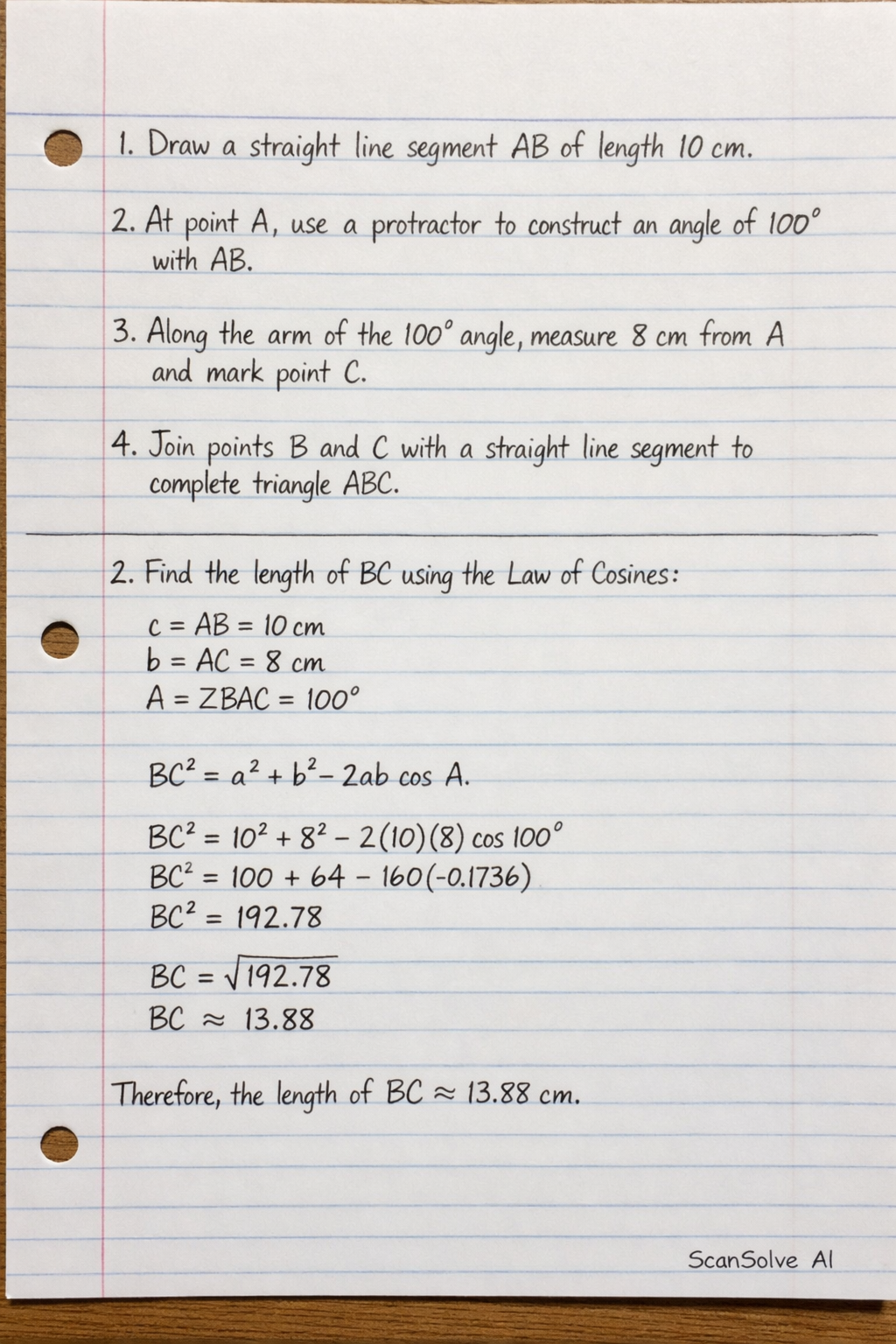
- Draw a straight line segment AB of length 10 cm.
- At point A, use a protractor to construct an angle of with AB.
- Along the arm of the angle, measure 8 cm from A and mark point C.
- Join points B and C with a straight line segment to complete triangle ABC.
a) (ii) Measure and write the length of BC.
Since I cannot perform a physical measurement, I will calculate the length of BC using the Law of Cosines.
In , we are given:
cm
cm
Using the Law of Cosines:
Substitute the given values:
The length of BC is approximately .
Part (b):
b) On your diagram, show the locus of points within triangle ABC which are:
b) (i) Equidistant from C.
A locus of points equidistant from a single point C is a circle centered at C. Since no specific radius is given, this describes any circle with center C. If the question intended a unique locus, it might have meant "equidistant from B and C" (the perpendicular bisector of BC) or "a specific distance from C". Assuming the most common interpretation for such problems, if it meant "equidistant from B and C", you would construct the perpendicular bisector of BC. If it literally means "equidistant from C", it's a circle centered at C.
b) (ii) 5cm from AB.
This locus is a line parallel to the line segment AB, located 5 cm away from AB, and within the triangle. To construct this:
- Draw a line segment perpendicular to AB from any point on AB.
- Measure 5 cm along this perpendicular line from AB.
- Draw a line through this 5 cm mark, parallel to AB. This parallel line is the locus.
b) (iii) Equidistant from AC and BC.
This locus is the angle bisector of . To construct this:
- Place the compass point at C and draw an arc that intersects both AC and BC.
- From each intersection point on AC and BC, draw another arc such that these two new arcs intersect.
- Draw a line from C through the intersection point of the two arcs. This line is the angle bisector.
Part (c):
c) A point P, within triangle ABC, is such that it is less than or equal to 5cm from C, less than or equal to 5cm from AB and nearer to AC than BC. Indicate, by shading, the region in which P must lie.
To find the region for point P, you need to identify the area that satisfies all three conditions simultaneously within :
- Less than or equal to 5cm from C: This region is the interior and boundary of a circle centered at C with a radius of 5 cm.
- Less than or equal to 5cm from AB: This region is between the line segment AB and the line parallel to AB that is 5 cm away (as constructed in part b(ii)).
- Nearer to AC than BC: This region is on the side of the angle bisector of (as constructed in part b(iii)) that is closer to the side AC.
The region in which P must lie is the intersection of these three regions, all confined within the boundaries of . You would shade this combined area on your diagram.
Still stuck on this one?
Ask a follow-up, and the answer starts from this question.
More Mathematics Questions
Handwritten Step-by-Step Solution
Get this as a handwritten image on WhatsApp — like a tutor wrote it for you.
Try on WhatsApp