
We read your photo as:
A) In which day did the learners do the fewest questions? B) Determine the total number of questions worked out in the week. C) Determine the mean number of questions. Solve the inequality: 3(1+x) < 5
ScanSolve AI Answer
Answer
13a - 6b + 2
Step-by-step solution
15 stepsHere are the solutions to the problems:
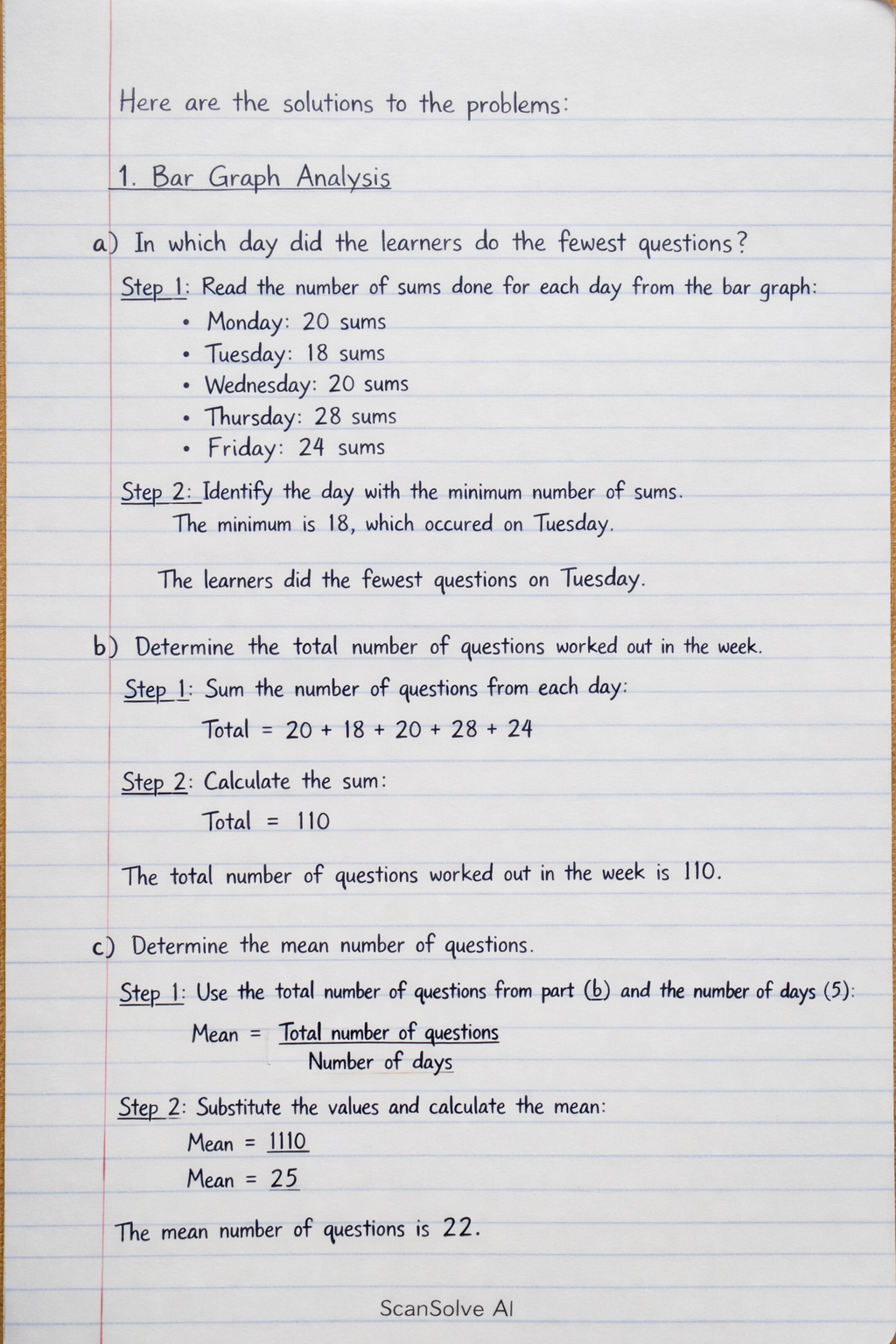
1. Bar Graph Analysis
Part a· 2 steps
In which day did the learners do the fewest questions?
Read the number of sums done for each day from the bar graph.
- Monday: 20 sums
- Tuesday: 18 sums
- Wednesday: 20 sums
- Thursday: 28 sums
- Friday: 24 sums
Identify the day with the minimum number of sums.
The minimum is 18, which occurred on Tuesday.
The learners did the fewest questions on Tuesday.
Part b· 2 steps
Determine the total number of questions worked out in the week.
Sum the number of questions from each day.
Calculate the sum.
The total number of questions worked out in the week is 110.
Part c
Determine the mean number of questions.
Use the total number of questions from part (b) and the number of days (5).
Substitute the values and calculate the mean.
The mean number of questions is 22.
2. Solve the inequality
Distribute the 3 on the left side of the inequality.
Subtract $3x$ from both sides of the inequality.
Add 13 to both sides of the inequality.
Divide both sides by 2.
The solution to the inequality is .
3. Probability
Kombo has six numbers: 4, 7, 9, 11, 21, 23. Find the probability that the number picked is a prime number.Identify the total number of possible outcomes.
There are 6 numbers in the set.
Identify the prime numbers in the given set.
A prime number is a natural number greater than 1 that has no positive divisors other than 1 and itself.
- 4 is not prime ()
- 7 is prime
- 9 is not prime ()
- 11 is prime
- 21 is not prime ()
- 23 is prime The prime numbers in the set are 7, 11, and 23. There are 3 prime numbers.
Calculate the probability.
The probability that the number picked is a prime number is .
4. Simplify
Group the like terms together.
Combine the like terms.
The simplified expression is .
Try one yourself
A new problem that tests the same skill.
Still stuck on this one?
Ask a follow-up, and the answer starts from this question.
More Mathematics Questions
Handwritten Step-by-Step Solution
Get this as a handwritten image on WhatsApp — like a tutor wrote it for you.
Try on WhatsApp