We read your photo as:

A linear transformation of points in 3-dimensional space is defined by the matrix M, where M = [[2, 1, 1], [3, 2, 1], [1, 1, 0]]. Under this transformation, find the image of the points on the line (x-1)/1 = (y−2)/(-1) = (z−1)/(-1).

Mathematics

ScanSolve AI Answer

Answer

(5, 8, 3)

Step-by-step solution

5 steps

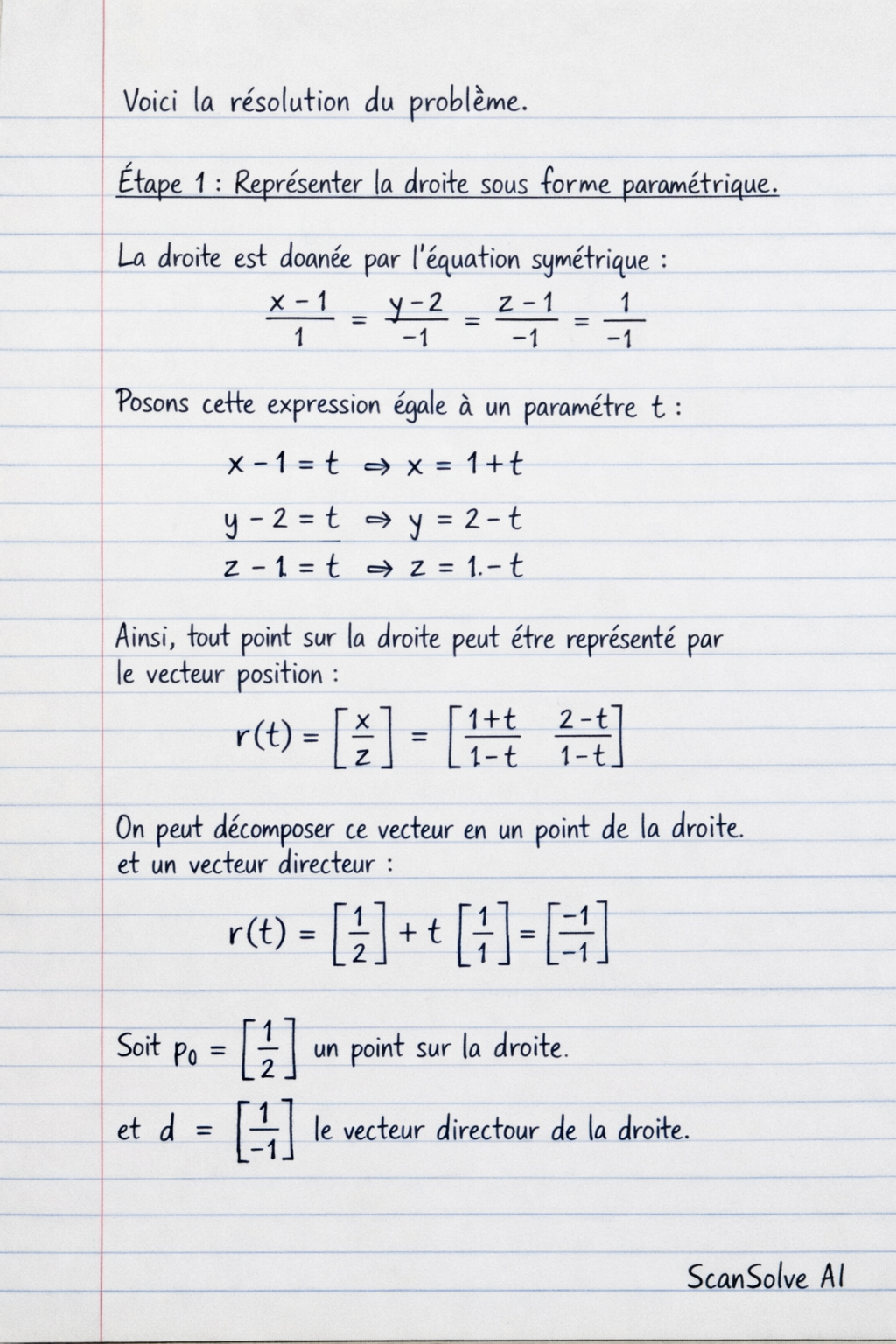
Voici la résolution du problème.

  1. Représenter la droite sous forme paramétrique.

    La droite est donnée par l'équation symétrique : x−11=y−2−1=z−1−1\frac{x-1}{1} = \frac{y-2}{-1} = \frac{z-1}{-1}.
    Posons cette expression égale à un paramètre tt:

    x−11=t⇒x=1+t\frac{x-1}{1} = t \Rightarrow x = 1+t y−2−1=t⇒y=2−t\frac{y-2}{-1} = t \Rightarrow y = 2-t z−1−1=t⇒z=1−t\frac{z-1}{-1} = t \Rightarrow z = 1-t

    Ainsi, tout point sur la droite peut être représenté par le vecteur position r(t)=[xyz]=[1+t2−t1−t]\mathbf{r}(t) = \begin{bmatrix} x \\ y \\ z \end{bmatrix} = \begin{bmatrix} 1+t \\ 2-t \\ 1-t \end{bmatrix}.
    On peut décomposer ce vecteur en un point de la droite et un vecteur directeur :

    r(t)=[121]+t[1−1−1]\mathbf{r}(t) = \begin{bmatrix} 1 \\ 2 \\ 1 \end{bmatrix} + t \begin{bmatrix} 1 \\ -1 \\ -1 \end{bmatrix}

    Soit p0=[121]\mathbf{p_0} = \begin{bmatrix} 1 \\ 2 \\ 1 \end{bmatrix} un point sur la droite et d=[1−1−1]\mathbf{d} = \begin{bmatrix} 1 \\ -1 \\ -1 \end{bmatrix} le vecteur directeur de la droite.

  2. Appliquer la transformation linéaire.

    La transformation linéaire est définie par la matrice M=[211321110]M = \begin{bmatrix} 2 & 1 & 1 \\ 3 & 2 & 1 \\ 1 & 1 & 0 \end{bmatrix}.
    L'image d'un point r\mathbf{r} est r′=Mr\mathbf{r'} = M\mathbf{r}.
    L'image de la droite est donc r′(t)=M(p0+td)=Mp0+t(Md)\mathbf{r'}(t) = M \left( \mathbf{p_0} + t \mathbf{d} \right) = M \mathbf{p_0} + t (M \mathbf{d}).

  3. Calculer l'image du point p0\mathbf{p_0}.

    Calculons Mp0M \mathbf{p_0}:

    M[121]=[211321110][121]=[2(1)+1(2)+1(1)3(1)+2(2)+1(1)1(1)+1(2)+0(1)]=[2+2+13+4+11+2+0]=[583]M \begin{bmatrix} 1 \\ 2 \\ 1 \end{bmatrix} = \begin{bmatrix} 2 & 1 & 1 \\ 3 & 2 & 1 \\ 1 & 1 & 0 \end{bmatrix} \begin{bmatrix} 1 \\ 2 \\ 1 \end{bmatrix} = \begin{bmatrix} 2(1)+1(2)+1(1) \\ 3(1)+2(2)+1(1) \\ 1(1)+1(2)+0(1) \end{bmatrix} = \begin{bmatrix} 2+2+1 \\ 3+4+1 \\ 1+2+0 \end{bmatrix} = \begin{bmatrix} 5 \\ 8 \\ 3 \end{bmatrix}
  4. Calculer l'image du vecteur directeur d\mathbf{d}.

    Calculons MdM \mathbf{d}:

    M[1−1−1]=[211321110][1−1−1]=[2(1)+1(−1)+1(−1)3(1)+2(−1)+1(−1)1(1)+1(−1)+0(−1)]=[2−1−13−2−11−1−0]=[000]M \begin{bmatrix} 1 \\ -1 \\ -1 \end{bmatrix} = \begin{bmatrix} 2 & 1 & 1 \\ 3 & 2 & 1 \\ 1 & 1 & 0 \end{bmatrix} \begin{bmatrix} 1 \\ -1 \\ -1 \end{bmatrix} = \begin{bmatrix} 2(1)+1(-1)+1(-1) \\ 3(1)+2(-1)+1(-1) \\ 1(1)+1(-1)+0(-1) \end{bmatrix} = \begin{bmatrix} 2-1-1 \\ 3-2-1 \\ 1-1-0 \end{bmatrix} = \begin{bmatrix} 0 \\ 0 \\ 0 \end{bmatrix}
  5. Déterminer l'image de la droite.

    L'image de la droite est donnée par :

    r′(t)=[583]+t[000]=[583]\mathbf{r'}(t) = \begin{bmatrix} 5 \\ 8 \\ 3 \end{bmatrix} + t \begin{bmatrix} 0 \\ 0 \\ 0 \end{bmatrix} = \begin{bmatrix} 5 \\ 8 \\ 3 \end{bmatrix}

    Puisque le vecteur directeur transformé est le vecteur nul, tous les points de la droite originale sont transformés en un seul point.

    L'image des points sur la droite est le point (5,8,3)(5, 8, 3).

Was this helpful?

Try one yourself

A new problem that tests the same skill.

Still stuck on this one?

Ask a follow-up, and the answer starts from this question.

Got a different question?Ask your own question
Handwritten step-by-step solution preview

Handwritten Step-by-Step Solution

Get this as a handwritten image on WhatsApp — like a tutor wrote it for you.

Try on WhatsApp