This mathematics problem involves applying core mathematical principles and formulas. Below you will find a complete step-by-step solution with detailed explanations for each step, helping you understand not just the answer but the method behind it.
In this question after integration pi is the upper boundary and 0 is the lower solve using the intervals the way I've enlisted
Mathematics
ScanSolve AI Answer
Answer
2
thanks for clarifying the limits! Let's integrate with as the lower boundary and as the upper boundary.
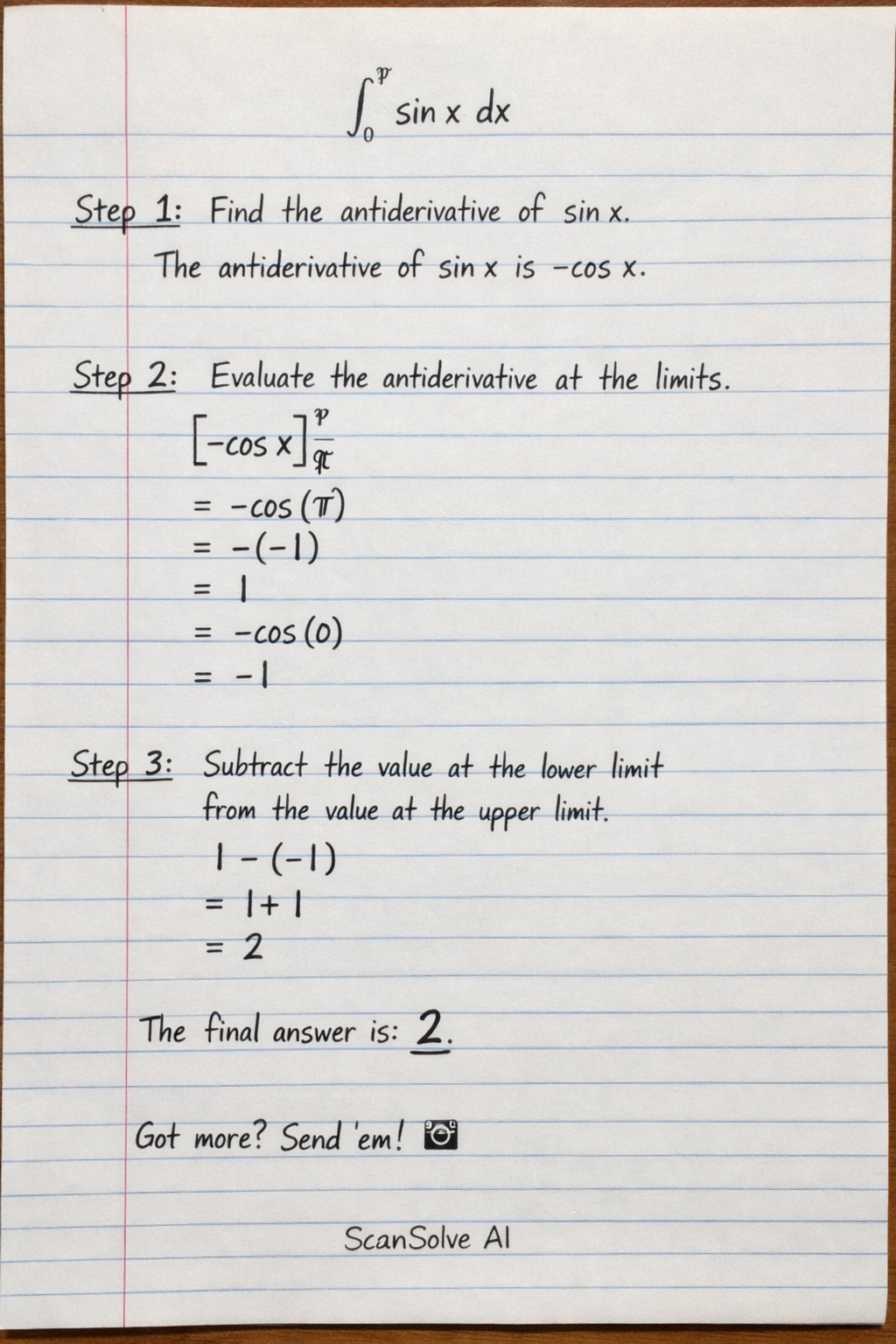
The integral is .
Step 1: Find the antiderivative of . The antiderivative of is .
Step 2: Evaluate the antiderivative at the limits of integration. Substitute the upper limit (): Substitute the lower limit ():
Step 3: Subtract the value at the lower limit from the value at the upper limit.
The final answer is .
Was this helpful?
Still stuck on this one?
Ask a follow-up, and the answer starts from this question.
Got a different question?Ask your own question
More Mathematics Questions
QSolve the integral questionQIntegrate sinx on the intervals of pi and 0QUsing Integration by parts, show that In = (pi)/(2) ^n-2 x x + ((n-1))/(n) In-2. Hence evaluate inte…QSolve the inequality below and write down the integral values that satisfy the equalityQIdentify the integral and its limits.
Browse by topic:Calculus

Handwritten Step-by-Step Solution
Get this as a handwritten image on WhatsApp — like a tutor wrote it for you.
Try on WhatsAppScanSolve AI Answer
thanks for clarifying the limits! Let's integrate x with 0 as the lower boundary and as the upper boundary. The integral is _0^ x \, dx. Step 1: Find the antiderivative of x. The antiderivative of x is - x. Step 2: Evaluate the antiderivative at the limits of integration. [ - x ]_0^ Substitute the upper limit (): -() = -(-1) = 1 Substitute the lower limit (0): -(0) = -1 Step 3: Subtract the value at the lower limit from the value at the upper limit. (1) - (-1) = 1 + 1 = 2 The final answer is 2.