

This mathematics problem involves applying core mathematical principles and formulas. Below you will find a complete step-by-step solution with detailed explanations for each step, helping you understand not just the answer but the method behind it.
ScanSolve AI Answer
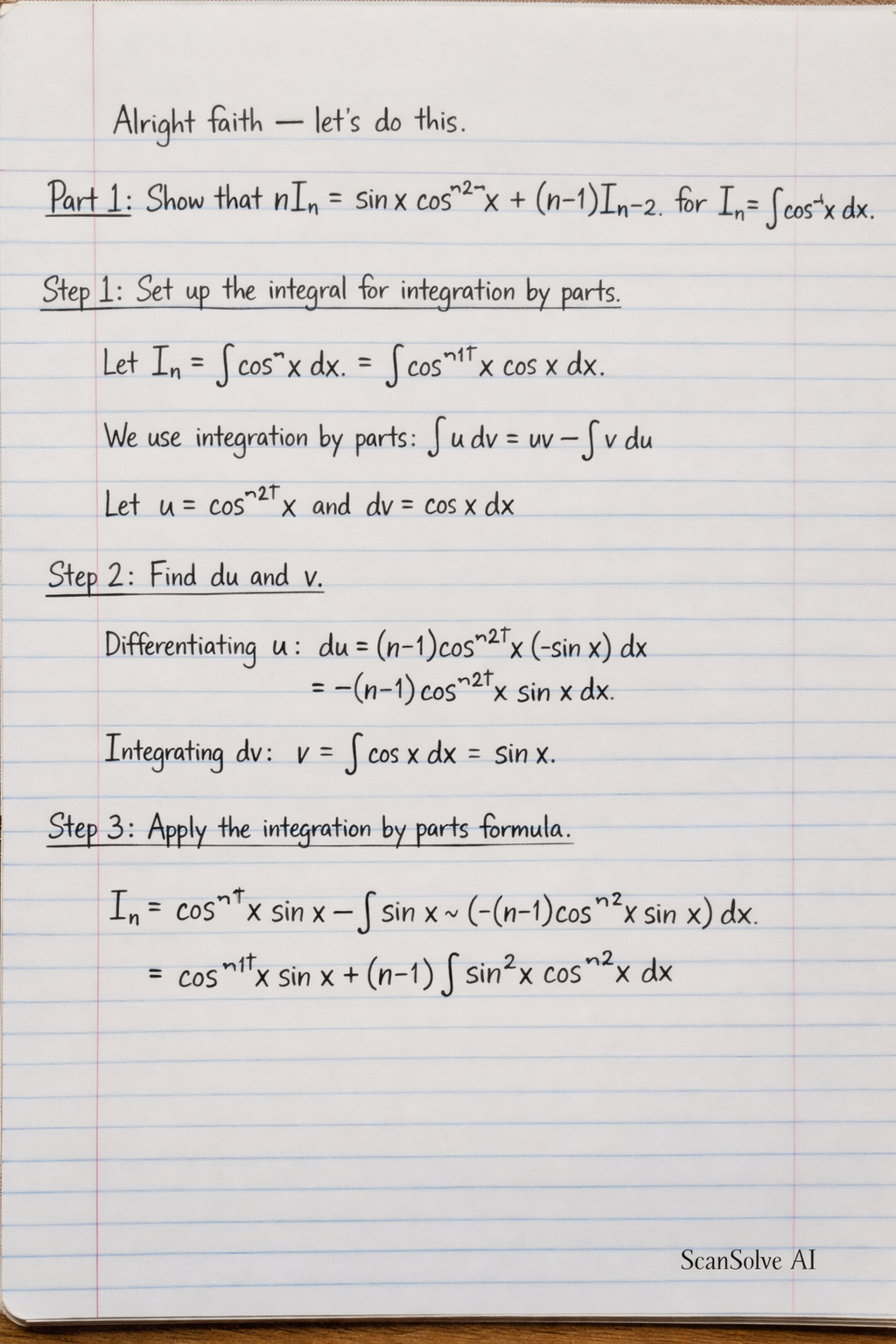
The problem asks us to first show a reduction formula for the integral of ^n x using integration by parts, and then use it to evaluate a definite integral. Part 1: Show that nI_n = x ^n-1 x + (n-1)I_n-2 for I_n = ^n x \, dx. Step 1: Set up the integral for integration by parts. Let I_n = ^n x \, dx = ^n-1 x · x \, dx. We use integration by parts formula: u \, dv = uv - v \, du. Let u = ^n-1 x and dv = x \, dx. Step 2: Find du and v. Differentiating u: du = (n-1)^n-2 x (- x) \, dx = -(n-1)^n-2 x x \, dx. Integrating dv: v = x \, dx = x. Step 3: Apply the integration by parts formula. I_n = ^n-1 x x - x · (-(n-1)^n-2 x x) \, dx I_n = ^n-1 x x + (n-1) ^2 x ^n-2 x \, dx Step 4: Use the identity ^2 x = 1 - ^2 x. I_n = ^n-1 x x + (n-1) (1 - ^2 x) ^n-2 x \, dx I_n = ^n-1 x x + (n-1) (^n-2 x - ^n x) \, dx I_n = ^n-1 x x + (n-1) ^n-2 x \, dx - (n-1) ^n x \, dx Step 5: Substitute I_n-2 and I_n back into the equation. I_n = ^n-1 x x + (n-1)I_n-2 - (n-1)I_n Step 6: Rearrange the equation to solve for I_n. I_n + (n-1)I_n = ^n-1 x x + (n-1)I_n-2 I_n (1 + n - 1) = ^n-1 x x + (n-1)I_n-2 nI_n = ^n-1 x x + (n-1)I_n-2 This proves the reduction formula. Part 2: Hence evaluate _0^()/(2) ^5 x \, dx. Step 1: Apply the reduction formula to the definite integral. Let J_n = _0^()/(2) ^n x \, dx. Using the reduction formula from Part 1: n J_n = [ x ^n-1 x ]_0^()/(2) + (n-1) J_n-2 Step 2: Evaluate the boundary term. For n > 1: [ x ^n-1 x ]_0^()/(2) = (()/(2)) ^n-1(()/(2)) - (0) ^n-1(0) = (1) · (0) - (0) · (1) = 0 So, for n > 1, the reduction formula for definite integrals from 0 to ()/(2) simplifies to: n J_n = (n-1) J_n-2 J_n = (n-1)/(n) J_n-2 Step 3: Use the reduction formula to evaluate J_5. J_5 = (5-1)/(5) J_5-2 = (4)/(5) J_3 J_3 = (3-1)/(3) J_3-2 = (2)/(3) J_1 Step 4: Calculate J_1. J_1 = _0^()/(2) x \, dx = [ x]_0^()/(2) = (()/(2)) - ( ✂️ _That answer was long and got cut off. Reply continue and I'll finish it._