
We read your photo as:
A man travels 5 km due east of a town A to town B, and then travels 7 km on a bearing of 162° from B to another town C. Calculate the: (a) Shortest distance from A to C, correct to the nearest km (b) Bearing of C from A, correct to the nearest degree
ScanSolve AI Answer
Answers
2 partsStep-by-step solution
6 stepsTo solve this problem, we'll use trigonometry, specifically the Cosine Rule and Sine Rule, after determining the angles in the triangle formed by towns A, B, and C.
Part a· 3 steps
Shortest distance from A to C
Draw a diagram and identify the knowns.
Let town A be the origin.
A man travels 5 km due east from A to B. So, the distance km.
From B, he travels 7 km to C on a bearing of . So, the distance km.
We need to find the angle .
Draw a North line at B. Since A is due west of B (because B is due east of A), the line BA points in the direction of from the North line at B.
The bearing of C from B is .
The angle is the angle between the line BA and the line BC.Apply the Cosine Rule to find the length AC.
The Cosine Rule states .
Round the distance to the nearest km.
Part b
Bearing of C from A
Use the Sine Rule to find .
The Sine Rule states .
Calculate the bearing of C from A.
Town B is due east of Town A. This means the line AB is along the East direction from A. The angle from the North line at A to the East direction (line AB) is .
The bearing of C from A is the angle measured clockwise from the North line at A to the line AC.
Bearing of C from A = .Round the bearing to the nearest degree.
Try one yourself
A new problem that tests the same skill.
Still stuck on this one?
Ask a follow-up, and the answer starts from this question.
More Mathematics Questions
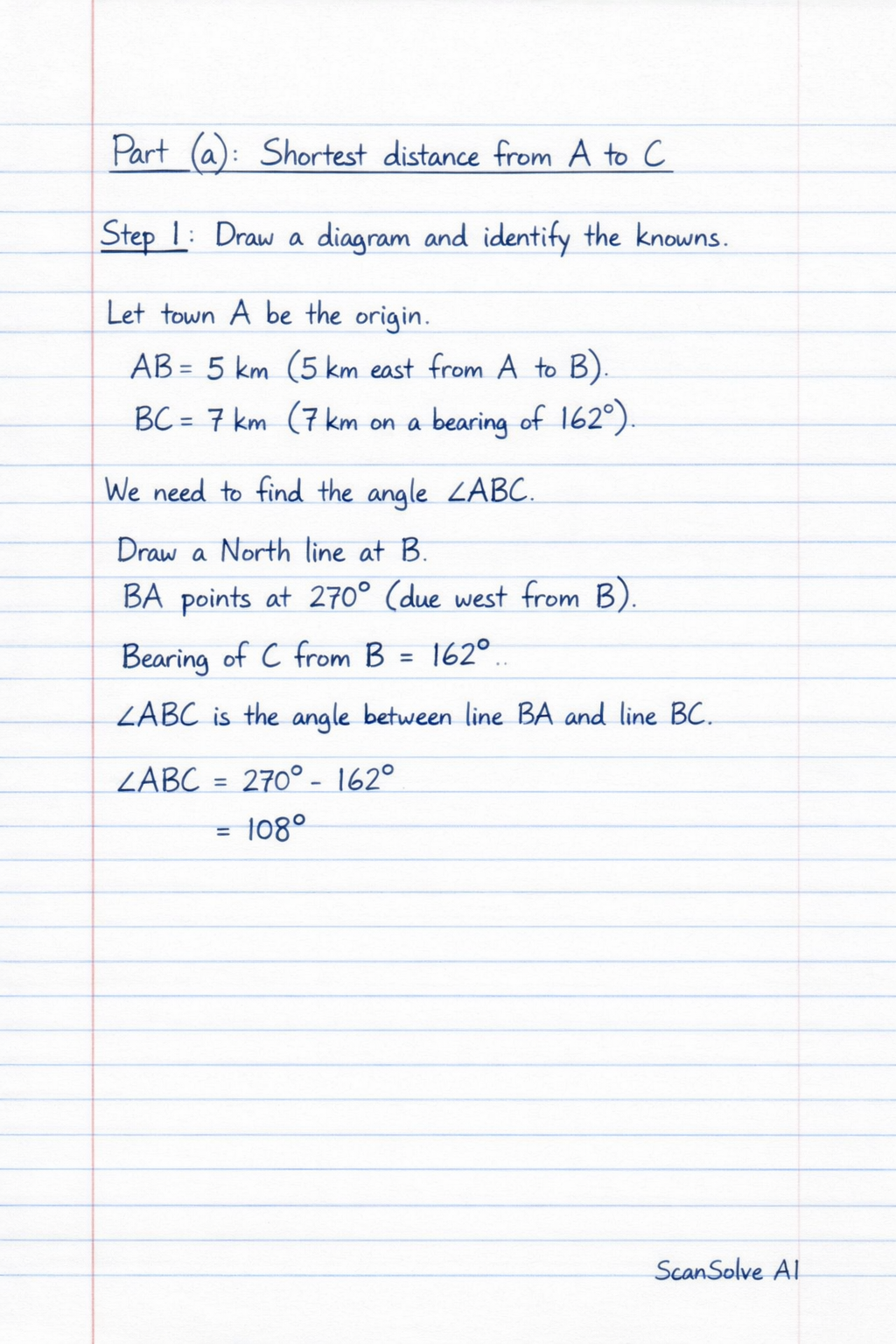
Handwritten Step-by-Step Solution
Get this as a handwritten image on WhatsApp — like a tutor wrote it for you.
Try on WhatsApp