
We read your photo as:
A measurement of 14.5 kg is recorded. Calculate: a) The absolute error. b) The percentage error. c) The tolerance.
Mathematics
ScanSolve AI Answer
Step-by-step solution
4 stepsHere are the calculations for the given mass:
- The measured mass is .
- The measurement is given to one decimal place, so the smallest unit of measurement is .
Part a· 1 step
Absolute error
Calculate the absolute error.
The absolute error is half of the smallest unit of measurement.
The absolute error is .
Part b· 2 steps
Percentage error
Use the formula for percentage error.
Substitute the values and calculate.
Rounding to two decimal places, the percentage error is .
Part c· 1 step
Tolerance
State the tolerance.
Tolerance is the range within which the actual value lies, expressed as the measured value plus or minus the absolute error.
This means the actual mass is between and .
The tolerance is .
Was this helpful?
Still stuck on this one?
Ask a follow-up, and the answer starts from this question.
Got a different question?Ask your own question
More Mathematics Questions
QA ruler calibrated in cm measures a table length of 102.0 cm. Find A. the limit of reading, B. the…QA rectangular room is 15 cm long and 12 cm wide. Each measurement has a 1.5% error. Calculate the…QCalculate the error and the percentage errorQP = ab2c3d4, The percentage error in measurement of a, b, c and d is 0.5% each. What is the…QCalculate the percentage uncertainty for the measurement 105.01 e 0.02.
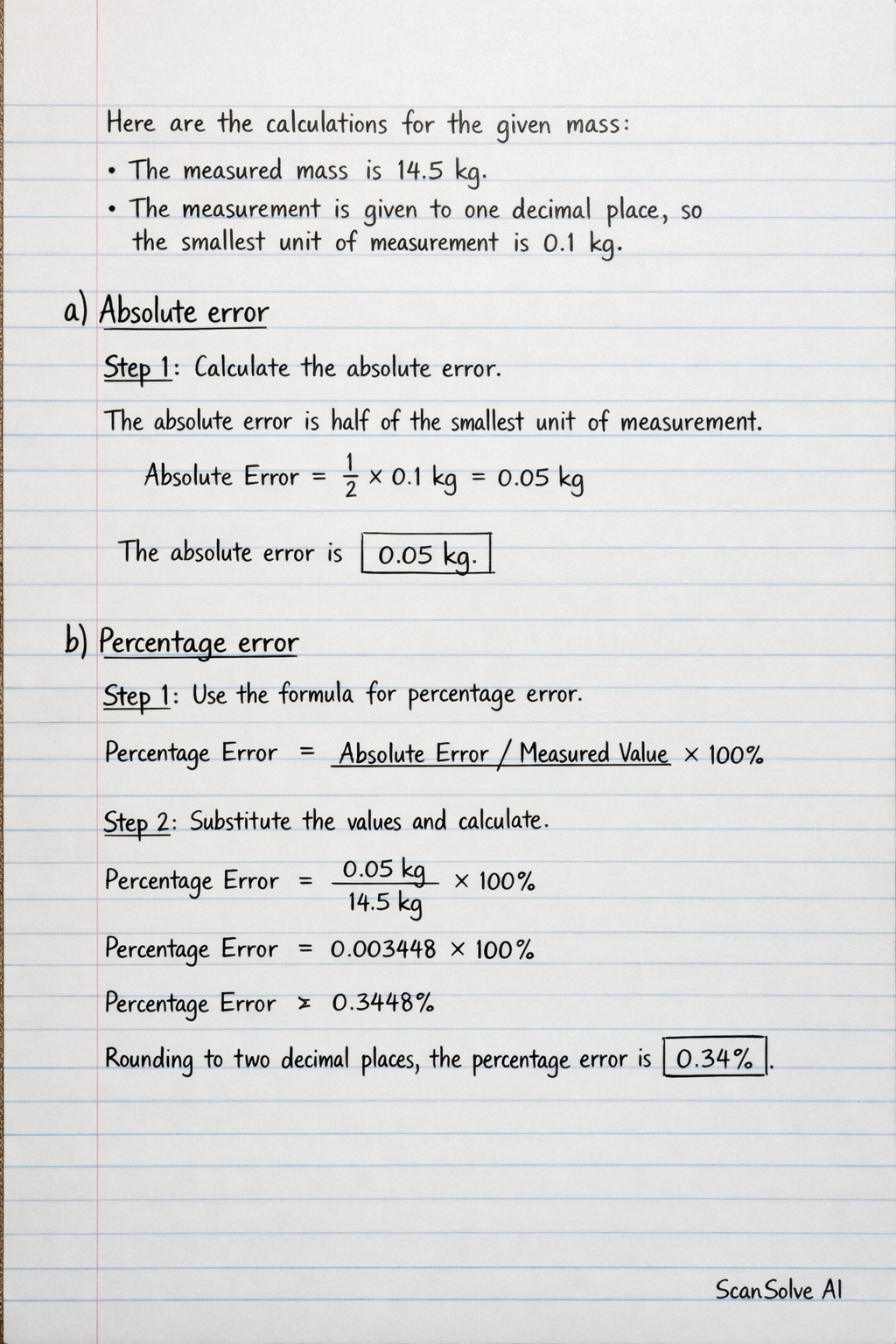
Handwritten Step-by-Step Solution
Get this as a handwritten image on WhatsApp — like a tutor wrote it for you.
Try on WhatsApp