
We read your photo as:
A packet of sweets is shared between Amina, Pauline and Sharon in the ratio 2:3:5. If Pauline received 12 sweets, how many did Sharon receive?
ScanSolve AI Answer
Answer
Step-by-step solution
9 stepsHere are the solutions to the remaining questions:
2) A packet of sweets is shared between Amina, Pauline and Sharon in the ratio 2:3:5. If Pauline received 12 sweets, how many did Sharon receive?
Determine the value of one ratio part.
The ratio for Amina : Pauline : Sharon is .
Pauline's share corresponds to 3 parts of the ratio.
Given that Pauline received 12 sweets, we can find the value of one part:Calculate Sharon's share.
Sharon's share corresponds to 5 parts of the ratio.
Sharon received .
3) A right circular cone has a base diameter of 12 cm and a height of 8 cm. Find the total surface area of the cone, leaving your answer to the nearest unit. Take .
Determine the radius and calculate the slant height.
The base diameter is , so the radius .
The height .
The slant height can be found using the Pythagorean theorem:Calculate the area of the base.
The area of the circular base is .
Calculate the lateral surface area.
The lateral surface area is .
Calculate the total surface area and round to the nearest unit.
The total surface area (TSA) is the sum of the base area and the lateral surface area.
Rounding to the nearest unit, the total surface area is .
4) Complete the logic table.
Fill the
~Qcolumn (negation of Q).Fill the
P ^ ~Qcolumn (conjunction of P and ~Q).Fill the
P v (P ^ ~Q)column (disjunction of P and (P ^ ~Q)).P Q ~Q P ^ ~Q P v (P ^ ~Q) T T F F T T F T T T F T F F F F F T F F The completed logic table is shown above.
Try one yourself
A new problem that tests the same skill.
Still stuck on this one?
Ask a follow-up, and the answer starts from this question.
More Mathematics Questions
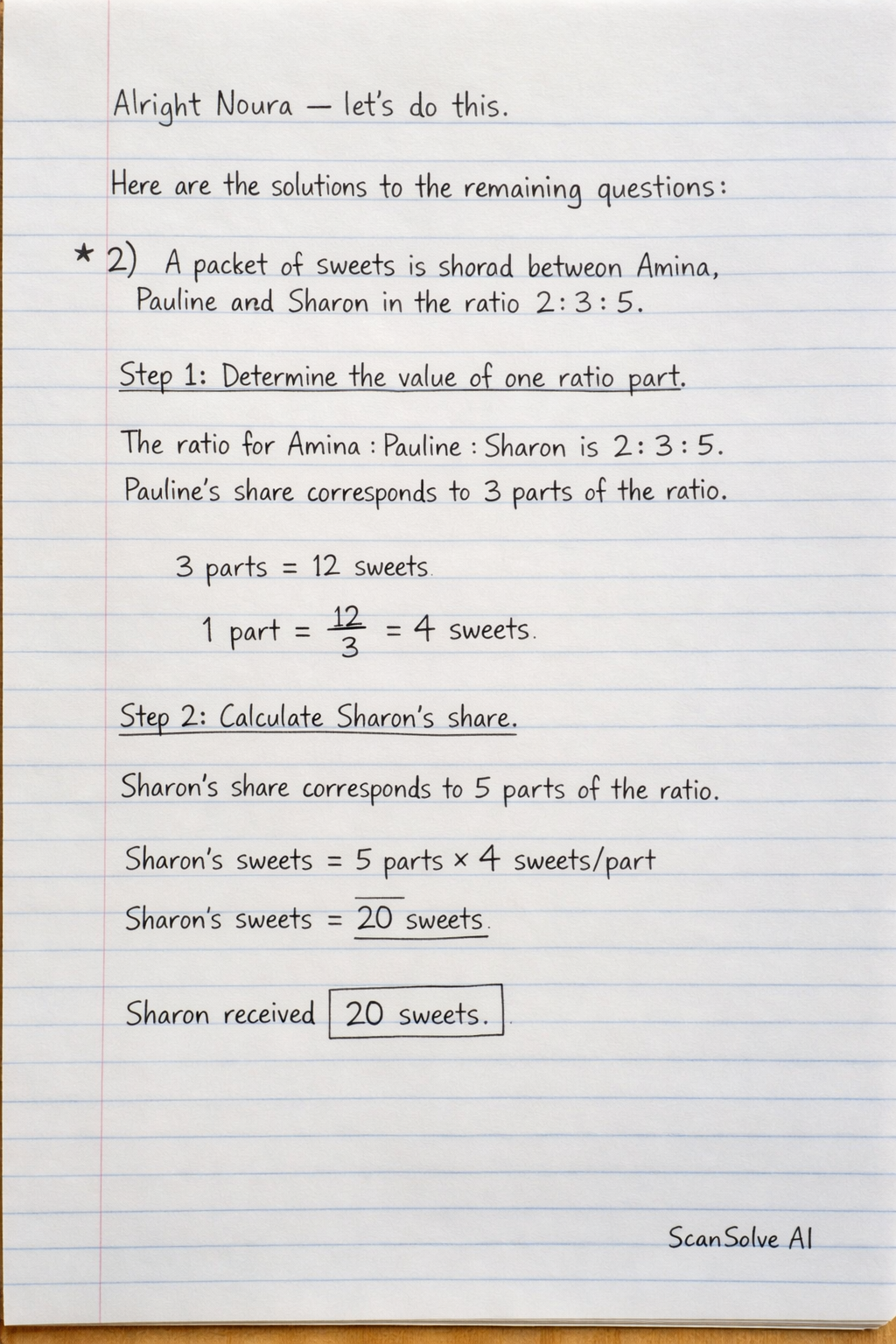
Handwritten Step-by-Step Solution
Get this as a handwritten image on WhatsApp — like a tutor wrote it for you.
Try on WhatsApp