
We read your photo as:
Seeta has 5 mint and 4 chocolate favoured sweets wrapped alike. He chooses two sweets at random and eats them one after the other. Find the probability that Seeta ate sweets of different flavours.
ScanSolve AI Answer
Answer
Step-by-step solution
10 stepsHere are the solutions to the problems:
Part 19· 4 steps
Determine the total number of sweets and the number of each flavour.
Number of mint sweets = 5
Number of chocolate sweets = 4
Total number of sweets =Calculate the probability of picking sweets of different flavours.
There are two possible scenarios:
-
Scenario 1: First sweet is mint, second sweet is chocolate (MC). Probability of picking a mint sweet first = After picking one mint sweet, there are 8 sweets left (4 mint, 4 chocolate). Probability of picking a chocolate sweet second = Probability of MC =
-
Scenario 2: First sweet is chocolate, second sweet is mint (CM). Probability of picking a chocolate sweet first = After picking one chocolate sweet, there are 8 sweets left (5 mint, 3 chocolate). Probability of picking a mint sweet second = Probability of CM =
-
Add the probabilities of the two scenarios to find the total probability of picking sweets of different flavours.
Simplify the fraction.
The probability that Seeta ate sweets of different flavours is .
Part 20
Part a· 3 steps
Describe a single transformation that maps A onto B.
Identify the coordinates of the vertices of triangle A and triangle B.
Triangle A has vertices at , , and .
Triangle B has vertices at , , and .Compare the coordinates of corresponding vertices.
- maps to
- maps to
- maps to
Notice that the x-coordinates remain unchanged, while the y-coordinates are transformed. This suggests a reflection across a horizontal line.
Determine the line of reflection.
For a reflection across the line , a point maps to .
Let's use the first pair of points: .
So, .
.
.
The line of reflection is .Let's verify with another point: . This matches.
The single transformation that maps A onto B is a reflection in the line .
Part b· 3 steps
Draw the image of B after stretch, y-axis invariant and stretch factor .
Understand the transformation.
A stretch with the y-axis invariant means that points on the y-axis (where ) do not change their position. The stretch factor of means that the x-coordinate of every point is multiplied by , while the y-coordinate remains the same.
The transformation rule is .Apply the transformation to the vertices of triangle B.
The vertices of triangle B are , , and .
- For :
- For :
- For :
Draw the image.
To draw the image of B, plot the new vertices:
- Connect these three points with straight lines to form the stretched triangle.
Try one yourself
A new problem that tests the same skill.
Still stuck on this one?
Ask a follow-up, and the answer starts from this question.
More Mathematics Questions
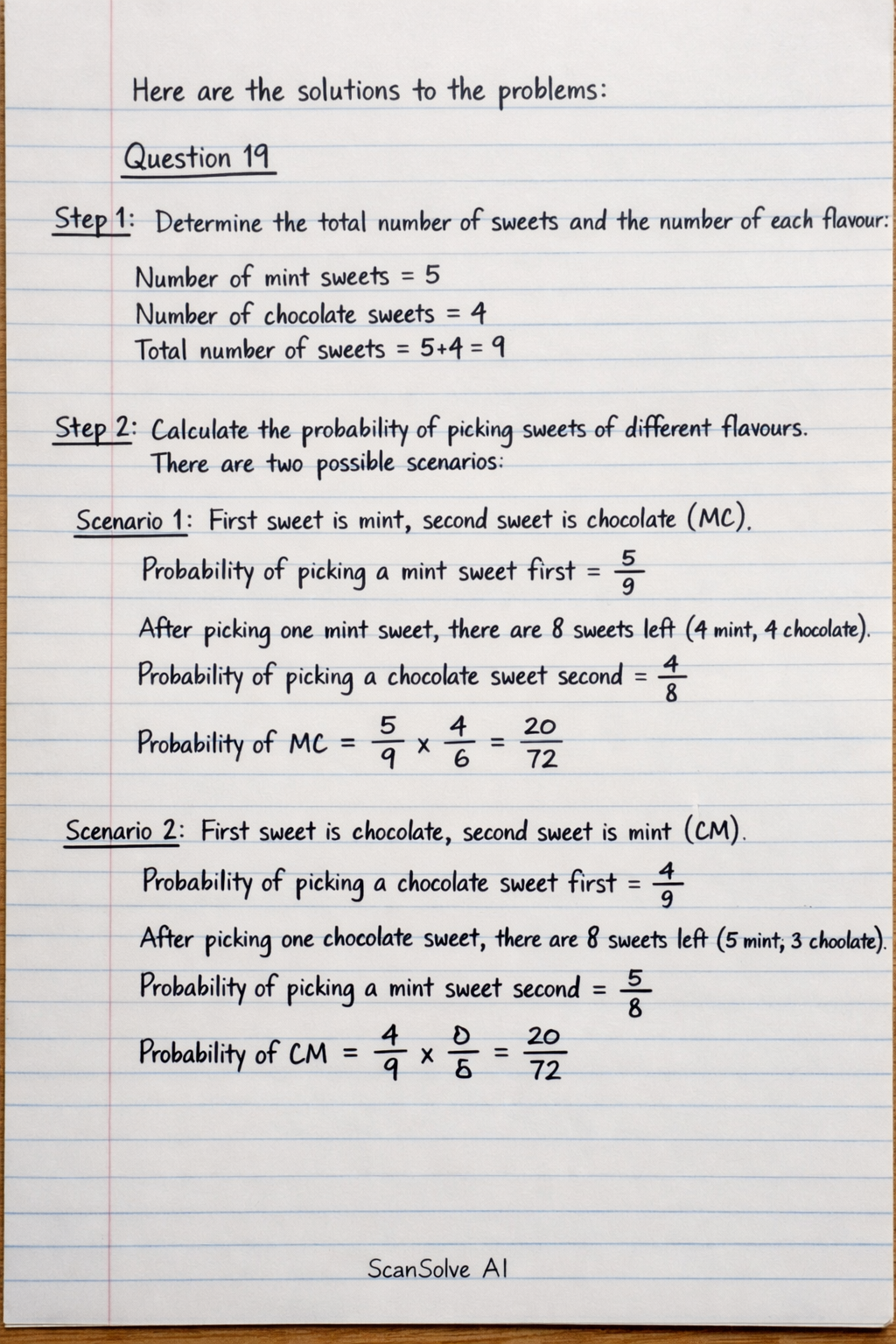
Handwritten Step-by-Step Solution
Get this as a handwritten image on WhatsApp — like a tutor wrote it for you.
Try on WhatsApp