A patient is prescribed a medication where the dosage follows an arithmetic progression. Ifthe dose on Day 3 is 15 mg and on Day 7 is 27 mg, lind the first dose and the common difference. (ii) What will be the dose on Day 12? Calculate the total medication administered in the first 2 weeks (14 days). Find the first four terns in the expansion of (1 - 2x)" in ascending power of x

Mathematics

ScanSolve AI Answer

Answer

b

1−2nx+2n(n−1)x2−4n(n−1)(n−2)3x31 - 2nx + 2n(n-1)x^2 - \frac{4n(n-1)(n-2)}{3}x^3

a)

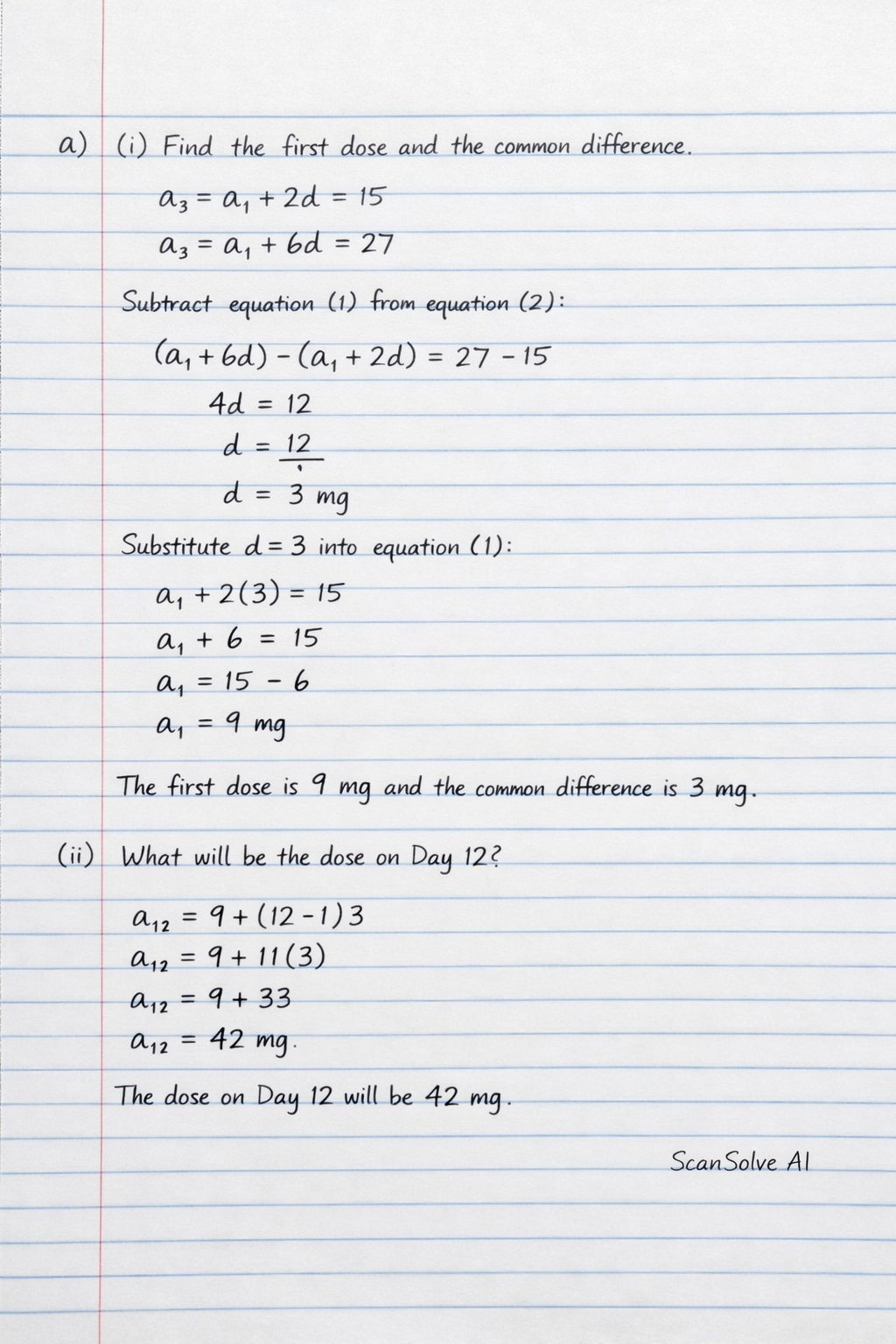
(i) Find the first dose and the common difference.
Let the first dose be a1a_1 and the common difference be dd.
For an arithmetic progression, the nn-th term is given by an=a1+(n−1)da_n = a_1 + (n-1)d.

Given:
Dose on Day 3 (a3a_3) is 15 mg.

a3=a1+(3−1)d  ⟹  a1+2d=15(1)a_3 = a_1 + (3-1)d \implies a_1 + 2d = 15 \quad (1)

Dose on Day 7 (a7a_7) is 27 mg.

a7=a1+(7−1)d  ⟹  a1+6d=27(2)a_7 = a_1 + (7-1)d \implies a_1 + 6d = 27 \quad (2)

Subtract equation (1) from equation (2):

(a1+6d)−(a1+2d)=27−15(a_1 + 6d) - (a_1 + 2d) = 27 - 15 4d=124d = 12 d=124d = \frac{12}{4} d=3 mgd = 3 \text{ mg}

Substitute d=3d=3 into equation (1):

a1+2(3)=15a_1 + 2(3) = 15 a1+6=15a_1 + 6 = 15 a1=15−6a_1 = 15 - 6 a1=9 mga_1 = 9 \text{ mg}

The first dose is 9 mg and the common difference is 3 mg.

(ii) What will be the dose on Day 12?
Using the formula an=a1+(n−1)da_n = a_1 + (n-1)d with a1=9a_1 = 9 mg, d=3d = 3 mg, and n=12n=12:

a12=9+(12−1)3a_{12} = 9 + (12-1)3 a12=9+(11)3a_{12} = 9 + (11)3 a12=9+33a_{12} = 9 + 33 a12=42 mga_{12} = 42 \text{ mg}

The dose on Day 12 will be 42 mg.

(iii) Calculate the total medication administered in the first 2 weeks (14 days).
The sum of the first nn terms of an arithmetic progression is given by Sn=n2(2a1+(n−1)d)S_n = \frac{n}{2}(2a_1 + (n-1)d).
Here, n=14n=14, a1=9a_1 = 9 mg, and d=3d = 3 mg.

S14=142(2(9)+(14−1)3)S_{14} = \frac{14}{2}(2(9) + (14-1)3) S14=7(18+(13)3)S_{14} = 7(18 + (13)3) S14=7(18+39)S_{14} = 7(18 + 39) S14=7(57)S_{14} = 7(57) S14=399 mgS_{14} = 399 \text{ mg}

The total medication administered in the first 2 weeks is 399 mg.

b) Find the first four terms in the expansion of (1−2x)n(1 - 2x)^n in ascending power of x.
Using the binomial expansion formula (a+b)n=(n0)anb0+(n1)an−1b1+(n2)an−2b2+(n3)an−3b3+…(a+b)^n = \binom{n}{0}a^n b^0 + \binom{n}{1}a^{n-1}b^1 + \binom{n}{2}a^{n-2}b^2 + \binom{n}{3}a^{n-3}b^3 + \dots
Here, a=1a=1 and b=−2xb=-2x.

First term (k=0k=0):

(n0)(1)n(−2x)0=1⋅1⋅1=1\binom{n}{0}(1)^n(-2x)^0 = 1 \cdot 1 \cdot 1 = 1

Second term (k=1k=1):

(n1)(1)n−1(−2x)1=n⋅1⋅(−2x)=−2nx\binom{n}{1}(1)^{n-1}(-2x)^1 = n \cdot 1 \cdot (-2x) = -2nx

Third term (k=2k=2):

(n2)(1)n−2(−2x)2=n(n−1)2!⋅1⋅(4x2)=n(n−1)2⋅4x2=2n(n−1)x2\binom{n}{2}(1)^{n-2}(-2x)^2 = \frac{n(n-1)}{2!} \cdot 1 \cdot (4x^2) = \frac{n(n-1)}{2} \cdot 4x^2 = 2n(n-1)x^2

Fourth term (k=3k=3):

(n3)(1)n−3(−2x)3=n(n−1)(n−2)3!⋅1⋅(−8x3)=n(n−1)(n−2)6⋅(−8x3)=−4n(n−1)(n−2)3x3\binom{n}{3}(1)^{n-3}(-2x)^3 = \frac{n(n-1)(n-2)}{3!} \cdot 1 \cdot (-8x^3) = \frac{n(n-1)(n-2)}{6} \cdot (-8x^3) = -\frac{4n(n-1)(n-2)}{3}x^3

The first four terms are:

1−2nx+2n(n−1)x2−4n(n−1)(n−2)3x3\boxed{1 - 2nx + 2n(n-1)x^2 - \frac{4n(n-1)(n-2)}{3}x^3}
Was this helpful?

Try one yourself

A new problem that tests the same skill.

Still stuck on this one?

Ask a follow-up, and the answer starts from this question.

Got a different question?Ask your own question
Handwritten step-by-step solution preview

Handwritten Step-by-Step Solution

Get this as a handwritten image on WhatsApp — like a tutor wrote it for you.

Try on WhatsApp