
We read your photo as:
A polynomial f(x) = (p-1)x3 + px2 + qx + r gives remainders 4, 0, and 5 when divided by (x-1), (x+1), and (x+2) respectively. Find the values of p, q, r.
Mathematics
ScanSolve AI Answer
Step-by-step solution
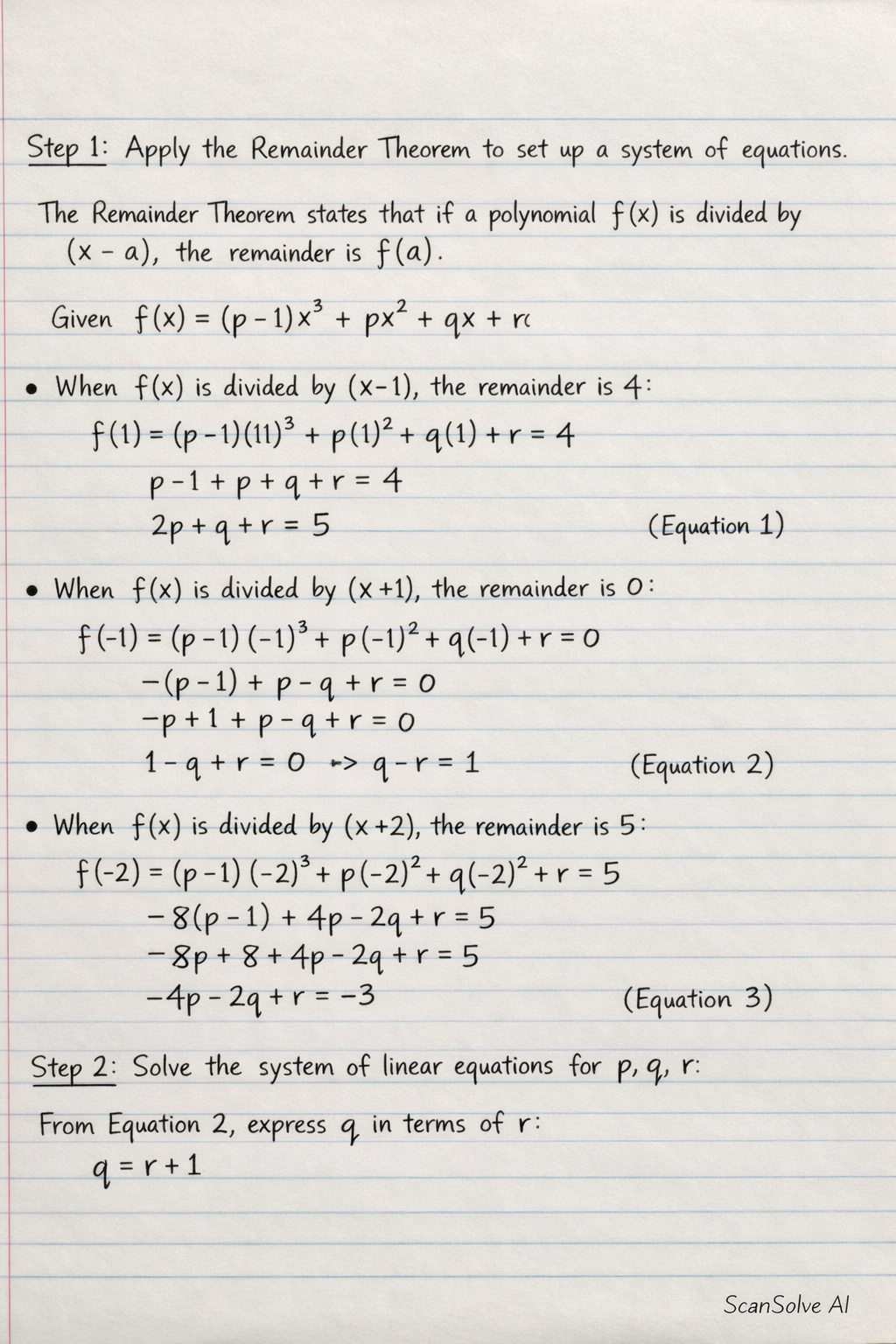
2 stepsApply the Remainder Theorem to set up a system of equations.
The Remainder Theorem states that if a polynomial is divided by , the remainder is .
Given .-
When is divided by , the remainder is 4:
-
When is divided by , the remainder is 0:
-
When is divided by , the remainder is 5:
-
Solve the system of linear equations for $p, q, r$.
From Equation 2, express in terms of :
Substitute into Equation 1:
Substitute into Equation 3:
Add Equation 4 and Equation 5:
Substitute into Equation 4:
$r = 2 + \frac{1}{3} = \frac{
Was this helpful?
Still stuck on this one?
Ask a follow-up, and the answer starts from this question.
Got a different question?Ask your own question
More Mathematics Questions
QGiven f(x) = 2x3 + px2 + qx + 1. When f(x) is divided by x+1, the remainder is 5. When f(x) is…QFind the values of p and q If (x2 + x − 2) is a factor of f(x) = x3 + px2 + 2x + q.QAccording one polynomial determine the values of p and q if(X-1) and (X+2) are factors of…QA function is defined as f(x) = (72)/(px+r). Given f(6)=12 and f(7)=9, find: a) the values of p and…QGiven p = 5 −7 , q = −1 3 , and r = 2 1 .
Handwritten Step-by-Step Solution
Get this as a handwritten image on WhatsApp — like a tutor wrote it for you.
Try on WhatsApp