
We read your photo as:
A population of plants grows according to the model P = A * (2^kt). Initially, there are 400 plants. After 2 years, there are 1600 plants. Calculate the growth rate k and the time t when the populatio
ScanSolve AI Answer
Answer
Step-by-step solution
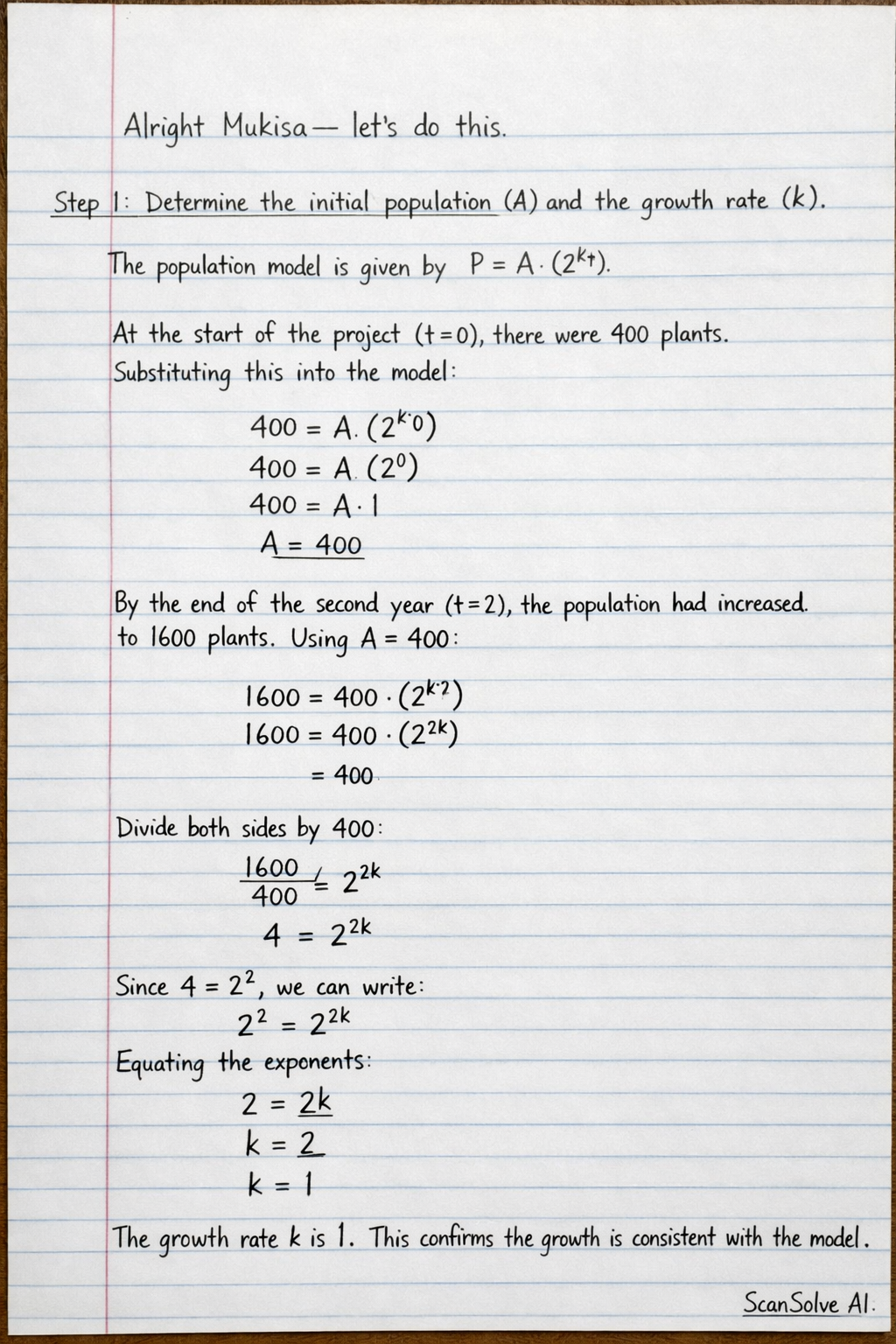
3 stepsDetermine the initial population () and the growth rate ().
The population model is given by .
At the start of the project (), there were 400 plants. Substituting this into the model:By the end of the second year (), the population had increased to 1,600 plants. Using :
Divide both sides by 400:
Since , we can write:
Equating the exponents:
The growth rate is 1. This confirms the growth is consistent with the model.
Predict when the population will reach a Self-Sustaining level of 25,600 plants.
We use the population model with and . We want to find when .
Divide both sides by 400:
Since , we have:
Equating the exponents:
The population will reach a self-sustaining level in 6 years.
Calculate the Stability Index () for the self-sustaining level.
The Stability Index formula is .
For the self-sustaining level, and .Using the logarithm property :
Since , then .
The Stability Index at the self-sustaining level is 6.
The population will reach a self-sustaining level of 25,600 plants in .
The Stability Index () at this level is .
Try one yourself
A new problem that tests the same skill.
Still stuck on this one?
Ask a follow-up, and the answer starts from this question.
More Mathematics Questions
Handwritten Step-by-Step Solution
Get this as a handwritten image on WhatsApp — like a tutor wrote it for you.
Try on WhatsApp