We read your photo as:

A project's initial cost of $64,000 is split between labour, materials, and contractor's charges in the ratio 12:15:5. Labour costs increase by x%, materials by 2x%, and contractor's charges remain th

Mathematics

ScanSolve AI Answer

Answers

2 parts
a

x=25x = 25

b

\85,000.00$

Step-by-step solution

4 steps
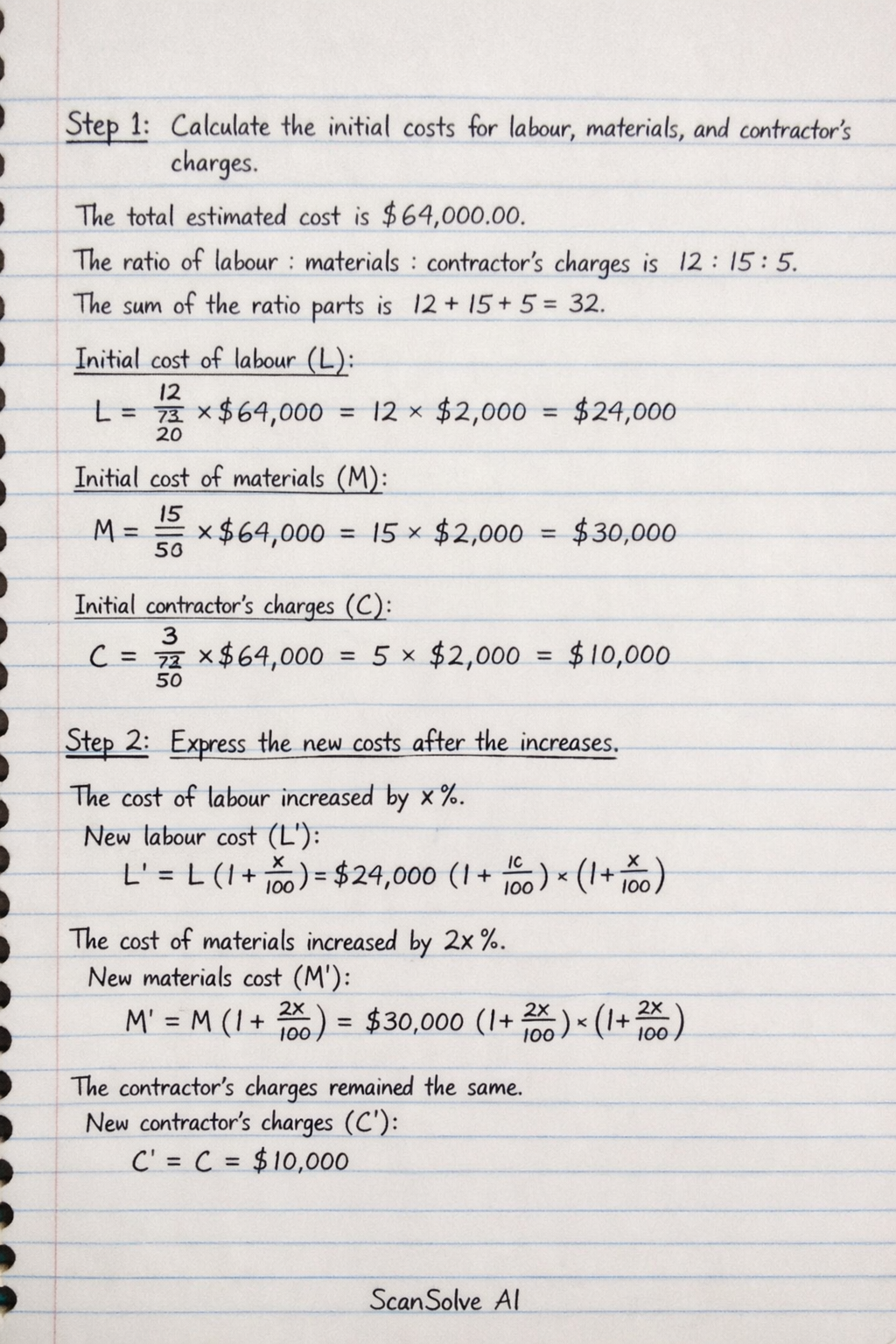
  1. Calculate the initial costs for labour, materials, and contractor's charges.

    The total estimated cost is \64,000.00.Theratiooflabour:materials:contractor′schargesis. The ratio of labour : materials : contractor's charges is 12 : 15 : 5.Thesumoftheratiopartsis. The sum of the ratio parts is 12 + 15 + 5 = 32$.

    Initial cost of labour (L): L=1232×$64,000=12×$2,000=$24,000L = \frac{12}{32} \times \$64,000 = 12 \times \$2,000 = \$24,000

    Initial cost of materials (M): M=1532×$64,000=15×$2,000=$30,000M = \frac{15}{32} \times \$64,000 = 15 \times \$2,000 = \$30,000

    Initial contractor's charges (C): C=532×$64,000=5×$2,000=$10,000C = \frac{5}{32} \times \$64,000 = 5 \times \$2,000 = \$10,000

  2. Express the new costs after the increases.

    The cost of labour increased by x%x \%.
    New labour cost (L'): L′=L(1+x100)=$24,000(1+x100)L' = L \left(1 + \frac{x}{100}\right) = \$24,000 \left(1 + \frac{x}{100}\right)

    The cost of materials increased by 2x%2x \%.
    New materials cost (M'): M′=M(1+2x100)=$30,000(1+2x100)M' = M \left(1 + \frac{2x}{100}\right) = \$30,000 \left(1 + \frac{2x}{100}\right)

    The contractor's charges remained the same.
    New contractor's charges (C'): C′=C=$10,000C' = C = \$10,000

  3. Use the given condition to find the value of xx.

    After the increase, the cost of labour was two-thirds the cost of materials:

    L′=23M′L' = \frac{2}{3} M'

    Substitute the expressions for L' and M':

    24,000(1+x100)=23×30,000(1+2x100)24,000 \left(1 + \frac{x}{100}\right) = \frac{2}{3} \times 30,000 \left(1 + \frac{2x}{100}\right) 24,000(1+x100)=20,000(1+2x100)24,000 \left(1 + \frac{x}{100}\right) = 20,000 \left(1 + \frac{2x}{100}\right)

    Divide both sides by 1,000:

    24(1+x100)=20(1+2x100)24 \left(1 + \frac{x}{100}\right) = 20 \left(1 + \frac{2x}{100}\right)

    Divide both sides by 4:

    6(1+x100)=5(1+2x100)6 \left(1 + \frac{x}{100}\right) = 5 \left(1 + \frac{2x}{100}\right)

    Expand the equation:

    6+6x100=5+10x1006 + \frac{6x}{100} = 5 + \frac{10x}{100}

    Multiply by 100 to clear the denominators:

    600+6x=500+10x600 + 6x = 500 + 10x

    Rearrange and solve for xx:

    600−500=10x−6x600 - 500 = 10x - 6x 100=4x100 = 4x x=1004x = \frac{100}{4} x=25x = 25

    a) The value of xx:

    x=25\boxed{x = 25}
  4. Calculate the new cost of building the restaurant.

    First, calculate the new individual costs using x=25x=25.
    New labour cost (L'): L′=$24,000(1+25100)=$24,000×(1+0.25)=$24,000×1.25=$30,000L' = \$24,000 \left(1 + \frac{25}{100}\right) = \$24,000 \times (1 + 0.25) = \$24,000 \times 1.25 = \$30,000 New materials cost (M'): M′=$30,000(1+2×25100)=$30,000×(1+0.50)=$30,000×1.50=$45,000M' = \$30,000 \left(1 + \frac{2 \times 25}{100}\right) = \$30,000 \times (1 + 0.50) = \$30,000 \times 1.50 = \$45,000 New contractor's charges (C'): C′=$10,000C' = \$10,000 The new total cost of building the restaurant is the sum of the new labour, materials, and contractor's charges:

    New Total Cost=L′+M′+C′\text{New Total Cost} = L' + M' + C'

    New Total Cost=$30,000+$45,000+$10,000\text{New Total Cost} = \$30,000 + \$45,000 + \$10,000 New Total Cost=$85,000\text{New Total Cost} = \$85,000

    b) The new cost of building the restaurant: $85,000.00\boxed{\$85,000.00}

Was this helpful?

Try one yourself

A new problem that tests the same skill.

Still stuck on this one?

Ask a follow-up, and the answer starts from this question.

Got a different question?Ask your own question
Handwritten step-by-step solution preview

Handwritten Step-by-Step Solution

Get this as a handwritten image on WhatsApp — like a tutor wrote it for you.

Try on WhatsApp