
We read your photo as:
A rectangle PQRS has corners P(0,0) A(6,0) Q(6,3) R(0,3). (a) reflect the rectangle in the line y=x. Draw both the object and the image. (b) Find a false undeb reflection. Explain your answer. (c) Always one property that does not change after reflection.
ScanSolve AI Answer
Answers
3 partsStep-by-step solution
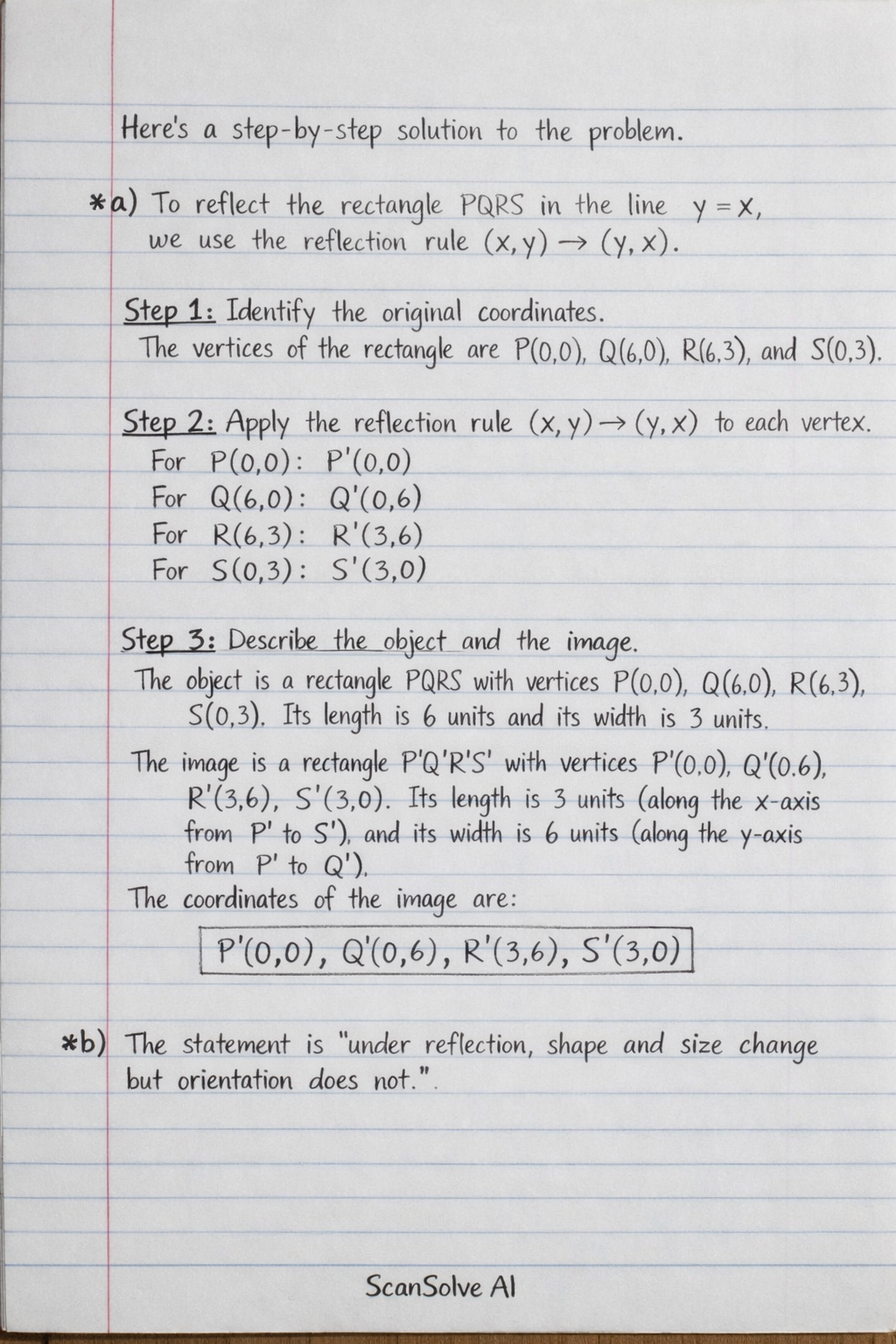
8 stepsHere's a step-by-step solution to the problem.
Part a· 3 steps
To reflect the rectangle PQRS in the line , we use the reflection rule .
Identify the original coordinates.
The vertices of the rectangle are , , , and .
Apply the reflection rule to each vertex.
For :
For :
For :
For :Describe the object and the image.
The object is a rectangle with vertices , , , . Its length is 6 units and its width is 3 units.
The image is a rectangle with vertices , , , . Its length is 3 units (along the x-axis from to ) and its width is 6 units (along the y-axis from to ).
The coordinates of the image are .
Part b
The statement is "under reflection, shape and size change but orientation does not."
Analyze the effect of reflection on shape and size.
Reflections are isometries, meaning they preserve distances and angles. Therefore, the shape and size of an object do not change under reflection. The statement claims they change, which is incorrect.
Analyze the effect of reflection on orientation.
Reflections reverse the orientation (or handedness) of an object. For example, a left hand reflects to a right hand. The statement claims orientation does not change, which is incorrect.
Conclude whether the statement is true or false and explain.
The statement is .
Reflections preserve shape and size, meaning they do not change. However, reflections do change the orientation of an object.
Part c
To name one property that does not change under reflection.
Recall properties preserved by reflections.
Reflections are rigid transformations. They preserve properties such as distance, angle measures, shape, and size.
State one such property.
One property that does not change under reflection is . (Other valid answers include size, angle measures, or distance between points).
Try one yourself
A new problem that tests the same skill.
Still stuck on this one?
Ask a follow-up, and the answer starts from this question.
More Mathematics Questions
Handwritten Step-by-Step Solution
Get this as a handwritten image on WhatsApp — like a tutor wrote it for you.
Try on WhatsApp