
We read your photo as:
A quadrilateral PQRS with vertices P(-2, 1), Q(0, 3), R(2, 2), and S(1, 0) is transformed by reflection in the x-axis, followed by a translation, and then a rotation of 180 degrees about the origin. F
ScanSolve AI Answer
Step-by-step solution
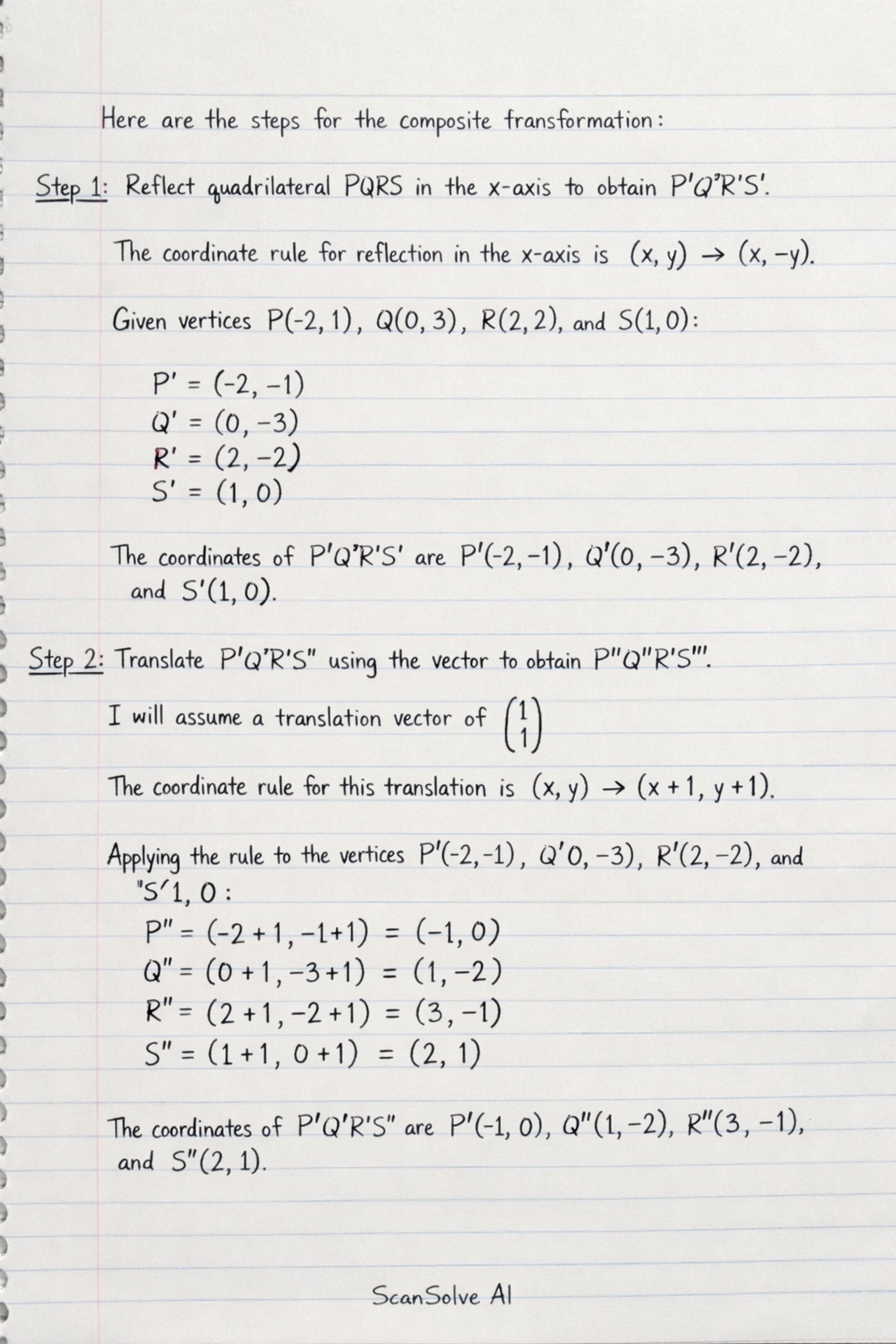
5 stepsHere are the steps for the composite transformation:
Reflect quadrilateral in the x-axis to obtain .
The coordinate rule for reflection in the x-axis is .
Given vertices , , , and :The coordinates of are , , , and .
Translate using the vector to obtain .
The translation vector is missing from the problem statement. For demonstration purposes, I will assume a translation vector of .
The coordinate rule for this translation is .
Applying the rule to the vertices , , , and :The coordinates of are , , , and .
Rotate through about the origin to obtain .
The coordinate rule for a rotation about the origin is .
Applying the rule to the vertices , , , and :The coordinates of are , , , and .
Enlarge with a scale factor of centred at the origin to obtain .
The coordinate rule for enlargement with scale factor centred at the origin is .
Applying the rule to the vertices , , , and :The coordinates of are , , , and .
To create the labeled graph, plot the original quadrilateral and all the transformed images , , , and using the coordinates calculated above on a coordinate plane.
Compare the area relationship between and .
Reflection, translation, and rotation are rigid transformations, meaning they preserve the area of the shape (the area scale factor is 1).
Enlargement with a scale factor changes the area by a factor of .
In this sequence of transformations, the only transformation that changes the area is the final enlargement with a scale factor of .
Therefore, the area of the final image is times the area of the original quadrilateral .The area of is one-fourth the area of .
Still stuck on this one?
Ask a follow-up, and the answer starts from this question.
More Mathematics Questions
Handwritten Step-by-Step Solution
Get this as a handwritten image on WhatsApp — like a tutor wrote it for you.
Try on WhatsApp