
We read your photo as:
Lim_x->0 (sqrt(1+x2) - sqrt(1-x)) / x2
ScanSolve AI Answer
Step-by-step solution
7 stepsCheck for indeterminate form by substituting into the expression.
Numerator: .
Denominator: .
Since the result is , it is an indeterminate form, and further steps are needed.Multiply the numerator and denominator by the conjugate of the numerator.
The conjugate of is .
Simplify the numerator using the difference of squares formula, .
Expand and simplify the numerator.
Factor out from the numerator and cancel a common factor of with the denominator.
Evaluate the limit by substituting into the simplified expression.
Numerator: .
Denominator: .
The expression is of the form , which indicates that the limit is either , , or does not exist.Analyze the one-sided limits.
The term approaches 2 as , which is a positive value. The sign of the denominator is determined by the sign of .
-
As (x approaches 0 from the positive side), . The denominator approaches from the positive side (). So, .
-
As (x approaches 0 from the negative side), . The denominator approaches from the negative side (). So, .
Since the left-hand limit () and the right-hand limit () are not equal, the limit does not exist.
The final answer is .
-
Still stuck on this one?
Ask a follow-up, and the answer starts from this question.
More Mathematics Questions
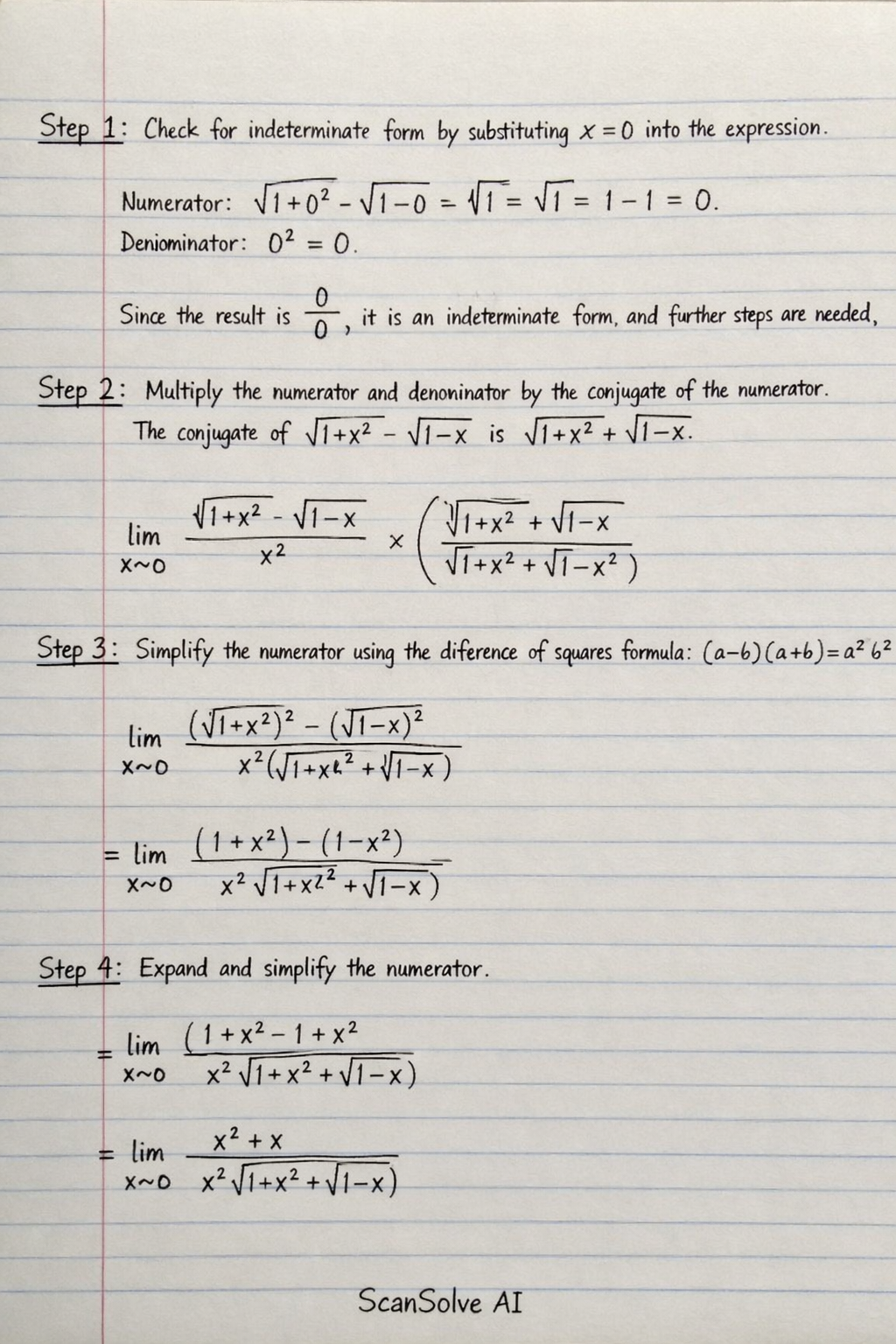
Handwritten Step-by-Step Solution
Get this as a handwritten image on WhatsApp — like a tutor wrote it for you.
Try on WhatsApp