We read your photo as:

A rectangular gate has a height of 1.2 m and a breadth of 95 cm. Calculate the total length of steel needed to make the frame of the gate, including the two diagonals.

Mathematics

ScanSolve AI Answer

Step-by-step solution

13 steps

here is the solution to the questions:

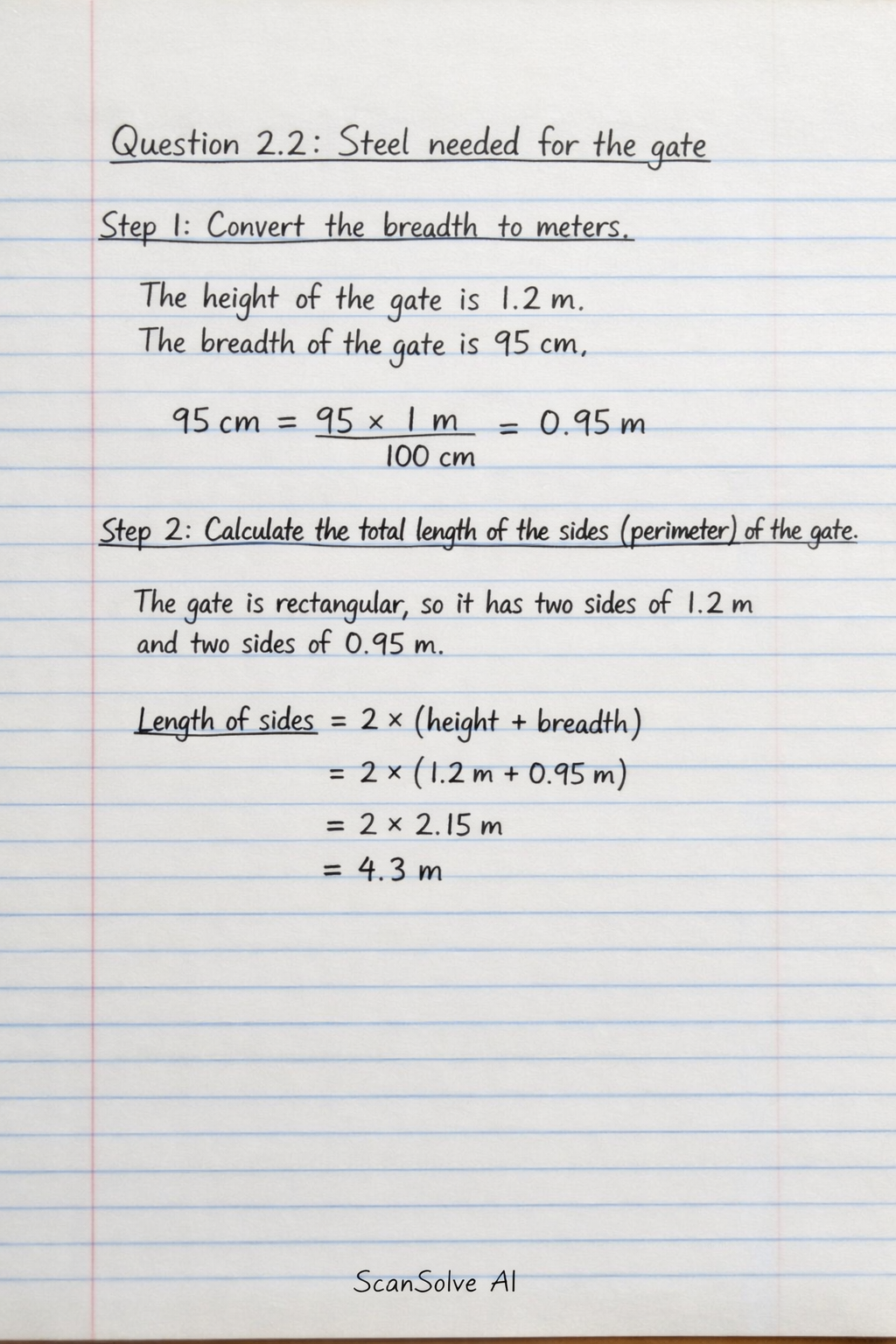
Question 2.2: Steel needed for the gate

  1. Convert the breadth to meters.

    The height of the gate is 1.2 m1.2 \text{ m}.
    The breadth of the gate is 95 cm95 \text{ cm}.

    95 cm=95×1 m100 cm=0.95 m95 \text{ cm} = 95 \times \frac{1 \text{ m}}{100 \text{ cm}} = 0.95 \text{ m}
  2. Calculate the total length of the sides (perimeter) of the gate.

    The gate is rectangular, so it has two sides of 1.2 m1.2 \text{ m} and two sides of 0.95 m0.95 \text{ m}.

    Length of sides=2×(height+breadth)\text{Length of sides} = 2 \times (\text{height} + \text{breadth}) Length of sides=2×(1.2 m+0.95 m)\text{Length of sides} = 2 \times (1.2 \text{ m} + 0.95 \text{ m}) Length of sides=2×2.15 m\text{Length of sides} = 2 \times 2.15 \text{ m} Length of sides=4.3 m\text{Length of sides} = 4.3 \text{ m}
  3. Calculate the length of one diagonal using the Pythagorean Theorem.

    The diagonals form right-angled triangles with the sides of the gate. Let dd be the length of a diagonal.

    d2=(height)2+(breadth)2d^2 = (\text{height})^2 + (\text{breadth})^2 d2=(1.2 m)2+(0.95 m)2d^2 = (1.2 \text{ m})^2 + (0.95 \text{ m})^2 d2=1.44 m2+0.9025 m2d^2 = 1.44 \text{ m}^2 + 0.9025 \text{ m}^2 d2=2.3425 m2d^2 = 2.3425 \text{ m}^2 d=2.3425 md = \sqrt{2.3425} \text{ m} d≈1.5305 md \approx 1.5305 \text{ m}
  4. Calculate the total length of the two diagonals.

    Since there are two diagonals of equal length:

    Length of diagonals=2×d\text{Length of diagonals} = 2 \times d Length of diagonals=2×1.5305 m\text{Length of diagonals} = 2 \times 1.5305 \text{ m} Length of diagonals≈3.061 m\text{Length of diagonals} \approx 3.061 \text{ m}
  5. Calculate the total amount of steel needed.

    Total steel=Length of sides+Length of diagonals\text{Total steel} = \text{Length of sides} + \text{Length of diagonals} Total steel=4.3 m+3.061 m\text{Total steel} = 4.3 \text{ m} + 3.061 \text{ m} Total steel=7.361 m\text{Total steel} = \boxed{\text{7.361 m}}

    Question 2.3: Water Tank and Cylindrical Buckets

    2.3.1 Calculate the volume of the rectangular tank.

  6. Identify the dimensions of the rectangular tank from the diagram.

    Length L=6 mL = 6 \text{ m}
    Breadth B=5 mB = 5 \text{ m}
    Height H=5 mH = 5 \text{ m}

  7. Apply the formula for the volume of a rectangular prism.

    Vtank=L×B×HV_{\text{tank}} = L \times B \times H Vtank=6 m×5 m×5 mV_{\text{tank}} = 6 \text{ m} \times 5 \text{ m} \times 5 \text{ m} Vtank=150 m3V_{\text{tank}} = \boxed{\text{150 m}^3}

    2.3.2 Calculate the volume of the cylindrical bucket. Round off to three decimal places.

  8. Identify the dimensions of the cylindrical bucket from the diagram and given π\pi.

    Diameter D=0.5 mD = 0.5 \text{ m}, so radius r=D2=0.5 m2=0.25 mr = \frac{D}{2} = \frac{0.5 \text{ m}}{2} = 0.25 \text{ m}
    Height h=1 mh = 1 \text{ m}
    π=3.14\pi = 3.14

  9. Apply the formula for the volume of a cylinder.

    Vbucket=πr2hV_{\text{bucket}} = \pi r^2 h Vbucket=3.14×(0.25 m)2×1 mV_{\text{bucket}} = 3.14 \times (0.25 \text{ m})^2 \times 1 \text{ m} Vbucket=3.14×0.0625 m2×1 mV_{\text{bucket}} = 3.14 \times 0.0625 \text{ m}^2 \times 1 \text{ m} Vbucket=0.19625 m3V_{\text{bucket}} = 0.19625 \text{ m}^3
  10. Round the volume to three decimal places.

    Vbucket=0.196 m3V_{\text{bucket}} = \boxed{\text{0.196 m}^3}

    2.3.3 How many full cylindrical buckets will be needed to fill the rectangular tank to 75% capacity?

  11. Calculate 75% capacity of the rectangular tank.

    \text{75% capacity} = 0.75 \times V_{\text{tank}} \text{75% capacity} = 0.75 \times 150 \text{ m}^3 \text{75% capacity} = 112.5 \text{ m}^3
  12. Calculate the number of buckets needed.

    Use the unrounded volume of the bucket for accuracy.

    \text{Number of buckets} = \frac{\text{75% capacity of tank}}{V_{\text{bucket}}} Number of buckets=112.5 m30.19625 m3\text{Number of buckets} = \frac{112.5 \text{ m}^3}{0.19625 \text{ m}^3} Number of buckets≈573.78\text{Number of buckets} \approx 573.78
  13. Round up to the nearest whole number since only full buckets can be used.

    Number of buckets=574 buckets\text{Number of buckets} = \boxed{\text{574 buckets}}
Was this helpful?

Still stuck on this one?

Ask a follow-up, and the answer starts from this question.

Got a different question?Ask your own question
Handwritten step-by-step solution preview

Handwritten Step-by-Step Solution

Get this as a handwritten image on WhatsApp — like a tutor wrote it for you.

Try on WhatsApp