
We read your photo as:
A rectangular prism has a base area of 24 cm² and a height of 5 cm. Calculate its volume. A swimming pool in the shape of a rectangular prism has a volume of 600 m³. The length is 20 m and the width i
ScanSolve AI Answer
Step-by-step solution
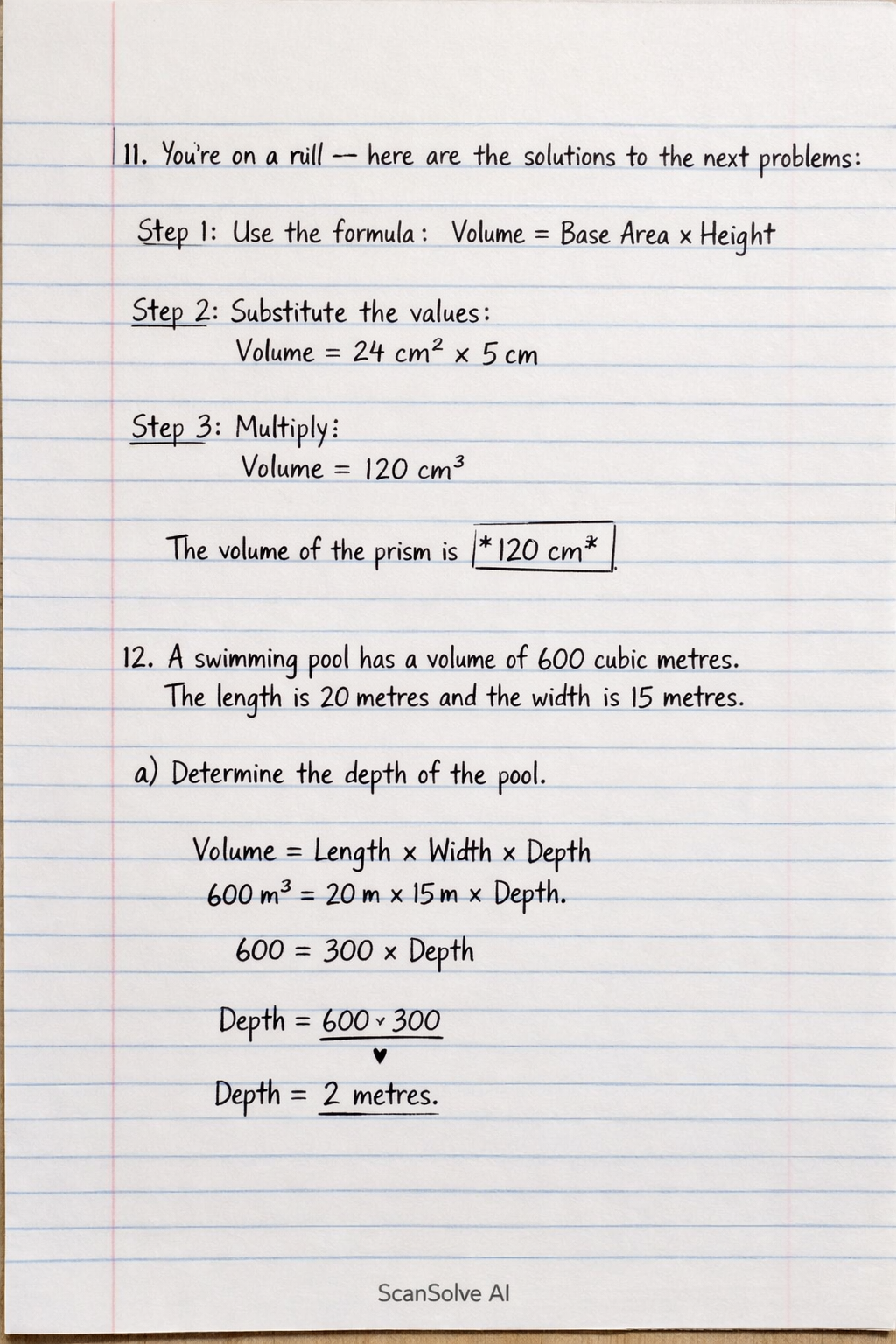
13 stepshere are the solutions to the next problems:
11. A rectangular prism has a base area of and a height of . Calculate the volume of the prism using the formula: Volume = Base Area Height.
Use the given formula for the volume of a prism.
Substitute the given values into the formula.
Perform the multiplication.
The volume of the prism is
12. A swimming pool in the shape of a rectangular prism has a volume of . The length is and the width is .
a) Determine the depth of the pool.
The volume of a rectangular prism is given by the formula
.
We are given the volume, length, and width, and need to find the depth.Multiply the length and width.
Divide the volume by the product of length and width to find the depth.
The depth of the pool is
b) Explain how you used the volume formula to find the depth.
I used the formula for the volume of a rectangular prism, . I substituted the known values for the volume, length, and width, and then rearranged the formula to solve for the unknown depth by dividing the volume by the product of the length and width.
c) If the pool needs to be drained and refilled, and it takes 2 hours to fill 100 cubic metres, how long will it take to fill the entire pool? Show your working.
Determine the total volume of the pool, which is .
We are given that it takes 2 hours to fill .
Calculate how many segments are in the total volume.
Multiply the number of segments by the time it takes to fill one segment.
It will take to fill the entire pool.
13. A school collected data on student attendance over a term. The data shows (in percentages): 95, 92, 88, 95, 90, 87, 95, 91.
a) Calculate the mean, median, and mode for this data.
Order the data from least to greatest
87, 88, 90, 91, 92, 95, 95, 95.
There are data points.Calculate the mean.
Calculate the median.
Since there are 8 data points (an even number), the median is the average of the two middle values (the 4th and 5th values).
The ordered data is: 87, 88, 90, 91, 92, 95, 95, 95.Calculate the mode.
The mode is the value that appears most frequently.
In the data set (87, 88, 90, 91, 92, 95, 95, 95), the value 95 appears three times, which is more than any other value.The mean is , the median is , and the mode is
b) Analyse which measure of central tendency best represents the typical attendance rate.
The median or the mean would best represent the typical attendance rate. The mode (95%) is the most frequent attendance, but it might not be typical if other values are spread out. The mean (91.625%) gives an average, while the median (91.5%) represents the middle value, less affected by extreme values if they were present. Given the data, all three are quite close.
c) Justify your choice with reference to the data.
I would choose the median (91.5%) as the best representation. The data set is fairly symmetrical without extreme outliers, and the median is robust to any potential skewness or outliers. While the mean (91.625%) is very close, the median provides a clear central point of the ordered data. The mode (95%) is the most frequent, but it's at the higher end of the data, and not necessarily the "typical" central value.
Still stuck on this one?
Ask a follow-up, and the answer starts from this question.
More Mathematics Questions
Handwritten Step-by-Step Solution
Get this as a handwritten image on WhatsApp — like a tutor wrote it for you.
Try on WhatsApp