
We read your photo as:
A right-angled triangle has a hypotenuse of 13 and one leg of 5. What is the length of the other leg, y?
Mathematics
ScanSolve AI Answer
Answer
Step-by-step solution
5 stepsIdentify the known values from the figure.
The figure shows a right-angled triangle.
The hypotenuse (the side opposite the right angle) is 13.
One leg is 5.
The other leg is .Apply the Pythagorean Theorem.
The Pythagorean Theorem states that in a right-angled triangle, the square of the hypotenuse () is equal to the sum of the squares of the other two sides ( and ).
Substitute the known values into the formula:
Calculate the squares of the known values.
Isolate by subtracting 25 from both sides.
Solve for by taking the square root of both sides.
The missing side is .
Was this helpful?
Try one yourself
A new problem that tests the same skill.
Still stuck on this one?
Ask a follow-up, and the answer starts from this question.
Got a different question?Ask your own question
More Mathematics Questions
QA right triangle has legs of length 6 and 8. Find the length of the hypotenuse. Show the steps, then…QIn the given right triangle, one leg is 20 and one acute angle is 70 degrees. Find the length of the…QA right-angled triangle has sides of 8 cm and 15 cm. Calculate the hypotenuse, perimeter, and area.QIn a right-angled triangle, the longest side has a length of 300 mm, while the horizontal length is…QThe sides x and y of a right-angled triangle are 2 mm and 3 mm respectively with the hypotenuse as…
Browse by topic:Geometry
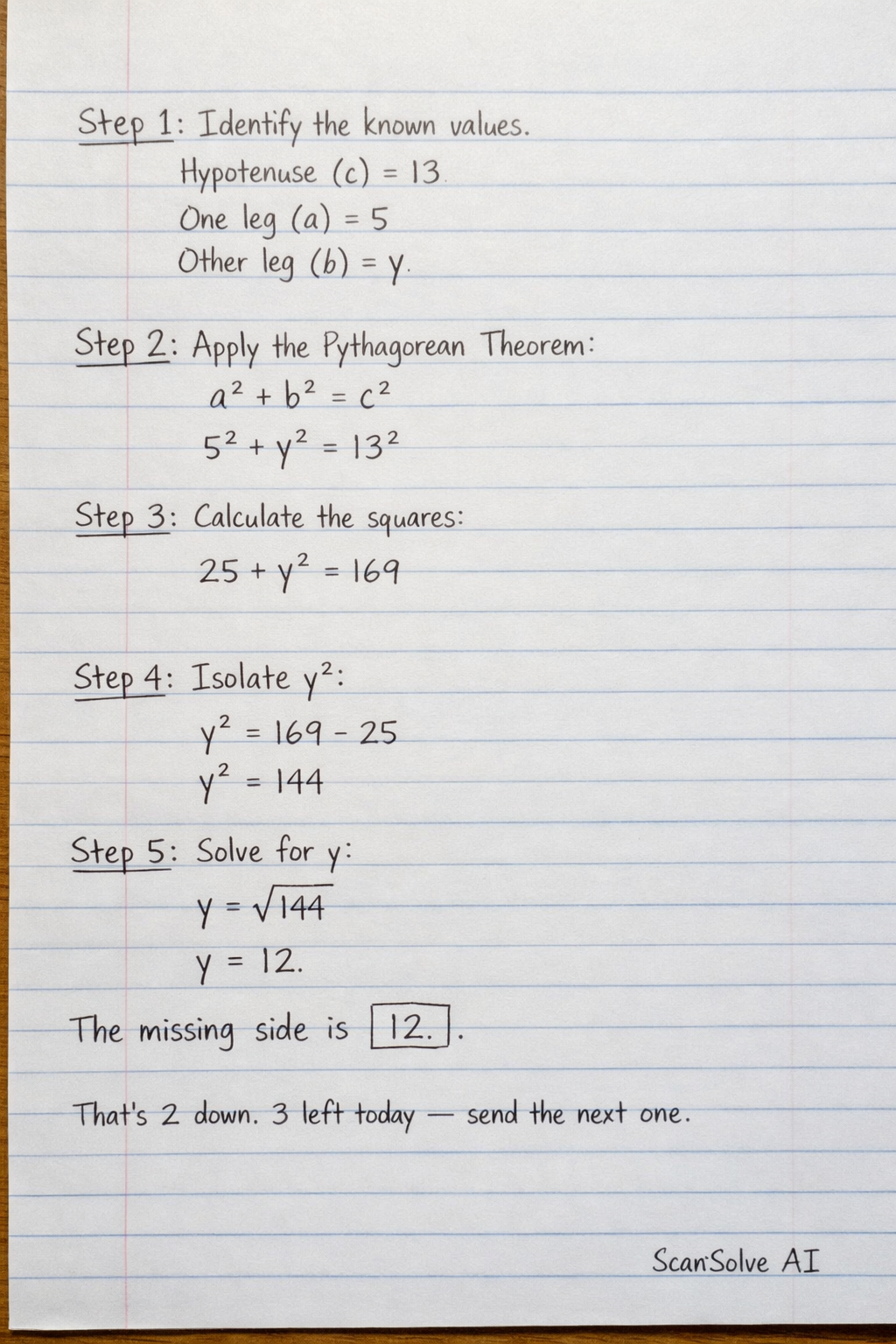
Handwritten Step-by-Step Solution
Get this as a handwritten image on WhatsApp — like a tutor wrote it for you.
Try on WhatsApp