
We read your photo as:
A sequence of figures is made up of squares. The number of squares in the first four figures are 2, 5, 10, 17. Find the rule for the number of squares in the nth figure and calculate the number of squ
ScanSolve AI Answer
Answer
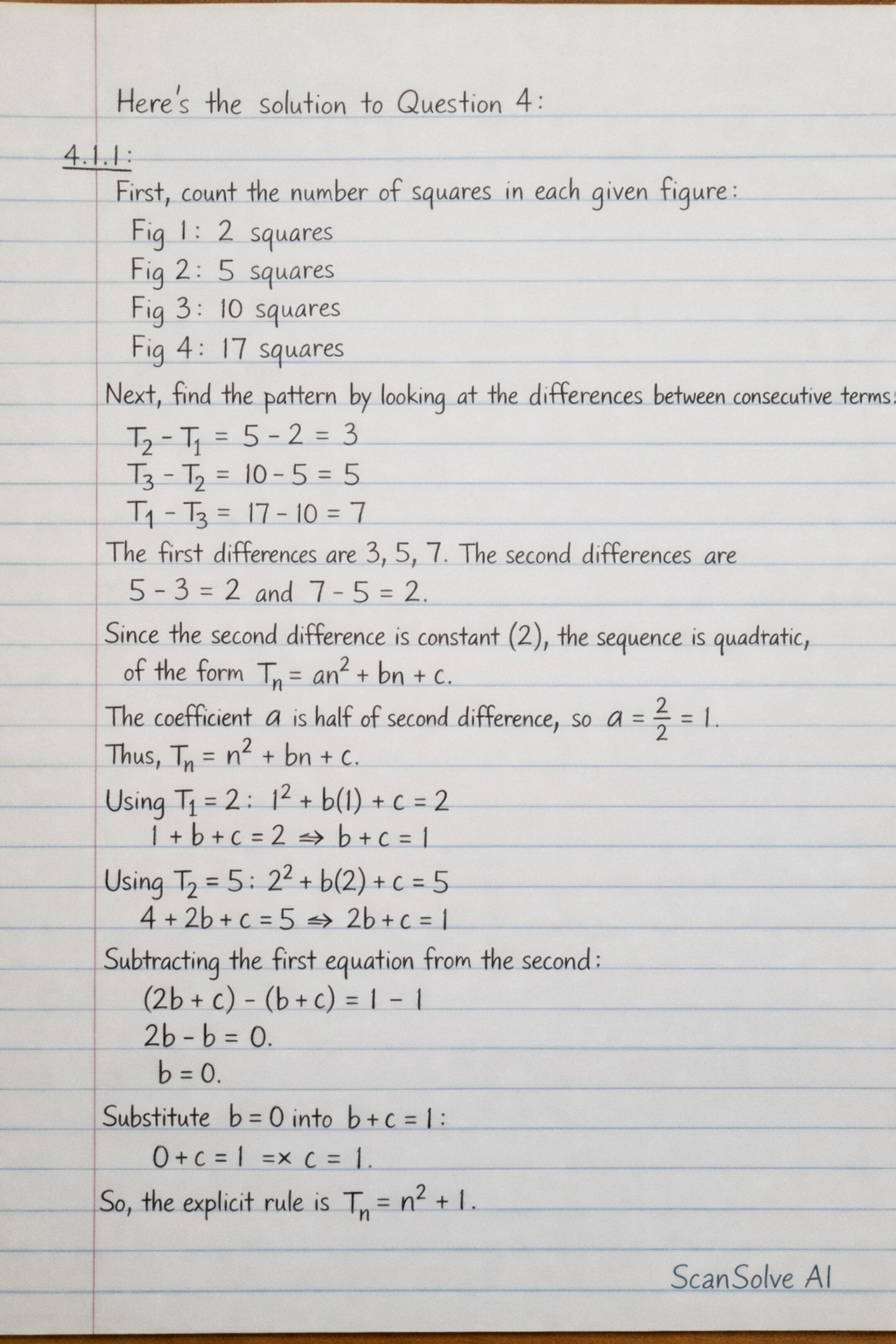
Here's the solution to Question 4:
4.1.1:
First, count the number of squares in each given figure:
- Fig 1: 2 squares
- Fig 2: 5 squares
- Fig 3: 10 squares
- Fig 4: 17 squares
Next, find the pattern by looking at the differences between consecutive terms:
The first differences are 3, 5, 7. The second differences are and . Since the second difference is constant (2), the sequence is quadratic, of the form .
The coefficient is half of the second difference, so .
Thus, .
Using : .
Using : .
Subtracting the first equation from the second: .
Substitute into .
So, the explicit rule is .
Now, calculate the number of squares for Figure 5 and Figure 6:
The completed table is:
4.1.2:
To find the number of squares in Figure 40, use the rule .
4.1.3:
The recursive rule describes how to get the next term from the previous one.
The number of squares in Figure is found by adding an odd number to the number of squares in Figure . The odd number added increases by 2 for each subsequent figure. Specifically, to get the number of squares for Figure , you add squares to the number of squares in Figure . The first figure has 2 squares.
4.1.4:
The algebraic form of the recursive rule described in 4.1.3 is:
Try one yourself
A new problem that tests the same skill.
Still stuck on this one?
Ask a follow-up, and the answer starts from this question.
More Mathematics Questions
Handwritten Step-by-Step Solution
Get this as a handwritten image on WhatsApp — like a tutor wrote it for you.
Try on WhatsApp