
We read your photo as:
A set of 70 females plays Volleyball, Basketball, and Table-tennis. Given the number of females playing only one sport, only all three, and that an equal number play exactly two sports, find the numbe
ScanSolve AI Answer
Step-by-step solution
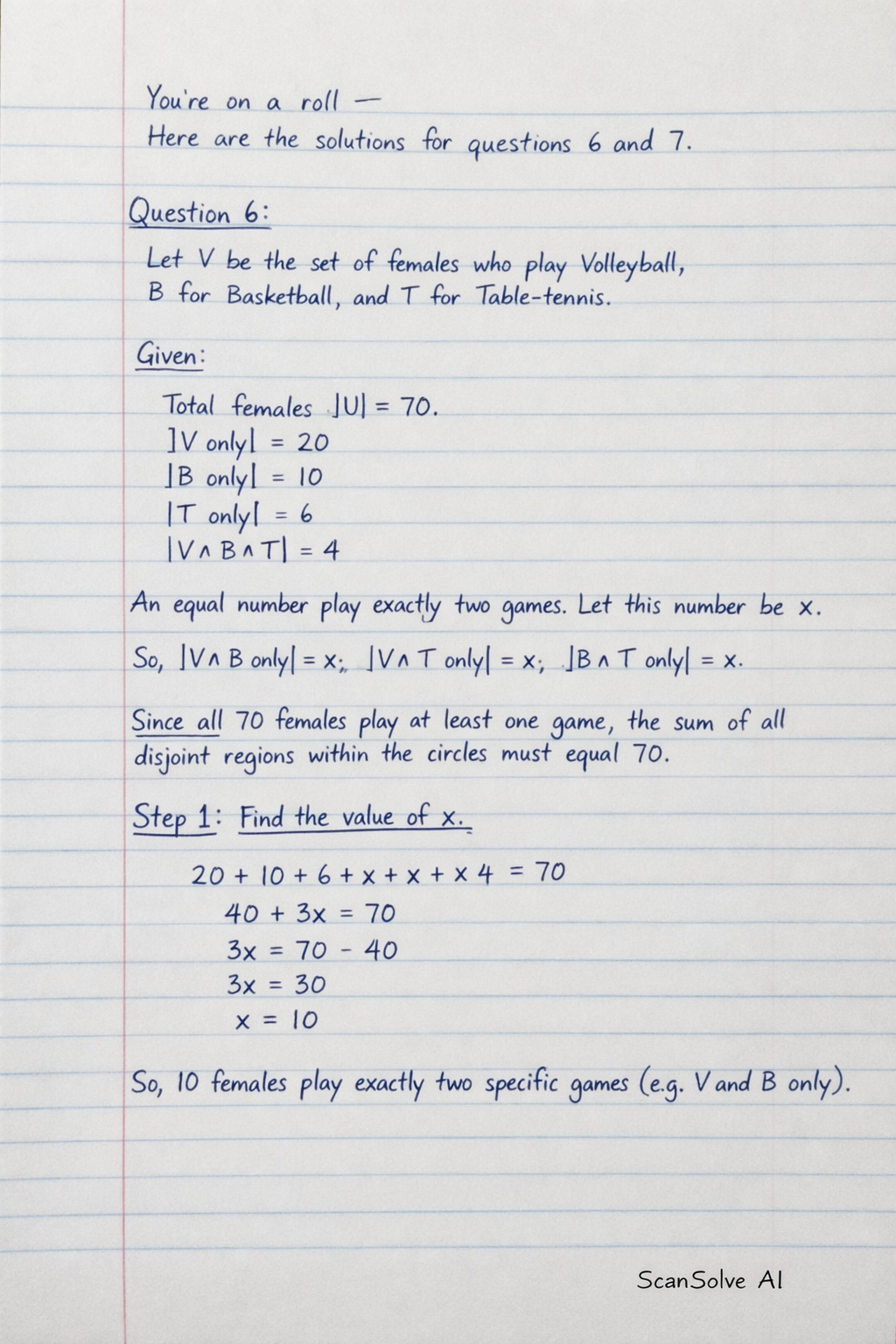
5 stepsHere are the solutions for questions 6 and 7.
Question 6:
Let V be the set of females who play Volleyball, B for Basketball, and T for Table-tennis.
Given:
Total females .
An equal number play exactly two games. Let this number be . So, , , .
Since all 70 females play at least one game, the sum of all disjoint regions within the circles must equal 70.
Find the value of .
So, 10 females play exactly two specific games (e.g., V and B only).
a) Illustrate this information on a Venn diagram.
Draw a rectangle representing the universal set . Inside the rectangle, draw three overlapping circles for V, B, and T.- In the region for V only, write 20.
- In the region for B only, write 10.
- In the region for T only, write 6.
- In the region where all three circles overlap (), write 4.
- In the region where V and B overlap (but not T), write .
- In the region where V and T overlap (but not B), write .
- In the region where B and T overlap (but not V), write . The sum of all numbers in the circles should be 70.
b) Find the number of females who play:
i. Volleyball
The number of females who play Volleyball is the sum of all regions within the V circle:The number of females who play Volleyball is .
ii. Basketball
The number of females who play Basketball is the sum of all regions within the B circle:The number of females who play Basketball is .
iii. Table-tennis
The number of females who play Table-tennis is the sum of all regions within the T circle:The number of females who play Table-tennis is .
c) How many females play exactly two games?
The number of females who play exactly two games is the sum of the regions where only two games overlap:Since :
The number of females who play exactly two games is .
Question 7:
a) Using a ruler and pair of compasses only construct;
i. Triangle ABC such that , angle and .- Draw a straight line and mark a point A on it.
- From A, measure 8 cm along the line and mark point B. So, .
- At point B, use a protractor or compass to construct an angle of with line segment AB. Draw a ray from B.
- At point A, use a protractor or compass to construct an angle of with line segment AB. Draw a ray from A.
- The intersection of the two rays drawn from A and B is point C, forming triangle ABC.
ii. Locus, of points equidistant from A and B.
- With the compass point at A, open it to more than half the length of AB. Draw arcs above and below AB.
- With the compass point at B, use the same radius to draw arcs above and below AB, intersecting the previous arcs.
- Draw a straight line connecting the two intersection points. This line is , the perpendicular bisector of AB.
iii. Locus, of points equidistant from B and C.
- With the compass point at B, open it to more than half the length of BC. Draw arcs on both sides of BC.
- With the compass point at C, use the same radius to draw arcs on both sides of BC, intersecting the previous arcs.
- Draw a straight line connecting the two intersection points. This line is , the perpendicular bisector of BC.
iv. Locate P the meeting point of and and circumscribe a circle.
- The point where and intersect is point P. This is the circumcenter of triangle ABC.
- Place the compass point at P and open it to point A (or B or C, as P is equidistant from all three vertices).
- Draw a circle with P as the center and PA (or PB or PC) as the radius. This is the circumscribed circle.
v. Measure and write down the radius of the circle.
Measure the distance from P to A (or B or C) using a ruler. This measurement is the radius of the circumscribed circle.b) Find three consecutive even numbers where the sum of the first and last number is 20 more than the middle.
Define the consecutive even numbers.
Let the middle even number be .
Then the first even number is .
And the last even number is .Set up the equation based on the given condition.
The sum of the first and last number is .
The middle number is .
The condition states: "the sum of the first and last number is 20 more than the middle".Solve the equation for .
Subtract from both sides:
Find the three consecutive even numbers.
- First number:
- Middle number:
- Last number:
The three consecutive even numbers are .
Still stuck on this one?
Ask a follow-up, and the answer starts from this question.
More Mathematics Questions
Handwritten Step-by-Step Solution
Get this as a handwritten image on WhatsApp — like a tutor wrote it for you.
Try on WhatsApp