
We read your photo as:
Find a magnitude and the unit vector of the following given that: a) a = 3i − 4j, b) b = i + 2j − k, c) c = i − 2k, d) d = 2j − 3k, e) e = 5i − 2j + k. 1) Find the magnitude. 2) Find the unit vector along the direction.
ScanSolve AI Answer
Step-by-step solution
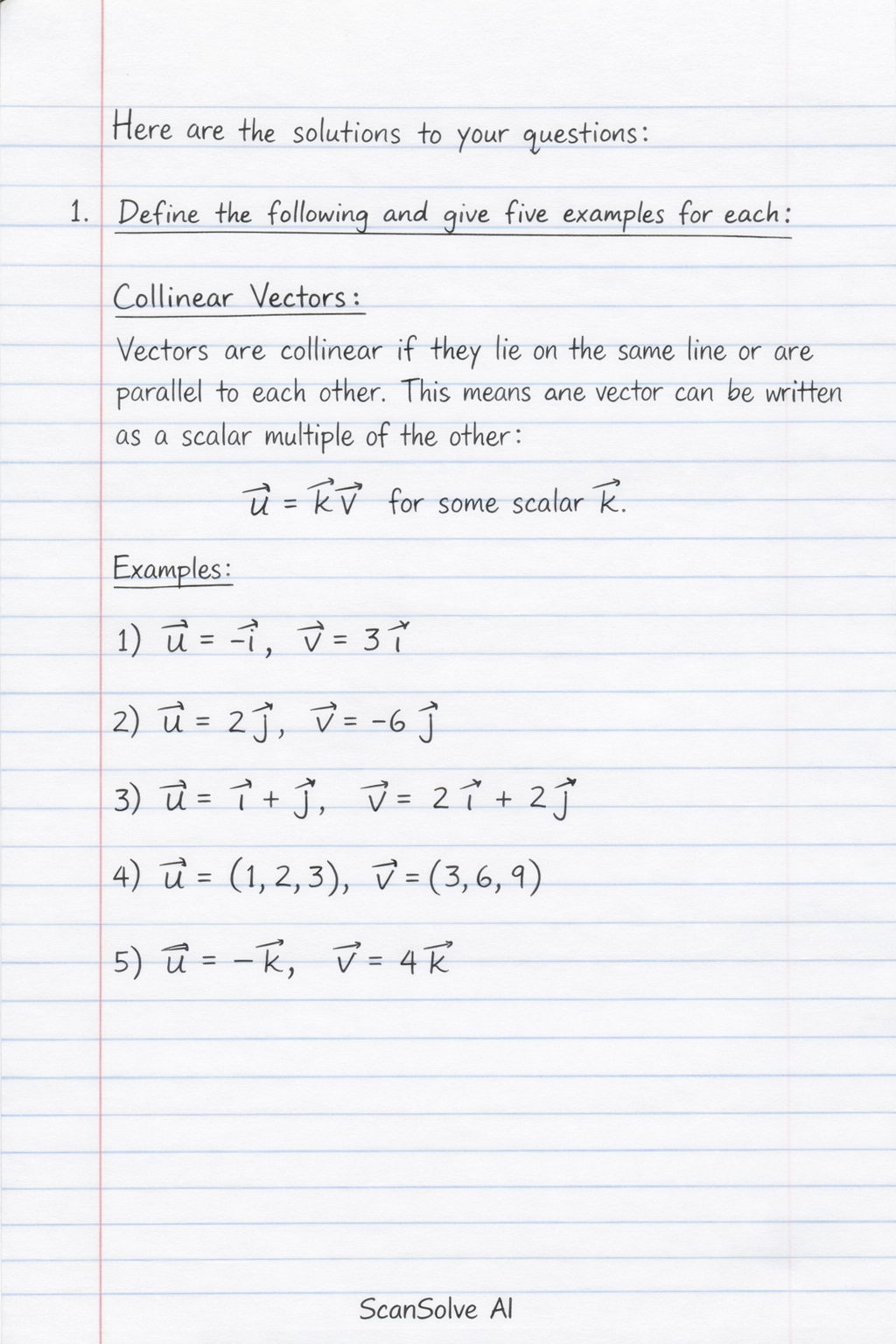
10 stepsHere are the solutions to your questions:
1. Define the following and give five examples for each:
-
Collinear Vectors: Vectors are collinear if they lie on the same line or are parallel to each other. This means one vector can be expressed as a scalar multiple of the other ( for some scalar ).
- Examples:
- ,
- ,
- ,
- ,
- ,
- Examples:
-
Non-collinear Vectors: Vectors are non-collinear if they do not lie on the same line and are not parallel. One vector cannot be expressed as a scalar multiple of the other.
- Examples:
- ,
- ,
- ,
- ,
- ,
- Examples:
2. Define the following and give five examples for each:
-
Coplanar Vectors: Vectors are coplanar if they lie in the same plane. For three vectors, they are coplanar if their scalar triple product is zero (). Any two vectors are always coplanar.
- Examples:
- , , (all in the -plane)
- , , (all in the -plane)
- , , (all collinear, hence coplanar)
- , , (all collinear, hence coplanar)
- , , (since )
- Examples:
-
Non-coplanar Vectors: Vectors are non-coplanar if they do not lie in the same plane. For three vectors, they are non-coplanar if their scalar triple product is non-zero ().
- Examples:
- , ,
- , ,
- , ,
- , ,
- , ,
- Examples:
3. Find the magnitude and the unit vector of the following vectors:
- a)
Calculate the magnitude of .
$$ |\vec{a}| = \sqrt{(3)^2 + (-4)^2 + (0)^2} = \sqrt{9 + 16} = \sqrt{25} = 5 $$ The magnitude is $\boxed{5}$.Calculate the unit vector .
$$ \hat{a} = \frac{\vec{a}}{|\vec{a}|} = \frac{3\vec{i} - 4\vec{j}}{5} = \frac{3}{5}\vec{i} - \frac{4}{5}\vec{j} $$ The unit vector is $\boxed{\frac{3}{5}\vec{i} - \frac{4}{5}\vec{j}}$.- b)
Calculate the magnitude of .
$$ |\vec{b}| = \sqrt{(1)^2 + (2)^2 + (-1)^2} = \sqrt{1 + 4 + 1} = \sqrt{6} $$ The magnitude is $\boxed{\sqrt{6}}$.Calculate the unit vector .
$$ \hat{b} = \frac{\vec{b}}{|\vec{b}|} = \frac{\vec{i} + 2\vec{j} - \vec{k}}{\sqrt{6}} = \frac{1}{\sqrt{6}}\vec{i} + \frac{2}{\sqrt{6}}\vec{j} - \frac{1}{\sqrt{6}}\vec{k} $$ The unit vector is $\boxed{\frac{1}{\sqrt{6}}\vec{i} + \frac{2}{\sqrt{6}}\vec{j} - \frac{1}{\sqrt{6}}\vec{k}}$.- c) (coefficient of is zero)
Calculate the magnitude of .
$$ |\vec{c}| = \sqrt{(1)^2 + (0)^2 + (-2)^2} = \sqrt{1 + 0 + 4} = \sqrt{5} $$ The magnitude is $\boxed{\sqrt{5}}$.Calculate the unit vector .
$$ \hat{c} = \frac{\vec{c}}{|\vec{c}|} = \frac{\vec{i} - 2\vec{k}}{\sqrt{5}} = \frac{1}{\sqrt{5}}\vec{i} - \frac{2}{\sqrt{5}}\vec{k} $$ The unit vector is $\boxed{\frac{1}{\sqrt{5}}\vec{i} - \frac{2}{\sqrt{5}}\vec{k}}$.- d) (coefficient of is zero)
Calculate the magnitude of .
$$ |\vec{d}| = \sqrt{(0)^2 + (2)^2 + (-3)^2} = \sqrt{0 + 4 + 9} = \sqrt{13} $$ The magnitude is $\boxed{\sqrt{13}}$.Calculate the unit vector .
$$ \hat{d} = \frac{\vec{d}}{|\vec{d}|} = \frac{2\vec{j} - 3\vec{k}}{\sqrt{13}} = \frac{2}{\sqrt{13}}\vec{j} - \frac{3}{\sqrt{13}}\vec{k} $$ The unit vector is $\boxed{\frac{2}{\sqrt{13}}\vec{j} - \frac{3}{\sqrt{13}}\vec{k}}$.- e)
Calculate the magnitude of .
$$ |\vec{e}| = \sqrt{(5)^2 + (-2)^2 + (1)^2} = \sqrt{25 + 4 + 1} = \sqrt{30} $$ The magnitude is $\boxed{\sqrt{30}}$.Calculate the unit vector .
$$
\hat{e} = \frac{\vec{e}}{|\vec{e}|} = \frac{5\vec{i} - 2\vec{j} + \vec{k}}{\sqrt{30}} = \frac{5}{\sqrt{30}}\vec{i} - \frac{2}{\sqrt{30}}\vec{j} + \frac{1}{\sqrt{30}}\vec{k}
$$
The unit vector is $\boxed{\frac{5}{\sqrt{30}}\vec{i} - \frac{2}{\sqrt{30}}\vec{j} + \frac{1}{\sqrt{30}}\vec{k}}$.
Still stuck on this one?
Ask a follow-up, and the answer starts from this question.
More Mathematics Questions
Handwritten Step-by-Step Solution
Get this as a handwritten image on WhatsApp — like a tutor wrote it for you.
Try on WhatsApp