
We read your photo as:
Find the unit vector in the direction of the sum of the vectors v1 = i + 4j + 2k, v2 = 3i − 3j − 2k, and v3 = -2i + 2j + 6k.
Mathematics
ScanSolve AI Answer
Answer
Step-by-step solution
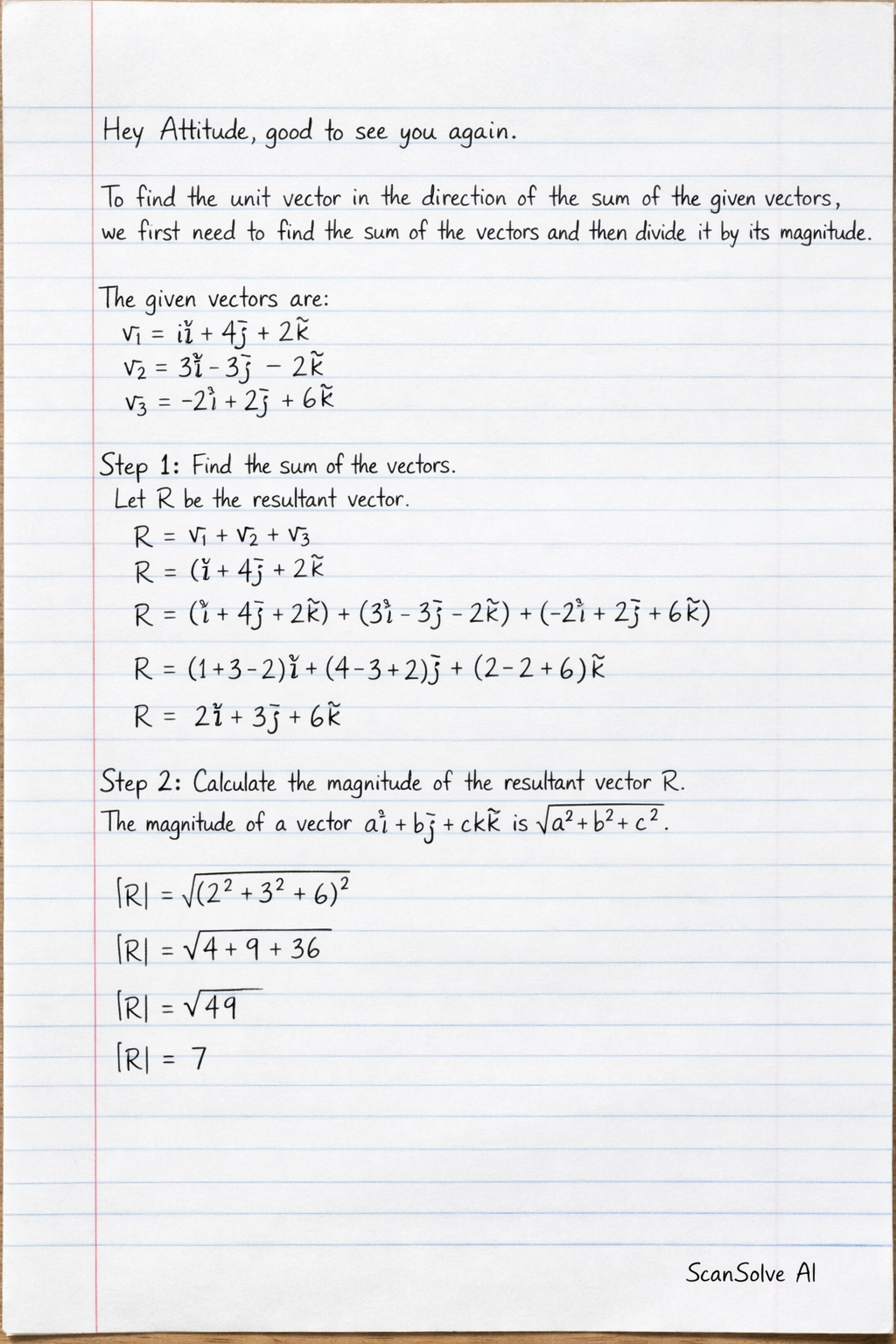
3 stepsTo find the unit vector in the direction of the sum of the given vectors, we first need to find the sum of the vectors and then divide it by its magnitude.
The given vectors are:
Find the sum of the vectors.
Let be the resultant vector.
Combine the corresponding components:
Calculate the magnitude of the resultant vector .
The magnitude of a vector is .
Find the unit vector in the direction of .
The unit vector is given by .
Comparing this result with the given options, it matches option (d).
The final answer is .
Was this helpful?
Try one yourself
A new problem that tests the same skill.
Still stuck on this one?
Ask a follow-up, and the answer starts from this question.
Got a different question?Ask your own question
More Mathematics Questions
QGiven three vectors, find their sum. The vectors are v1 = i + 4j + 2k, v2 = 3i − 3j − 2k, and v3…QShow that the vectors v1 = 4i − 6j + 9k and v2 = −6i + 9j − (27)/(2)k are parallel.QFind a unit vector perpendicular to the plane containing vectors P = 3i − 2j + 4k and Q = i + j…QFind a magnitude and the unit vector of the following given that: a) a = 3i − 4j, b) b = i + 2j − k…QFind the vector equation of a line passing through the point (1, 3, 4) and parallel to the vector i…
Browse by topic:Linear Algebra
Handwritten Step-by-Step Solution
Get this as a handwritten image on WhatsApp — like a tutor wrote it for you.
Try on WhatsApp