
We read your photo as:
A set of numbers is given as 2, 5, 4, 8, 3, 6, x, 9, 5, 4, 7. If the mode is 5, find the value of x, the median, and the lower and upper quartiles.
ScanSolve AI Answer
Answers
4 partsStep-by-step solution
10 stepsThe given set of numbers is $2, 5, 4, 8, 3, 6, x, 9, 5, 4, 7$.
The mode is given as 5.
Part a· 2 steps
To find the value of
Count the frequency of each number in the given set.
The numbers are $2, 5, 4, 8, 3, 6, x, 9, 5, 4, 7$.
Frequencies:
2: 1
3: 1
4: 2
5: 2
6: 1
7: 1
8: 1
9: 1Determine based on the mode.
Since the mode is 5, it must be the number that appears most frequently. Currently, 4 and 5 both appear twice. For 5 to be the unique mode, must be 5.
The value of is .
Part b
To find the median
Substitute into the set and arrange the numbers in ascending order.
The set becomes $2, 5, 4, 8, 3, 6, 5, 9, 5, 4, 7$.
Sorted set: $2, 3, 4, 4, 5, 5, 5, 6, 7, 8, 9$.Find the total number of data points () and the median position.
There are 11 numbers, so .
The median is the -th term.Identify the median from the sorted set.
The term in the sorted set is 5.
The median is .
Part c
To find the lower and upper quartiles
Use the sorted data and the median.
Sorted data: . (Median is underlined)
Find the lower quartile ().
is the median of the lower half of the data (excluding the median itself for an odd ).
Lower half: . There are 5 terms.The term in the lower half is 4. So, .
Find the upper quartile ().
is the median of the upper half of the data (excluding the median itself).
Upper half: . There are 5 terms.The term in the upper half is 7. So, .
The lower quartile is and the upper quartile is .
Part d
To find the interquartile range (IQR)
Use the calculated lower and upper quartiles.
and .
Calculate the IQR.
The interquartile range is .
Try one yourself
A new problem that tests the same skill.
Still stuck on this one?
Ask a follow-up, and the answer starts from this question.
More Mathematics Questions
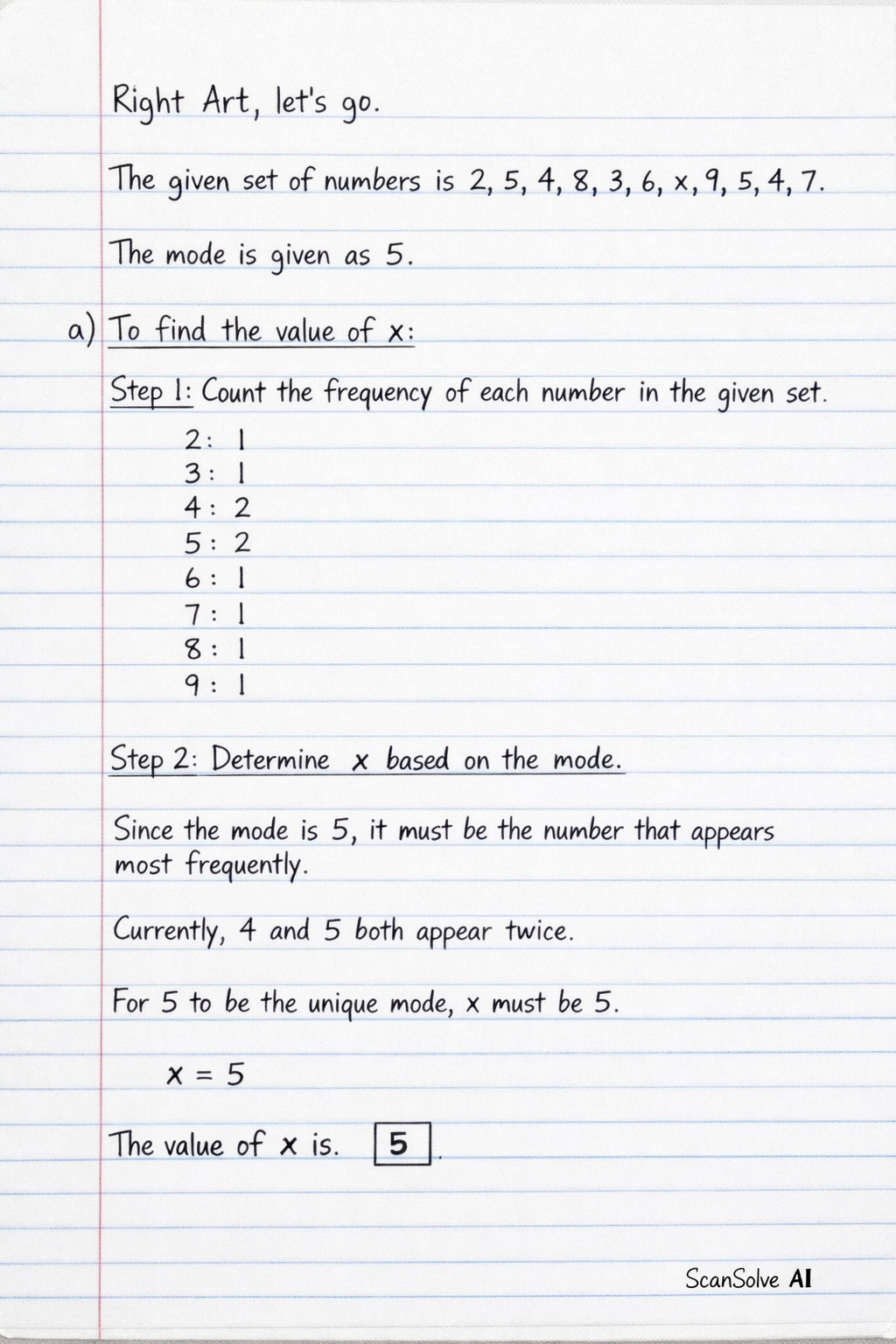
Handwritten Step-by-Step Solution
Get this as a handwritten image on WhatsApp — like a tutor wrote it for you.
Try on WhatsApp