

This mathematics problem involves applying core mathematical principles and formulas. Below you will find a complete step-by-step solution with detailed explanations for each step, helping you understand not just the answer but the method behind it.
ScanSolve AI Answer
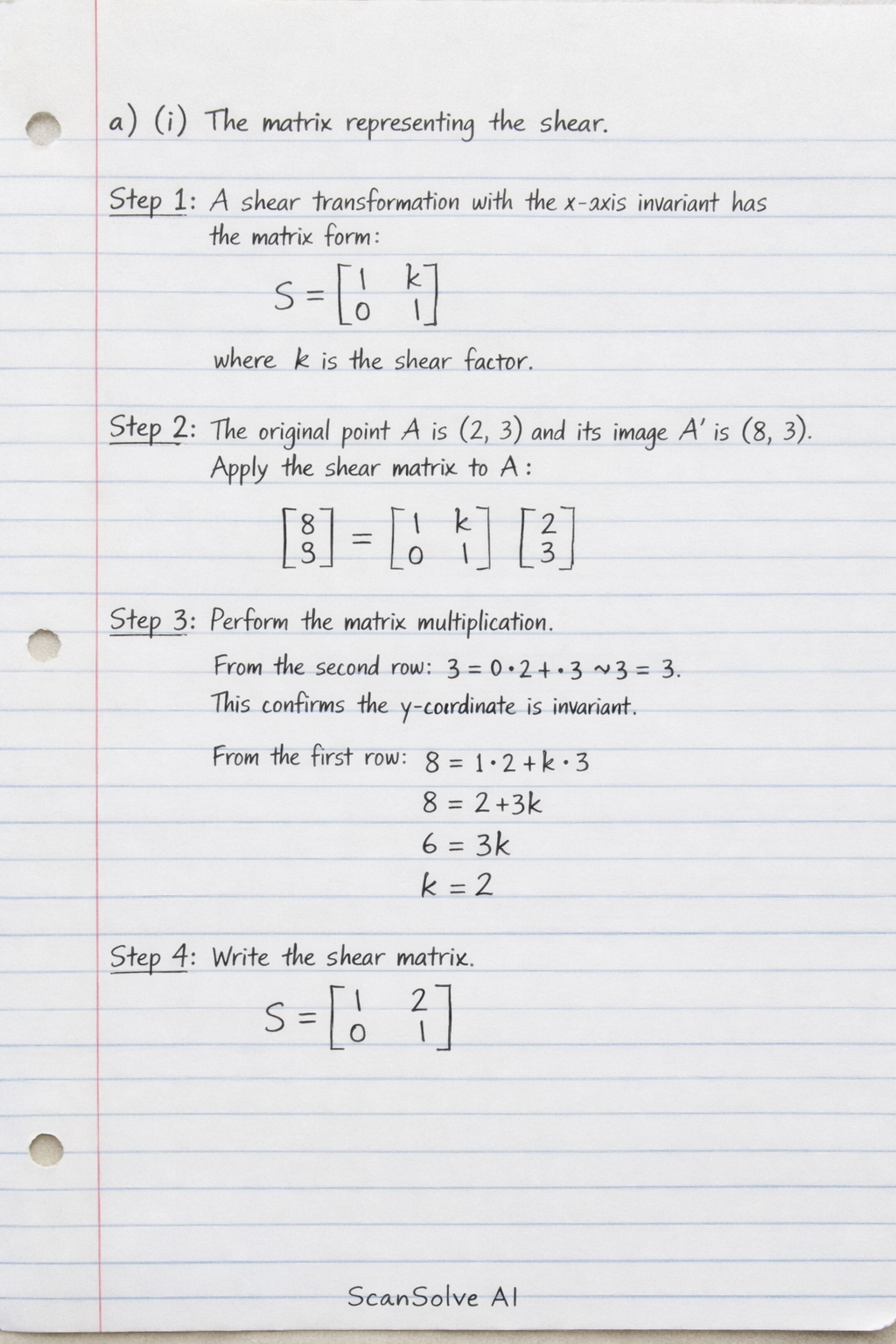
a) (i) The matrix representing the shear. Step 1: A shear transformation with the x-axis invariant has the matrix form: S = 1 & k \\ 0 & 1 where k is the shear factor. Step 2: The original point A is (2, 3) and its image A' is (8, 3). Apply the shear matrix to A: 8 \\ 3 = 1 & k \\ 0 & 1 2 \\ 3 Step 3: Perform the matrix multiplication. From the second row: 3 = 0 · 2 + 1 · 3 3 = 3. This confirms the y-coordinate is invariant. From the first row: 8 = 1 · 2 + k · 3 8 = 2 + 3k 6 = 3k k = 2 Step 4: Write the shear matrix. S = 1 & 2 \\ 0 & 1 a) (ii) The coordinates of B' and C'. Step 1: Apply the shear matrix S = 1 & 2 \\ 0 & 1 to point B(5, 2). x'_B \\ y'_B = 1 & 2 \\ 0 & 1 5 \\ 2 = (1)(5) + (2)(2) \\ (0)(5) + (1)(2) = 5 + 4 \\ 0 + 2 = 9 \\ 2 So, B' is (9, 2). Step 2: Apply the shear matrix S = 1 & 2 \\ 0 & 1 to point C(4, -1). x'_C \\ y'_C = 1 & 2 \\ 0 & 1 4 \\ -1 = (1)(4) + (2)(-1) \\ (0)(4) + (1)(-1) = 4 - 2 \\ 0 - 1 = 2 \\ -1 So, C' is (2, -1). b) (i) Find the coordinates of triangle A''B''C''. Step 1: Apply the transformation matrix M = -2 & 0 \\ 0 & 1 to A'(8, 3). x''_A \\ y''_A = -2 & 0 \\ 0 & 1 8 \\ 3 = (-2)(8) + (0)(3) \\ (0)(8) + (1)(3) = -16 \\ 3 So, A'' is (-16, 3). Step 2: Apply the transformation matrix M = -2 & 0 \\ 0 & 1 to B'(9, 2). x''_B \\ y''_B = -2 & 0 \\ 0 & 1 9 \\ 2 = (-2)(9) + (0)(2) \\ (0)(9) + (1)(2) = -18 \\ 2 So, B'' is (-18, 2). Step 3: Apply the transformation matrix M = -2 & 0 \\ 0 & 1 to C'(2, -1). x''_C \\ y''_C = -2 & 0 \\ 0 & 1 2 \\ -1 = (-2)(2) + (0)(-1) \\ (0)(2