We read your photo as:

A solid is made up of a cone, a cylinder, and a hemisphere. The diameter of the base of the cone and cylinder is 10 cm. The height of the cylinder is 15 cm and the slant height of the cone is 13 cm. C

Mathematics

ScanSolve AI Answer

Answers

3 parts
a

32 cm32 \text{ cm}

b

1754.3 cm31754.3 \text{ cm}^3

c

832.6 cm2832.6 \text{ cm}^2

Step-by-step solution

11 steps

Here's the solution to the problem:

Part a· 3 steps

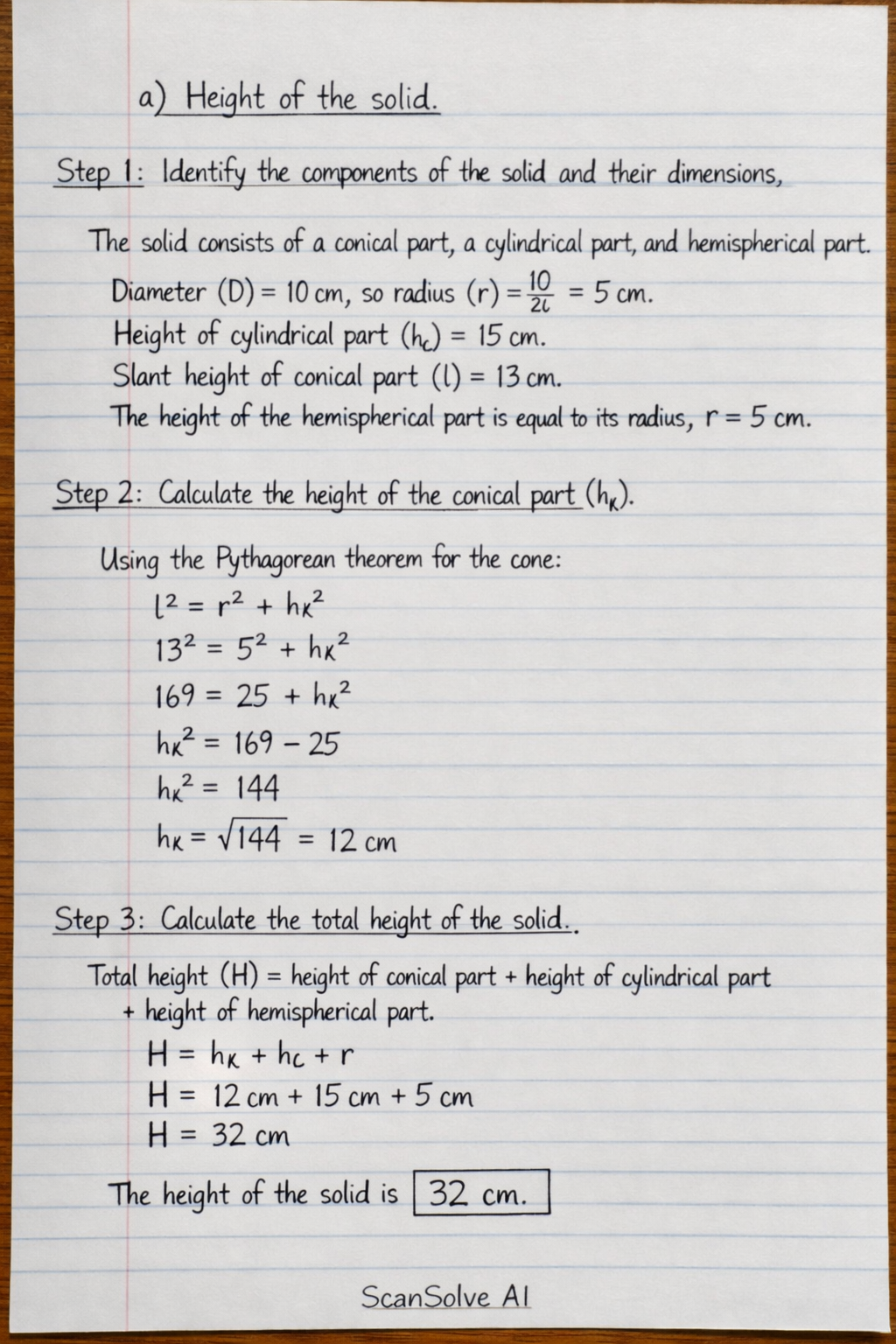
Height of the solid

  1. Identify the components of the solid and their dimensions.

    The solid consists of a conical part, a cylindrical part, and a hemispherical part.
    Diameter (DD) = 10 cm, so radius (rr) = 102=5\frac{10}{2} = 5 cm.
    Height of cylindrical part (hch_c) = 15 cm.
    Slant height of conical part (ll) = 13 cm.
    The height of the hemispherical part is equal to its radius, r=5r = 5 cm.

  2. Calculate the height of the conical part (hkh_k).

    Using the Pythagorean theorem for the cone: l2=r2+hk2l^2 = r^2 + h_k^2.

    132=52+hk213^2 = 5^2 + h_k^2 169=25+hk2169 = 25 + h_k^2 hk2=169−25h_k^2 = 169 - 25 hk2=144h_k^2 = 144 hk=144=12 cmh_k = \sqrt{144} = 12 \text{ cm}
  3. Calculate the total height of the solid.

    Total height (HH) = height of conical part + height of cylindrical part + height of hemispherical part.

    H=hk+hc+rH = h_k + h_c + r H=12 cm+15 cm+5 cmH = 12 \text{ cm} + 15 \text{ cm} + 5 \text{ cm} H=32 cmH = 32 \text{ cm}

    The height of the solid is 32 cm\boxed{32 \text{ cm}}.

Part b

1754.3 cm31754.3 \text{ cm}^3

Volume of the solid, correct to 1 decimal place

  1. Calculate the volume of the conical part (VkV_k).

    The formula for the volume of a cone is Vk=13πr2hkV_k = \frac{1}{3} \pi r^2 h_k. Use π=3.142\pi = 3.142.

    Vk=13×3.142×(5 cm)2×12 cmV_k = \frac{1}{3} \times 3.142 \times (5 \text{ cm})^2 \times 12 \text{ cm} Vk=13×3.142×25 cm2×12 cmV_k = \frac{1}{3} \times 3.142 \times 25 \text{ cm}^2 \times 12 \text{ cm} Vk=3.142×25 cm2×4 cmV_k = 3.142 \times 25 \text{ cm}^2 \times 4 \text{ cm} Vk=314.2 cm3V_k = 314.2 \text{ cm}^3
  2. Calculate the volume of the cylindrical part (VcV_c).

    The formula for the volume of a cylinder is Vc=πr2hcV_c = \pi r^2 h_c.

    Vc=3.142×(5 cm)2×15 cmV_c = 3.142 \times (5 \text{ cm})^2 \times 15 \text{ cm} Vc=3.142×25 cm2×15 cmV_c = 3.142 \times 25 \text{ cm}^2 \times 15 \text{ cm} Vc=1178.25 cm3V_c = 1178.25 \text{ cm}^3
  3. Calculate the volume of the hemispherical part (VhV_h).

    The formula for the volume of a hemisphere is Vh=23πr3V_h = \frac{2}{3} \pi r^3.

    Vh=23×3.142×(5 cm)3V_h = \frac{2}{3} \times 3.142 \times (5 \text{ cm})^3 Vh=23×3.142×125 cm3V_h = \frac{2}{3} \times 3.142 \times 125 \text{ cm}^3 Vh=785.53 cm3V_h = \frac{785.5}{3} \text{ cm}^3 Vh≈261.833 cm3V_h \approx 261.833 \text{ cm}^3
  4. Calculate the total volume of the solid.

    Total volume (VV) = Vk+Vc+VhV_k + V_c + V_h.

    V=314.2 cm3+1178.25 cm3+261.833 cm3V = 314.2 \text{ cm}^3 + 1178.25 \text{ cm}^3 + 261.833 \text{ cm}^3 V=1754.283 cm3V = 1754.283 \text{ cm}^3

    Rounding to 1 decimal place:

    V≈1754.3 cm3V \approx 1754.3 \text{ cm}^3

    The volume of the solid is 1754.3 cm3\boxed{1754.3 \text{ cm}^3}.

Part c

832.6 cm2832.6 \text{ cm}^2

Surface area of the solid, correct to 1 decimal place

  1. Calculate the curved surface area of the conical part (AkA_k).

    The formula for the curved surface area of a cone is Ak=πrlA_k = \pi r l.

    Ak=3.142×5 cm×13 cmA_k = 3.142 \times 5 \text{ cm} \times 13 \text{ cm} Ak=3.142×65 cm2A_k = 3.142 \times 65 \text{ cm}^2 Ak=204.23 cm2A_k = 204.23 \text{ cm}^2
  2. Calculate the curved surface area of the cylindrical part (AcA_c).

    The formula for the curved surface area of a cylinder is Ac=2πrhcA_c = 2 \pi r h_c.

    Ac=2×3.142×5 cm×15 cmA_c = 2 \times 3.142 \times 5 \text{ cm} \times 15 \text{ cm} Ac=3.142×150 cm2A_c = 3.142 \times 150 \text{ cm}^2 Ac=471.3 cm2A_c = 471.3 \text{ cm}^2
  3. Calculate the curved surface area of the hemispherical part (AhA_h).

    The formula for the curved surface area of a hemisphere is Ah=2πr2A_h = 2 \pi r^2.

    Ah=2×3.142×(5 cm)2A_h = 2 \times 3.142 \times (5 \text{ cm})^2 Ah=2×3.142×25 cm2A_h = 2 \times 3.142 \times 25 \text{ cm}^2 Ah=3.142×50 cm2A_h = 3.142 \times 50 \text{ cm}^2 Ah=157.1 cm2A_h = 157.1 \text{ cm}^2
  4. Calculate the total surface area of the solid.

    Total surface area (AA) = Ak+Ac+AhA_k + A_c + A_h.

    A=204.23 cm2+471.3 cm2+157.1 cm2A = 204.23 \text{ cm}^2 + 471.3 \text{ cm}^2 + 157.1 \text{ cm}^2 A=832.63 cm2A = 832.63 \text{ cm}^2

    Rounding to 1 decimal place:

    A≈832.6 cm2A \approx 832.6 \text{ cm}^2

    The surface area of the solid is 832.6 cm2\boxed{832.6 \text{ cm}^2}.

Was this helpful?

Try one yourself

A new problem that tests the same skill.

Still stuck on this one?

Ask a follow-up, and the answer starts from this question.

Got a different question?Ask your own question
Handwritten step-by-step solution preview

Handwritten Step-by-Step Solution

Get this as a handwritten image on WhatsApp — like a tutor wrote it for you.

Try on WhatsApp