We read your photo as:

A solid object is made of a cone on a hemisphere. The cone's slant height is 10 cm and its curved surface area is 60π cm². The hemisphere's radius is the same as the cone's radius. This object is plac

Mathematics

ScanSolve AI Answer

This answer stops before the end.

It was cut off when it was first written. Ask ScanSolve this question again for the full working.

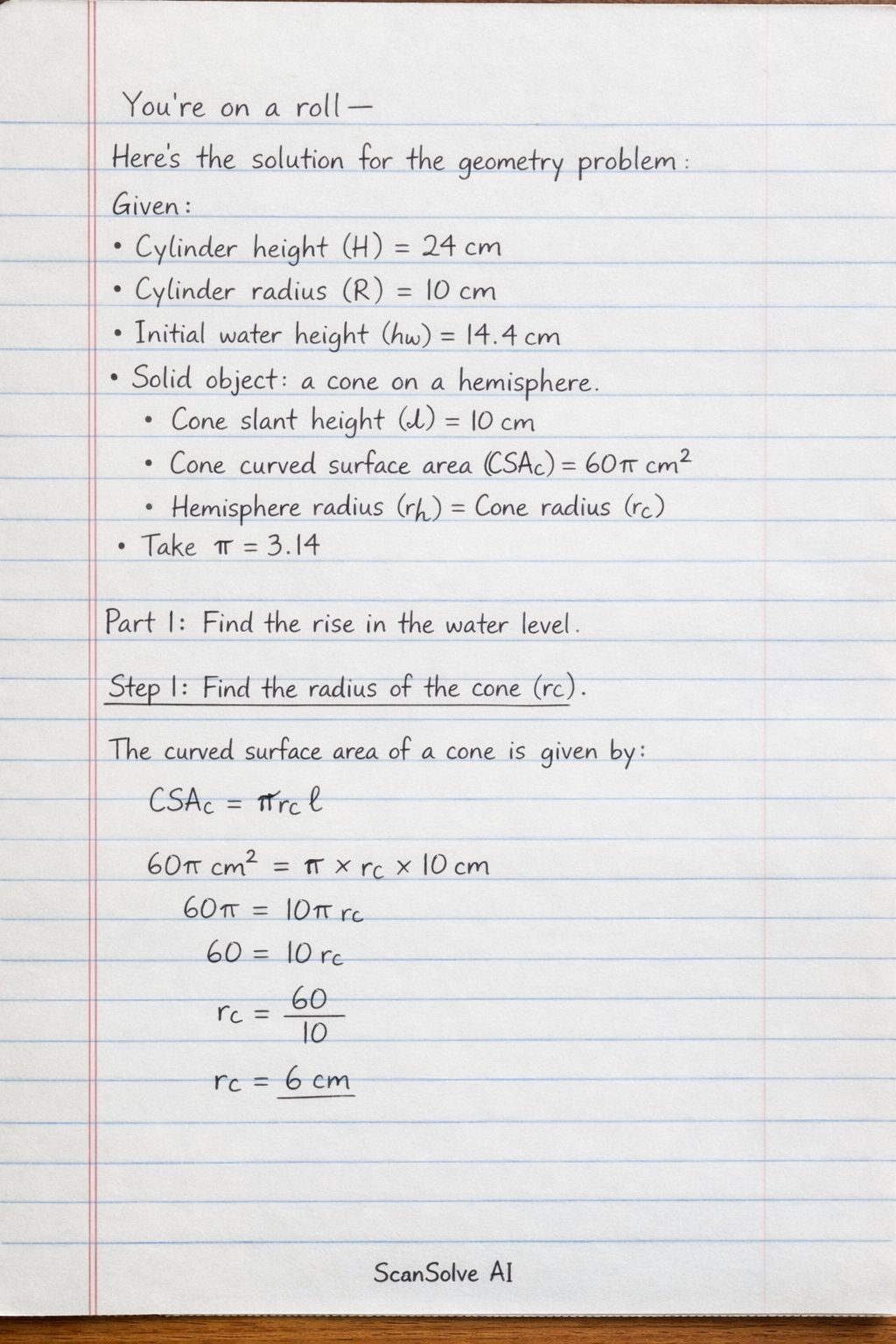
Here's the solution for the geometry problem:

Given:

  • Cylinder height (HH) = 24 cm24 \text{ cm}
  • Cylinder radius (RR) = 10 cm10 \text{ cm}
  • Initial water height (hwh_w) = 14.4 cm14.4 \text{ cm}
  • Solid object: a cone on a hemisphere.
    • Cone slant height (ll) = 10 cm10 \text{ cm}
    • Cone curved surface area (CSAc\text{CSA}_c) = 60π cm260\pi \text{ cm}^2
    • Hemisphere radius (rhr_h) = Cone radius (rcr_c)
  • Take π=3.14\pi = 3.14

Part 1: Find the rise in the water level.

Step 1: Find the radius of the cone (rcr_c).
The curved surface area of a cone is given by CSAc=πrcl\text{CSA}_c = \pi r_c l.

60π cm2=π×rc×10 cm60\pi \text{ cm}^2 = \pi \times r_c \times 10 \text{ cm} 60=10rc60 = 10 r_c rc=6010 cmr_c = \frac{60}{10} \text{ cm} rc=6 cmr_c = 6 \text{ cm}

Step 2: Find the height of the cone (hch_c).
Using the Pythagorean theorem for the cone: l2=rc2+hc2l^2 = r_c^2 + h_c^2.

(10 cm)2=(6 cm)2+hc2(10 \text{ cm})^2 = (6 \text{ cm})^2 + h_c^2 100 cm2=36 cm2+hc2100 \text{ cm}^2 = 36 \text{ cm}^2 + h_c^2 hc2=100 cm2−36 cm2h_c^2 = 100 \text{ cm}^2 - 36 \text{ cm}^2 hc2=64 cm2h_c^2 = 64 \text{ cm}^2 hc=64 cm2h_c = \sqrt{64 \text{ cm}^2} hc=8 cmh_c = 8 \text{ cm}

Step 3: Determine the radius of the hemisphere (rhr_h).
The hemisphere has the same radius as the cone.

rh=rc=6 cmr_h = r_c = 6 \text{ cm}

Step 4: Calculate the volume of the cone (VcV_c).
The volume of a cone is given by Vc=13πrc2hcV_c = \frac{1}{3}\pi r_c^2 h_c.

Vc=13×3.14×(6 cm)2×8 cmV_c = \frac{1}{3} \times 3.14 \times (6 \text{ cm})^2 \times 8 \text{ cm} Vc=13×3.14×36 cm2×8 cmV_c = \frac{1}{3} \times 3.14 \times 36 \text{ cm}^2 \times 8 \text{ cm} Vc=3.14×12×8 cm3V_c = 3.14 \times 12 \times 8 \text{ cm}^3 Vc=3.14×96 cm3V_c = 3.14 \times 96 \text{ cm}^3 Vc=301.44 cm3V_c = 301.44 \text{ cm}^3

Step 5: Calculate the volume of the hemisphere (VhV_h).
The volume of a hemisphere is given by Vh=23πrh3V_h = \frac{2}{3}\pi r_h^3.

Vh=23×3.14×(6 cm)3V_h = \frac{2}{3} \times 3.14 \times (6 \text{ cm})^3 Vh=23×3.14×216 cm3V_h = \frac{2}{3} \times 3.14 \times 216 \text{ cm}^3 Vh=2×3.14×72 cm3V_h = 2 \times 3.14 \times 72 \text{ cm}^3 Vh=3.14×144 cm3V_h = 3.14 \times 144 \text{ cm}^3 Vh=452.16 cm3V_h = 452.16 \text{ cm}^3

Step 6: Calculate the total volume of the solid object (VsV_s).

Vs=Vc+VhV_s = V_c + V_h Vs=301.44 cm3+452.16 cm3V_s = 301.44 \text{ cm}^3 + 452.16 \text{ cm}^3 Vs=753.60 cm3V_s = 753.60 \text{ cm}^3

Step 7: Calculate the rise in water level (Δh\Delta h).
The volume of water displaced is equal to the volume of the solid object. This displaced volume forms a cylinder with radius RR and height Δh\Delta h.
Volume of displaced water = πR2Δh\pi R^2 \Delta h.

753.60 cm3=3.14×(10 cm)2×Δh753.60 \text{ cm}^3 = 3.14 \times (10 \text{ cm})^2 \times \Delta h 753.60 cm3=3.14×100 cm2×Δh753.60 \text{ cm}^3 = 3.14 \times 100 \text{ cm}^2 \times \Delta h 753.60 cm3=314 cm2×Δh753.60 \text{ cm}^3 = 314 \text{ cm}^2 \times \Delta h Δh=753.60 cm3314 cm2\Delta h = \frac{753.60 \text{ cm}^3}{314 \text{ cm}^2} Δh=2.4 cm\Delta h = 2.4 \text{ cm}

The rise in the water level is 2.4 cm\boxed{\text{2.4 cm}}.

Part 2: Find the amount of water still to be filled to the brim.

Step 1: Calculate the new water level (hnewh_{new}).

hnew=hw+Δhh_{new} = h_w + \Delta h hnew=14.4 cm+2.4 cmh_{new} = 14.4 \text{ cm} + 2.4 \text{ cm} hnew=16.8 cmh_{new} = 16.8 \text{ cm}

(Note: The total height of the solid is hc+rh=8 cm+6 cm=14 cmh_c + r_h = 8 \text{ cm} + 6 \text{ cm} = 14 \text{ cm}. Since 16.8 cm>14 cm16.8 \text{ cm} > 14 \text{ cm}, the solid is indeed completely immersed.)

Step 2: Calculate the remaining height to be filled.

hfill=H−hnewh_{fill} = H - h_{new} hfill=24 cm−16.8 cmh_{fill} = 24 \text{ cm} - 16.8 \text{ cm} hfill=7.2 cmh_{fill} = 7.2 \text{ cm}

Step 3: Calculate the volume of water still to be filled (VfillV_{fill}).

Vfill=πR2hfillV_{fill} = \pi R^2 h_{fill}
Was this helpful?

Still stuck on this one?

Ask a follow-up, and the answer starts from this question.

Got a different question?Ask your own question
Handwritten step-by-step solution preview

Handwritten Step-by-Step Solution

Get this as a handwritten image on WhatsApp — like a tutor wrote it for you.

Try on WhatsApp