We read your photo as:

A sphere has a diameter of 12 cm. Calculate its volume to the nearest cubic centimeter. Use pi = 22/7.

Mathematics

ScanSolve AI Answer

Answers

5 parts
38

A. 905 cm3\text{A. } 905 \text{ cm}^3

39

D. 14\text{D. } \frac{1}{4}

40

A. 25144\text{A. } \frac{25}{144}

41

B. 60∘\text{B. } 60^\circ

Step-by-step solution

13 steps

Here are the solutions to the questions.

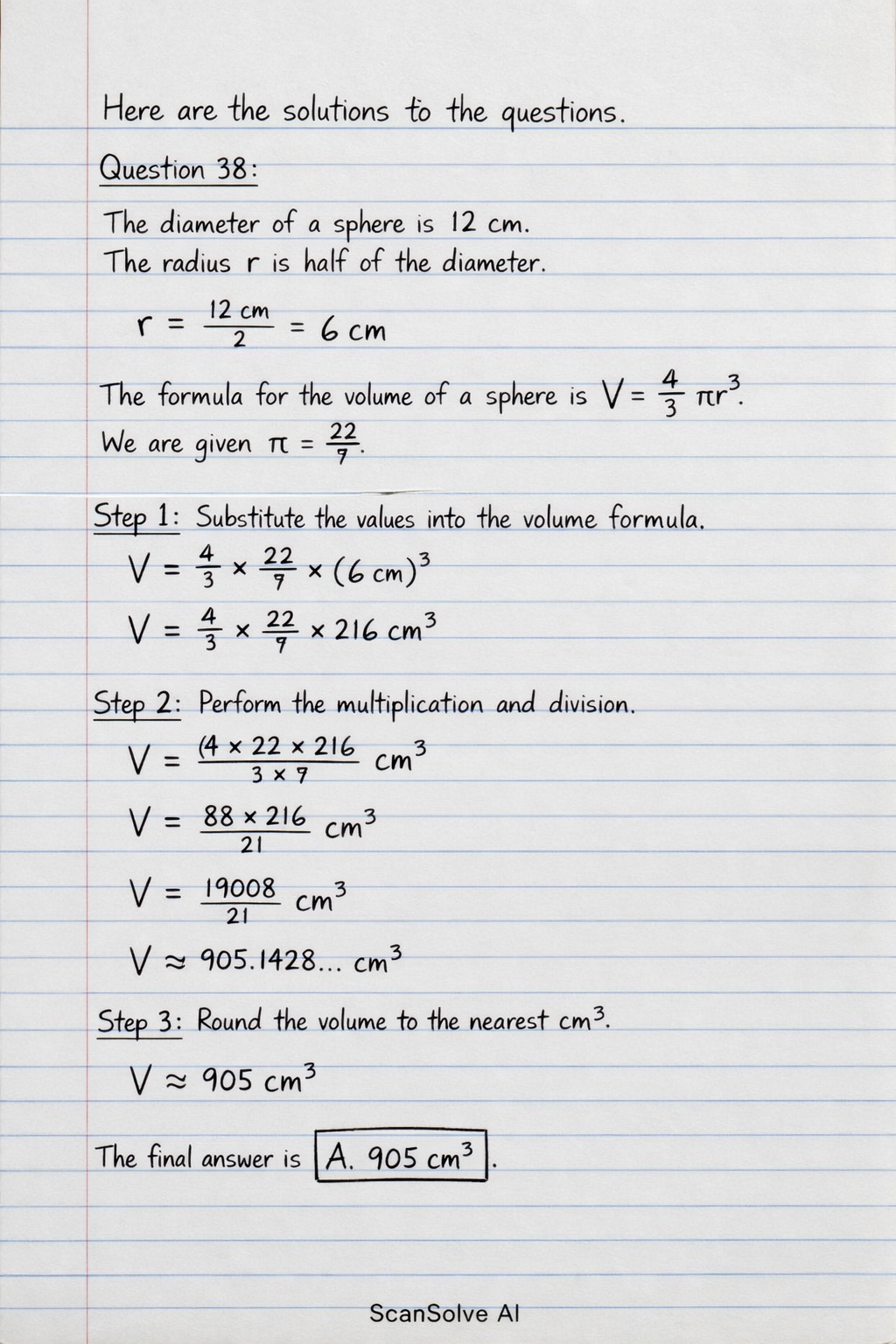
Part 38· 3 steps

The diameter of a sphere is 12 cm12 \text{ cm}.
The radius rr is half of the diameter.

r=12 cm2=6 cmr = \frac{12 \text{ cm}}{2} = 6 \text{ cm}

The formula for the volume of a sphere is V=43πr3V = \frac{4}{3}\pi r^3.
We are given π=227\pi = \frac{22}{7}.

  1. Substitute the values into the volume formula.

    V=43×227×(6 cm)3V = \frac{4}{3} \times \frac{22}{7} \times (6 \text{ cm})^3 V=43×227×216 cm3V = \frac{4}{3} \times \frac{22}{7} \times 216 \text{ cm}^3
  2. Perform the multiplication and division.

    V=4×22×2163×7 cm3V = \frac{4 \times 22 \times 216}{3 \times 7} \text{ cm}^3 V=88×21621 cm3V = \frac{88 \times 216}{21} \text{ cm}^3 V=1900821 cm3V = \frac{19008}{21} \text{ cm}^3 V≈905.1428... cm3V \approx 905.1428... \text{ cm}^3
  3. Round the volume to the nearest cm3\text{cm}^3.

    V≈905 cm3V \approx 905 \text{ cm}^3

    The final answer is A. 905 cm3\boxed{\text{A. } 905 \text{ cm}^3}.

Part 39

D. 14\text{D. } \frac{1}{4}

A box contains 12 identical balls.
Number of red balls = 5.
Number of blue balls = 4.
Number of green balls = Total balls - (Red balls + Blue balls)

Green balls=12−(5+4)=12−9=3\text{Green balls} = 12 - (5 + 4) = 12 - 9 = 3

The probability of selecting a green ball is the number of green balls divided by the total number of balls.

P(green)=Number of green ballsTotal number of balls=312P(\text{green}) = \frac{\text{Number of green balls}}{\text{Total number of balls}} = \frac{3}{12}
  1. Simplify the probability.

    P(green)=14P(\text{green}) = \frac{1}{4}

    The final answer is D. 14\boxed{\text{D. } \frac{1}{4}}.

Part 40

A. 25144\text{A. } \frac{25}{144}

Two balls are selected at random, one after the other, with replacement.
Total balls = 12.
Number of red balls = 5.

  1. Calculate the probability of the first ball being red.

    P(1st red)=Number of red ballsTotal number of balls=512P(\text{1st red}) = \frac{\text{Number of red balls}}{\text{Total number of balls}} = \frac{5}{12}
  2. Calculate the probability of the second ball being red.

    Since the first ball is replaced, the total number of balls and the number of red balls remain the same for the second draw.

    P(2nd red)=512P(\text{2nd red}) = \frac{5}{12}
  3. Calculate the probability that both balls are red.

    Since the events are independent (due to replacement), multiply their probabilities.

    P(both red)=P(1st red)×P(2nd red)P(\text{both red}) = P(\text{1st red}) \times P(\text{2nd red}) P(both red)=512×512P(\text{both red}) = \frac{5}{12} \times \frac{5}{12} P(both red)=25144P(\text{both red}) = \frac{25}{144}

    The final answer is A. 25144\boxed{\text{A. } \frac{25}{144}}.

Part 41

B. 60∘\text{B. } 60^\circ

In the diagram, PQPQ is a straight line.
The sum of angles on a straight line is 180∘180^\circ.
From the diagram, the angles x,y,z,x, y, z, and mm are on the straight line PQPQ.

x+y+z+m=180∘x + y + z + m = 180^\circ

We are given the relationship m=12(x+y+z)m = \frac{1}{2}(x+y+z).

  1. Express (x+y+z)(x+y+z) in terms of mm.

    From the given relationship, multiply both sides by 2:

    2m=x+y+z2m = x+y+z
  2. Substitute 2m2m for (x+y+z)(x+y+z) into the equation for angles on a straight line.

    (2m)+m=180∘(2m) + m = 180^\circ 3m=180∘3m = 180^\circ
  3. Solve for mm.

    m=180∘3m = \frac{180^\circ}{3} m=60∘m = 60^\circ

    The final answer is B. 60∘\boxed{\text{B. } 60^\circ}.

Part 422

The points on a linear graph are given in the table. We need to find the gradient.
The formula for the gradient GG between two points (x1,y1)(x_1, y_1) and (x2,y2)(x_2, y_2) is:

G=y2−y1x2−x1G = \frac{y_2 - y_1}{x_2 - x_1}

Let's use the first two points from the table:
(x1,y1)=(6.20,3.90)(x_1, y_1) = (6.20, 3.90)
(x2,y2)=(6.85,5.20)(x_2, y_2) = (6.85, 5.20)

  1. Substitute the coordinates into the gradient formula.

    G=5.20−3.906.85−6.20G = \frac{5.20 - 3.90}{6.85 - 6.20}
  2. Calculate the differences.

    G=1.300.65G = \frac{1.30}{0.65}
  3. Perform the division.

    G=2G = 2

    Let's verify with another pair of points, for example, the second and third points:
    (x1,y1)=(6.85,5.20)(x_1, y_1) = (6.85, 5.20)
    (x2,y2)=(7.50,6.50)(x_2, y_2) = (7.50, 6.50)

    G=6.50−5.207.50−6.85G = \frac{6.50 - 5.20}{7.50 - 6.85} G=1.300.65G = \frac{1.30}{0.65} G=2G = 2

    The gradient is consistent.

    The final answer is 2\boxed{2}.

Was this helpful?

Try one yourself

A new problem that tests the same skill.

Still stuck on this one?

Ask a follow-up, and the answer starts from this question.

Got a different question?Ask your own question
Handwritten step-by-step solution preview

Handwritten Step-by-Step Solution

Get this as a handwritten image on WhatsApp — like a tutor wrote it for you.

Try on WhatsApp