
We read your photo as:
A square-based pyramid has a base side length of 20 cm and a slant edge of 26 cm. Calculate the total number of surfaces and the total surface area.
ScanSolve AI Answer
Answers
2 partsStep-by-step solution
5 stepsHere's the solution to question 5:
Given:
Length of a side of the base of the square-based pyramid, cm.
Length of the slant edge, cm.
Part a
A square-based pyramid has one square base and four triangular lateral faces.
Therefore, the total number of surfaces is .
Part b
To find the total surface area (TSA) of the pyramid, we need the base area and the lateral surface area.
The formula for TSA is .
Base Area .
Lateral Surface Area , where is the slant height.
Calculate the vertical height () of the pyramid.
We use the relationship between the slant edge (), vertical height (), and half of the base diagonal. Alternatively, we can use the relationship .
Substitute the given values:
Calculate the slant height () of the pyramid.
We use the relationship between the slant height (), vertical height (), and half of the base side length ().
Substitute the values for and :
Calculate the total surface area (TSA).
The total surface area of the pyramid is .
Part c· 2 steps
To compare the vertical height () and slant height ()
State the values of and .
Vertical height cm.
Slant height cm.Compare the values.
We know that and . So, is between 21 and 22.
cm.
Since , the slant height is greater than the vertical height.
Comparison: The slant height ( cm) is greater than the vertical height ( cm).
Still stuck on this one?
Ask a follow-up, and the answer starts from this question.
More Mathematics Questions
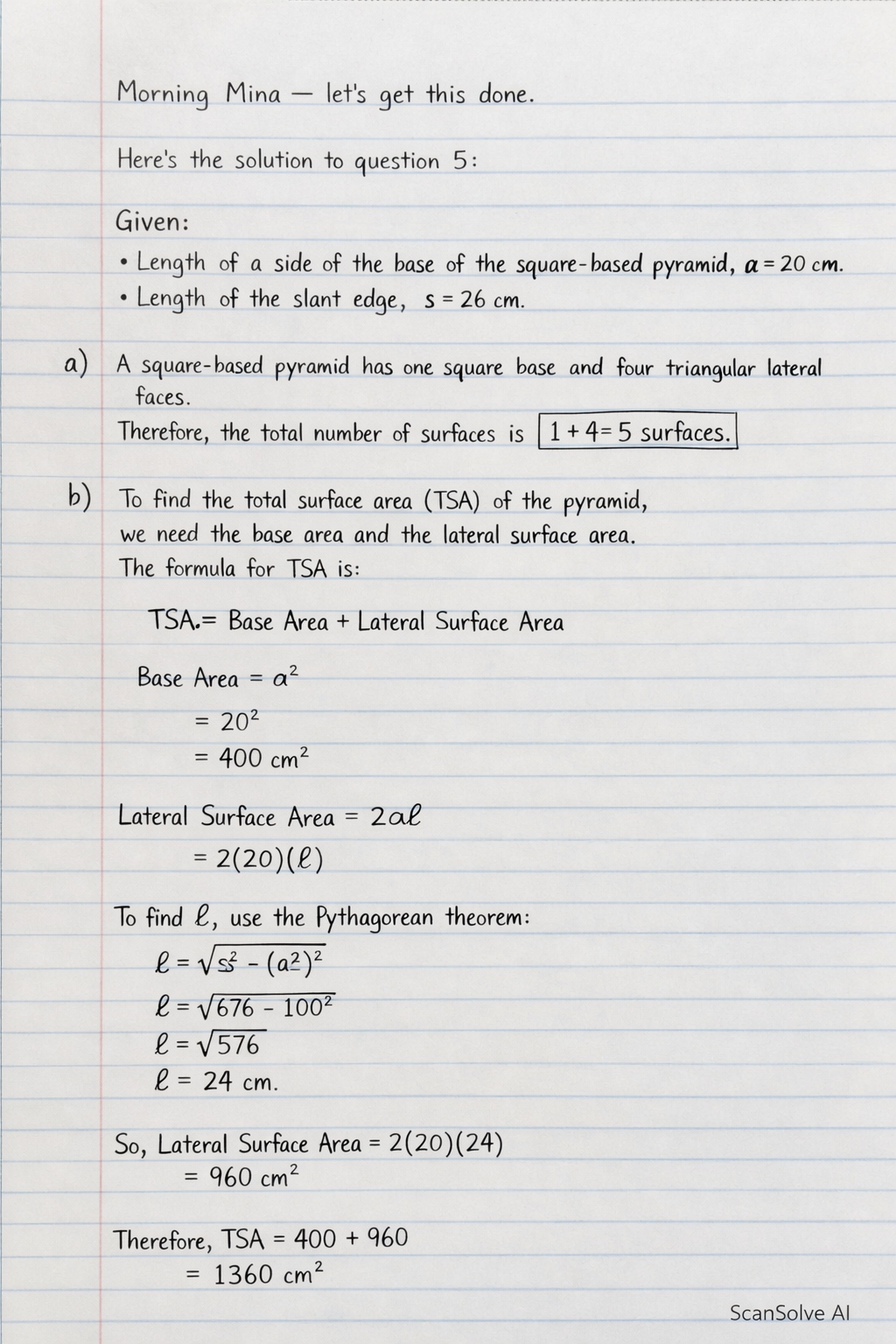
Handwritten Step-by-Step Solution
Get this as a handwritten image on WhatsApp — like a tutor wrote it for you.
Try on WhatsApp