
We read your photo as:
A. State the number of roads (ARCS) on the diagram by identifying their endpoints (nodes) b. State the number of regions in the network
ScanSolve AI Answer
Step-by-step solution
16 stepshere are the solutions to the problems:
Question 6:
A woman gave of her farm to her daughter and sold of the remainder.
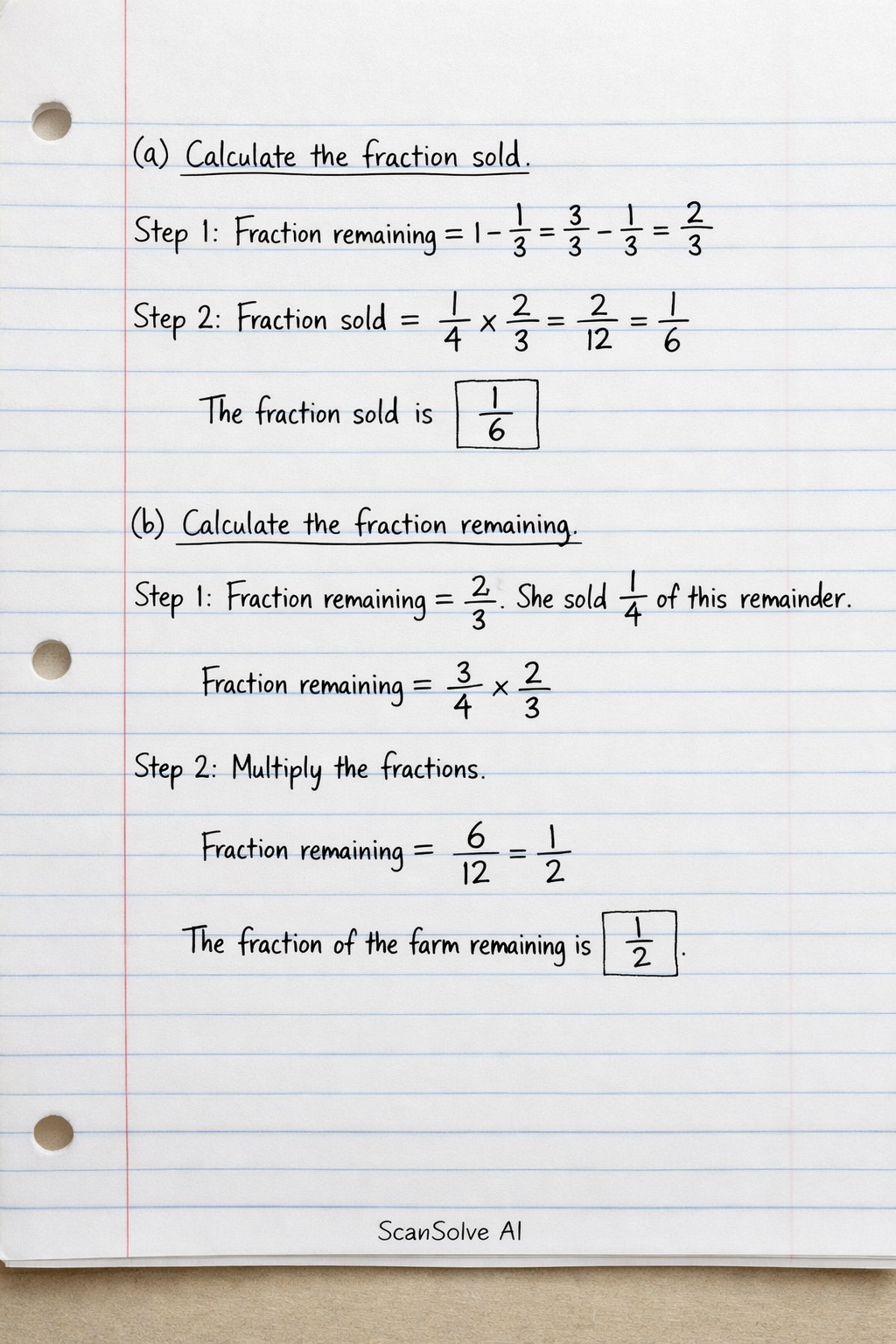
a) Calculate the fraction sold.
Determine the fraction of the farm remaining after giving to her daughter.
Calculate the fraction of the farm sold, which is of the remainder.
The fraction sold is .
b) Calculate the fraction of the farm remaining.
The fraction remaining after giving to her daughter was .
She sold of this remainder, meaning of this remainder is still left.
Multiply the fractions.
The fraction of the farm remaining is .
Question 7:
Solve for in the equation .Express both bases as powers of the same prime number, which is 2.
Substitute these into the equation.
Apply the exponent rule .
Since the bases are equal, equate the exponents.
Solve for .
The value of is .
Question 8:
A trader took a loan of 3,000,000 FCFA from a bank at the rate of 2% simple interest per annum.a) Calculate how much interest he pays per year.
Use the simple interest formula for one year
.
The interest paid per year is .
b) Calculate the total interest paid in three years.
Use the simple interest formula
.
The total interest paid in three years is .
c) Calculate the total amount paid at the end of three years.
The total amount paid is the principal plus the total interest.
The total amount paid at the end of three years is .
Question 9:
The diagram below represents roads linking the offices in an establishment.a) State the number of roads (ARCS) on the diagram by identifying their endpoints (nodes).
Identify the nodes (offices)
Principal, V Principal, BC Workshop, Bursary.
Count the lines connecting these nodes, which represent the roads (arcs).
- Principal to V Principal
- Principal to Bursary
- Principal to BC Workshop
- V Principal to Bursary
- BC Workshop to Bursary There are roads (arcs) on the diagram.
b) State the number of regions in the network.
Identify the number of vertices (nodes, V) and edges (arcs, E) in the planar graph.
Apply Euler's formula for planar graphs, which states , where is the number of faces (regions).
The number of regions in the network is .
Still stuck on this one?
Ask a follow-up, and the answer starts from this question.
More Mathematics Questions
Handwritten Step-by-Step Solution
Get this as a handwritten image on WhatsApp — like a tutor wrote it for you.
Try on WhatsApp