
We read your photo as:
Item 3: Using a Venn diagram, determine the number of students in each region based on the following data: [Data for sets A, B, C and their intersections would be provided here.]
Mathematics
ScanSolve AI Answer
Here's a step-by-step solution for Item 3:
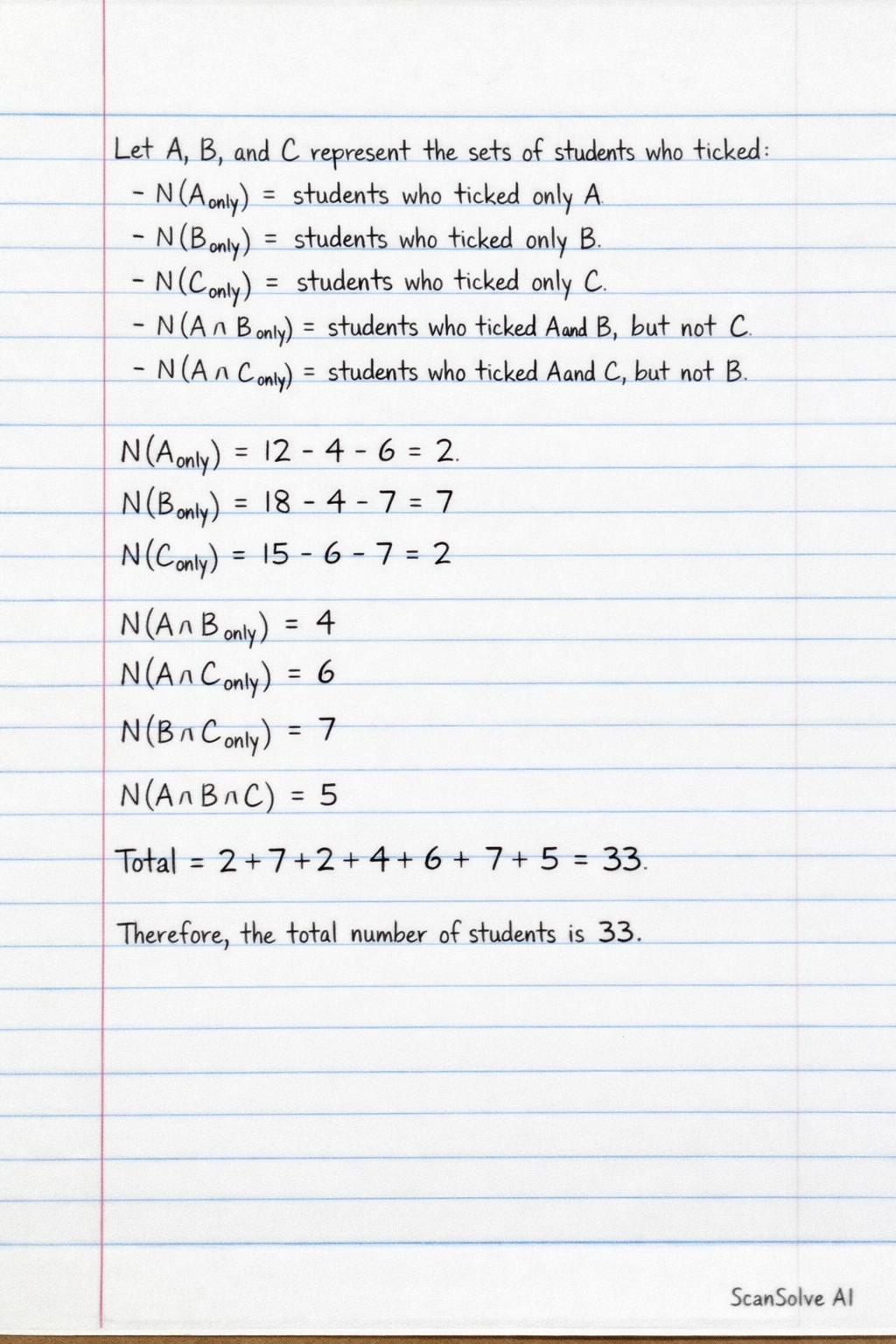
Let A, B, and C represent the sets of students who ticked Andrew, Badru, and Cathy, respectively. We will use a Venn diagram approach to solve this problem, where each region represents a distinct group of students.
Let:
- = students who ticked only A
- = students who ticked only B
- = students who ticked only C
- = students who ticked A and B, but not C
- = students who ticked A and C, but not B
Was this helpful?
Still stuck on this one?
Ask a follow-up, and the answer starts from this question.
Got a different question?Ask your own question
More Mathematics Questions
QIdentify the number of students in each distinct region of the Venn diagram.QLet the number of students in each region of the Venn diagram be:QSolve the following set theory problem using a Venn diagram. Given the total number of students and…QDefine variables for the number of students in each region of the Venn diagram.QI. Draw a Venn diagram to represent this information. Use your Venn diagram to calculate the number…
Browse by topic:Discrete Math
Handwritten Step-by-Step Solution
Get this as a handwritten image on WhatsApp — like a tutor wrote it for you.
Try on WhatsApp