
We read your photo as:
Solve the following set theory problem using a Venn diagram. Given the total number of students and various subsets, find the number of students in each specific region.
ScanSolve AI Answer
Answers
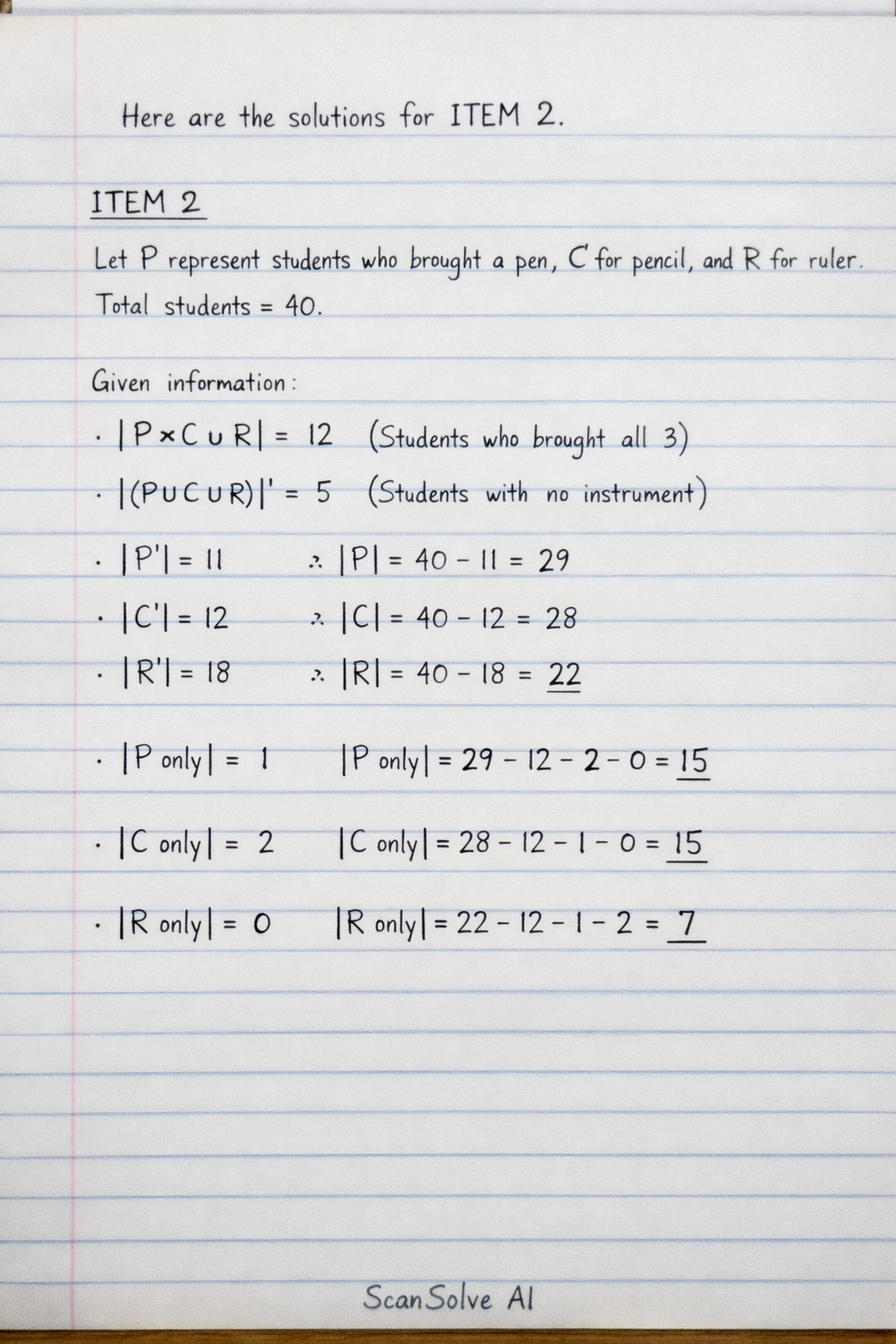
2 partsHere are the solutions for ITEM 2.
ITEM 2
Let P represent students who brought a pen, C for pencil, and R for ruler.
Total students = 40.
Given information:
- Total students = 40
- Students who brought all 3 instruments:
- Students who didn't have any instrument:
- Students who did not have a pen:
- Students who did not have a pencil:
- Students who did not have a ruler:
- Students who had a pen only:
- Students who had only a pencil:
- Students who had only a ruler:
Let's denote the number of students in each region of the Venn diagram:
- (all three)
- (pen and pencil, not ruler)
- (pen and ruler, not pencil)
- (pencil and ruler, not pen)
- (none)
We can set up equations using the total for each set:
Now, solve the system of equations:
From (1), .
Substitute into (3): .
Now we have two equations for and :
(from 2)
Adding these two equations: .
Substitute into .
Substitute into .
So, the number of students in each region is:
- Pen only:
- Pencil only:
- Ruler only:
- Pen and Pencil only:
- Pen and Ruler only:
- Pencil and Ruler only:
- All three:
- None:
Let's verify the total: . This is consistent.
a) Draw a Venn diagram to illustrate this information and find out how many had at least a pencil and a ruler.
The Venn diagram would look like this:
\begin{tikzpicture}
\begin{scope}[fill opacity=0.8]
    % Sets
    \fill[blue!20] (0,0) circle (1.5); % P
    \fill[red!20] (2,0) circle (1.5); % C
    \fill[green!20] (1, -2) circle (1.5); % R

    % Labels for regions
    \node at (-0.8, 0.8) {1}; % P only
    \node at (2.8, 0.8) {2}; % C only
    \node at (1, -3.2) {0}; % R only

    \node at (1, 0.2) {10}; % P and C only
    \node at (0.2, -1.2) {6}; % P and R only
    \node at (1.8, -1.2) {4}; % C and R only
    \node at (1, -0.8) {12}; % P and C and R

    % Set names
    \node at (-1.8, 1.5) {P};
    \node at (3.8, 1.5) {C};
    \node at (2.5, -3) {R};

    % Universal set
    \draw (-3,-4) rectangle (5,2);
    \node at (4.5, 1.5) {U};
    \node at (4, -3.5) {5}; % None
\end{scope}
\end{tikzpicture}
To find how many had at least a pencil and a ruler, we need to find the number of students in the intersection of C and R, which is . This includes students who had only pencil and ruler, and those who had all three.
b) The students who had less than two instruments were put in detention, how many students were put in detention?
"Less than two instruments" means students who had zero instruments or one instrument.
- Students with zero instruments:
- Students with one instrument:
Total students in detention = (students with zero instruments) + (students with one instrument)
Total in detention =
Still stuck on this one?
Ask a follow-up, and the answer starts from this question.
More Mathematics Questions
Handwritten Step-by-Step Solution
Get this as a handwritten image on WhatsApp — like a tutor wrote it for you.
Try on WhatsApp