
We read your photo as:
A) Step 1: Differentiate ((3x³)/( x)) with respect to x.
ScanSolve AI Answer
Answers
2 partsStep-by-step solution
3 stepsPart a
Step 1: Differentiate with respect to .
First, simplify the expression using logarithm properties:
Now, differentiate each term with respect to :
The derivative is .
Part b
Step 1: Find for the parametric curve.
The curve is defined by and .
First, find and :
Now, find using the chain rule:
Find the gradient of the tangent at .
Substitute into the expression for :
Find the coordinates of the point on the curve at .
Substitute into the parametric equations for and :
The point of tangency is .
Write the equation of the tangent line.
Using the point-slope form :
To eliminate fractions, multiply the entire equation by 12:
Rearrange the equation into the form :
The equation of the tangent to the curve is .
Try one yourself
A new problem that tests the same skill.
Still stuck on this one?
Ask a follow-up, and the answer starts from this question.
More Mathematics Questions
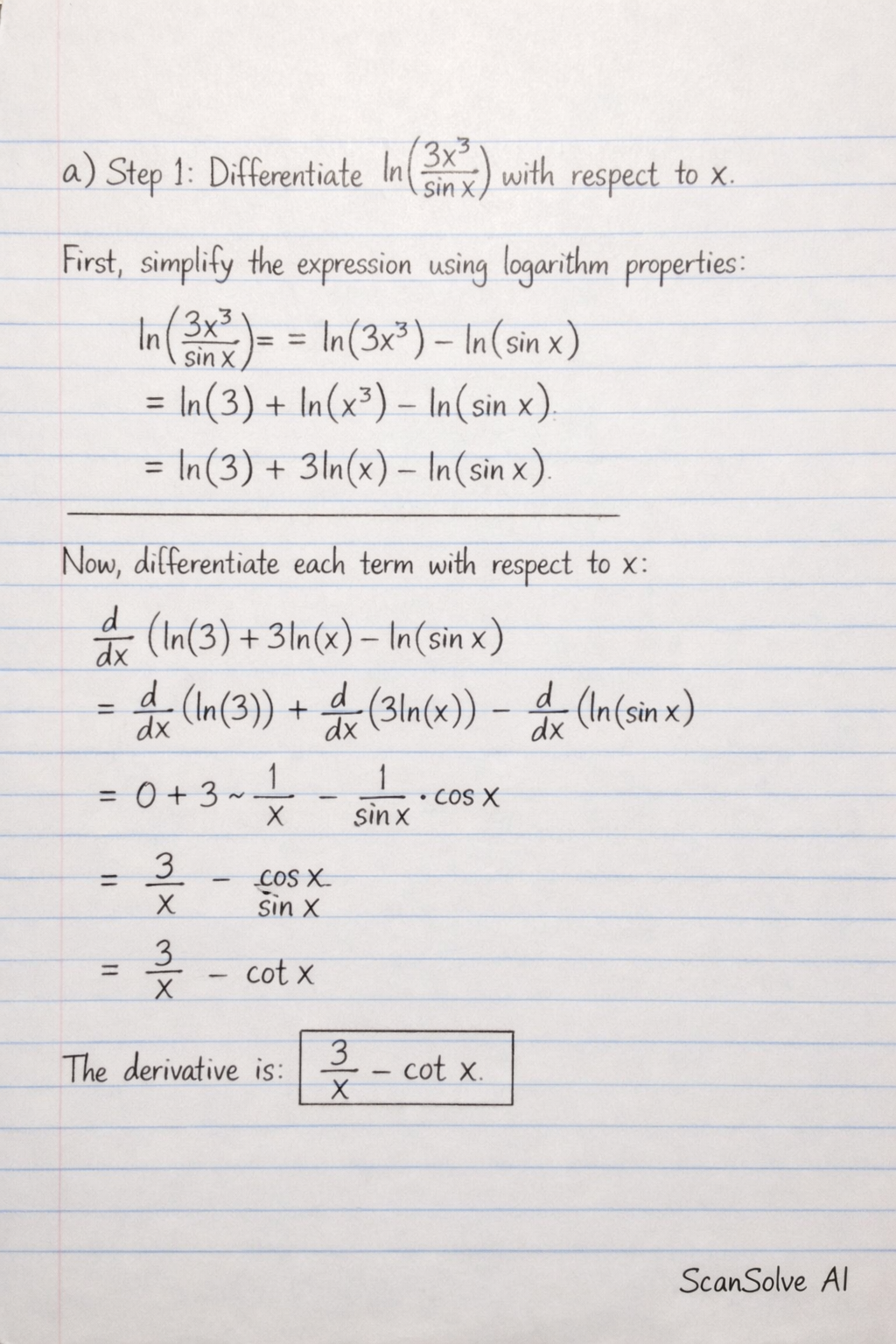
Handwritten Step-by-Step Solution
Get this as a handwritten image on WhatsApp — like a tutor wrote it for you.
Try on WhatsApp