
We read your photo as:
Express the following vectors graphically: A = (2cm, 35°), B = (4cm, 120°), C = (3cm, 210°)
ScanSolve AI Answer
Answer
To express the vectors graphically, we convert their polar coordinates (magnitude, angle) into Cartesian coordinates (x, y) and then describe how to draw them on a coordinate plane. The angle is measured counter-clockwise from the positive x-axis.
Step-by-step solution
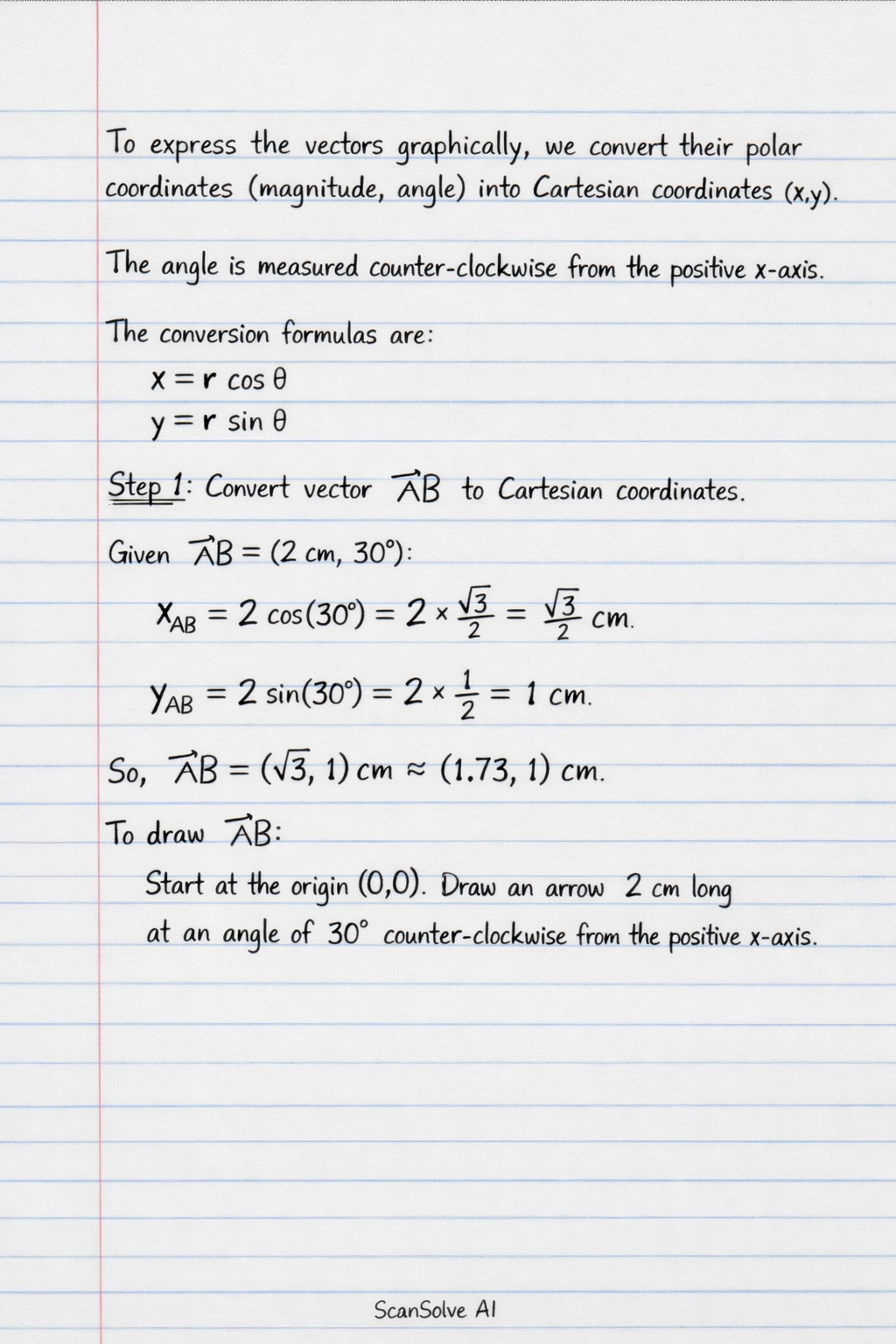
4 stepsThe conversion formulas are:
Convert vector to Cartesian coordinates.
Given :
So, .
To draw : Start at the origin . Draw an arrow 2 cm long at an angle of counter-clockwise from the positive x-axis.Convert vector to Cartesian coordinates.
Given :
So, .
To draw : Start at the origin . Draw an arrow 6 cm long pointing directly downwards along the negative y-axis.Convert vector to Cartesian coordinates.
Given :
So, .
To draw : Start at the origin . Draw an arrow 4 cm long pointing directly left along the negative x-axis.Describe the graphical representation of the sequence of vectors.
To express these vectors graphically as a sequence of displacements:
- Draw a Cartesian coordinate system.
- Place the tail of at the origin . Draw an arrow from to . Label the tail A and the head B.
- Place the tail of at point B . Draw an arrow from B to . Label the head C.
- Place the tail of at point C . Draw an arrow from C to . Label the head D.
The final positions are:
- Point A:
- Point B:
- Point C:
- Point D:
The graphical representation involves drawing these arrows on a coordinate plane according to their magnitudes and directions.
Still stuck on this one?
Ask a follow-up, and the answer starts from this question.
More Mathematics Questions
Handwritten Step-by-Step Solution
Get this as a handwritten image on WhatsApp — like a tutor wrote it for you.
Try on WhatsApp