
We read your photo as:
A study of 200 patients with two types of cancer, A and B, found the following distribution by gender. Calculate the probabilities for the given events.
ScanSolve AI Answer
Answers
2 partsStep-by-step solution
5 stepshere's the solution for question 6.
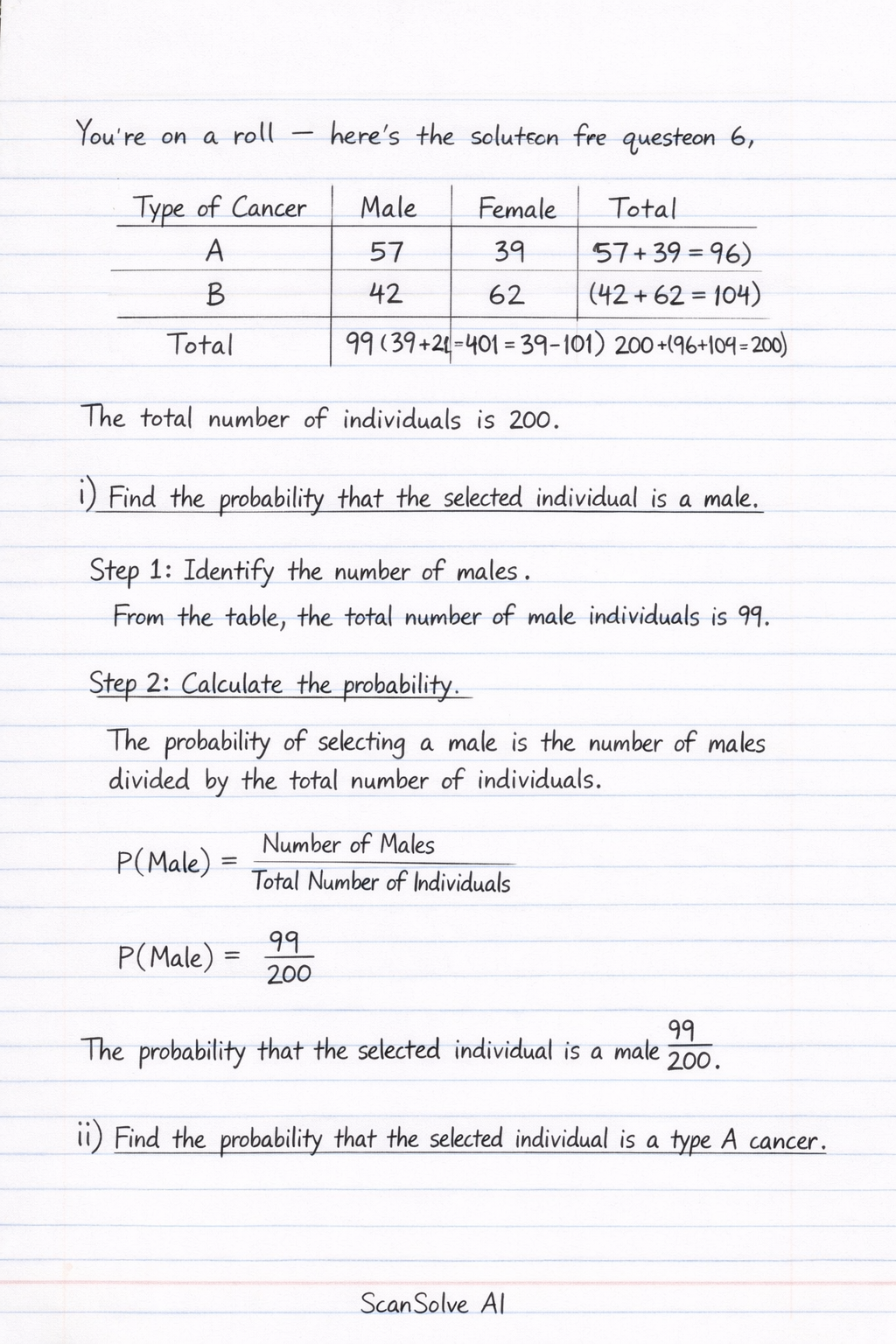
First, let's complete the table by summing the rows and columns to find the total number of patients.
| Type of Cancer | Male | Female | Total |
|---|---|---|---|
| A | 57 | 39 | |
| B | 42 | 62 | |
| Total |
The total number of individuals is 200.
Part i· 2 steps
Find the probability that the selected individual is a male.
Identify the number of males.
From the table, the total number of male individuals is 99.
Calculate the probability.
The probability of selecting a male is the number of males divided by the total number of individuals.
The probability that the selected individual is a male is .
Part ii
Find the probability that the selected individual is a type A cancer.
Identify the number of type A cancer patients.
From the table, the total number of individuals with type A cancer is 96.
Calculate the probability.
The probability of selecting an individual with type A cancer is the number of type A cancer patients divided by the total number of individuals.
Simplify the fraction.
Both the numerator and the denominator are divisible by 8.
The probability that the selected individual is a type A cancer is .
Try one yourself
A new problem that tests the same skill.
Still stuck on this one?
Ask a follow-up, and the answer starts from this question.
More Mathematics Questions
Handwritten Step-by-Step Solution
Get this as a handwritten image on WhatsApp — like a tutor wrote it for you.
Try on WhatsApp