
We read your photo as:
A survey of 80 farmers found that 50 grow maize and 60 grow rice. Represent this information on a Venn diagram and find the number of farmers who grow both crops.
ScanSolve AI Answer
Answer
Here's how to solve the problem:
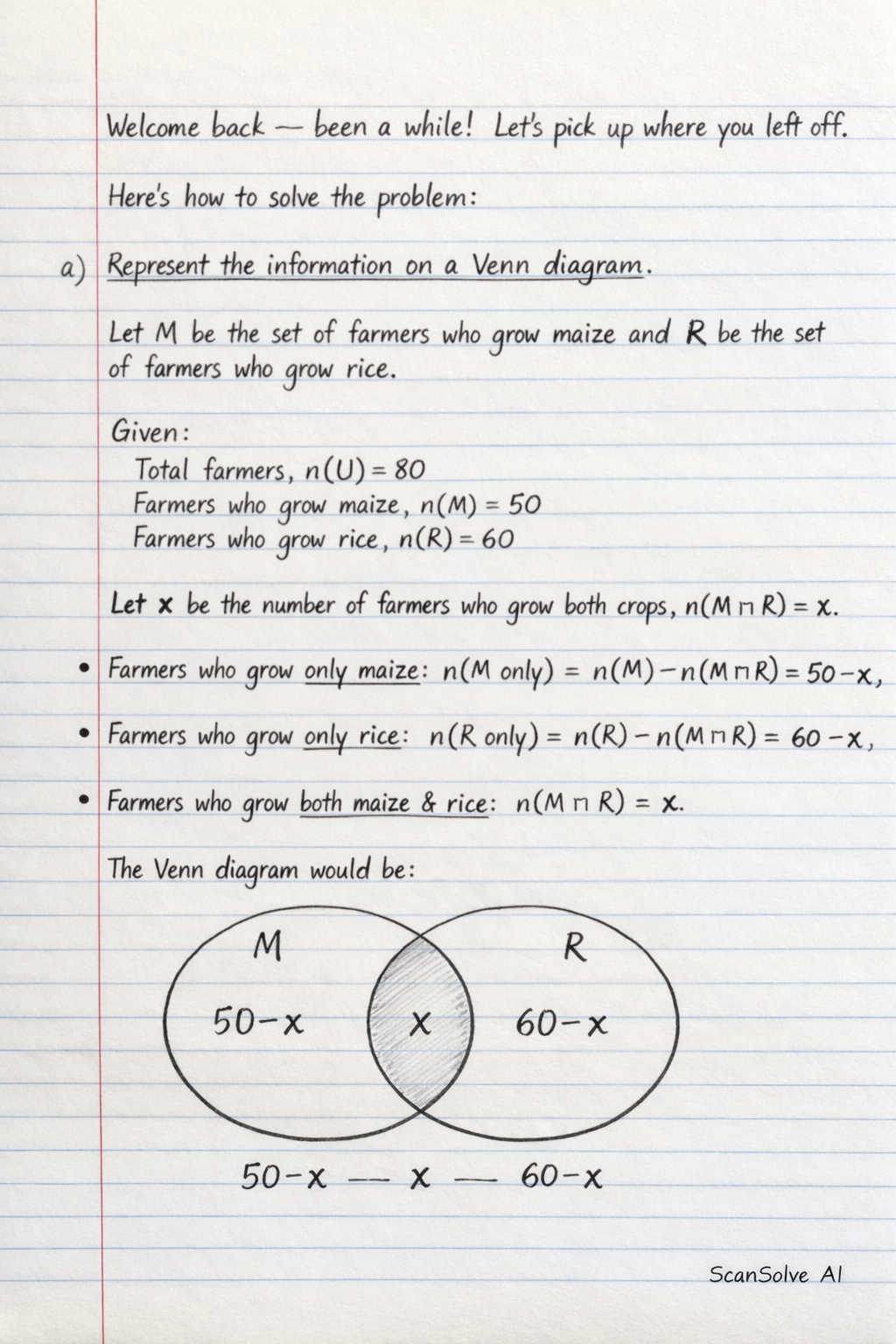
a) Represent the information on a Venn diagram.
Let be the set of farmers who grow maize and be the set of farmers who grow rice.
Given:
Total farmers,
Farmers who grow maize,
Farmers who grow rice,
Let be the number of farmers who grow both crops, .
The regions in the Venn diagram are:
- Farmers who grow only maize:
- Farmers who grow only rice:
- Farmers who grow both maize and rice:
The Venn diagram would show two overlapping circles. The left part of the maize circle (not overlapping) would be . The overlapping part would be . The right part of the rice circle (not overlapping) would be .
b) Write an equation in and solve it.
The total number of farmers is the sum of farmers in each distinct region of the Venn diagram.
Substitute the expressions for each region:
Combine like terms:
Now, solve for :
The number of farmers who grow both crops is .
Try one yourself
A new problem that tests the same skill.
Still stuck on this one?
Ask a follow-up, and the answer starts from this question.
More Mathematics Questions
Handwritten Step-by-Step Solution
Get this as a handwritten image on WhatsApp — like a tutor wrote it for you.
Try on WhatsApp