

This mathematics problem involves applying core mathematical principles and formulas. Below you will find a complete step-by-step solution with detailed explanations for each step, helping you understand not just the answer but the method behind it.
ScanSolve AI Answer
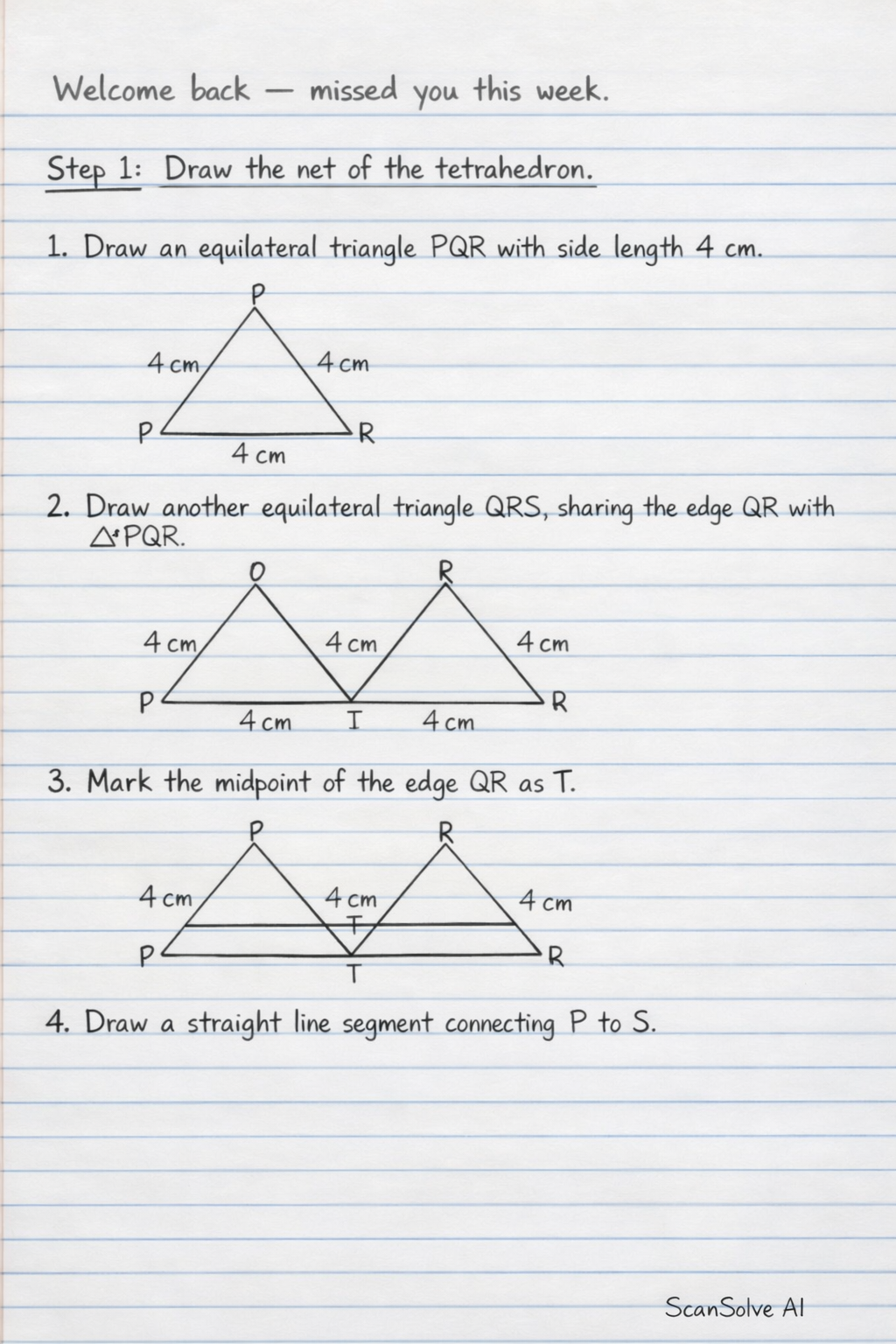
Welcome back — missed you this week. Step 1: Draw the net of the tetrahedron. To find the shortest path from P to S passing over the edge QR at its midpoint T, we need to unfold the faces PQR and QRS. The net consists of two equilateral triangles, PQR and QRS, sharing the common edge QR. All edges have a length of 4 cm. 1. Draw an equilateral triangle PQR with side length 4 cm. 2. Draw another equilateral triangle QRS, sharing the edge QR with PQR, such that vertex S is on the opposite side of QR from vertex P. 3. Mark the midpoint of the edge QR as T. 4. Draw a straight line segment connecting P to S. This line segment represents the shortest path and will pass through T. Step 2: Calculate the length of the straight path PS. In the net, the path PS is a straight line segment. Consider PQR. It is an equilateral triangle with side length 4 cm. The segment PT is the altitude from P to the midpoint T of QR. The length of an altitude in an equilateral triangle with side a is sqrt(3)2a. PT = sqrt(3)2 × 4 = 2sqrt(3) cm Similarly, consider QRS. It is an equilateral triangle with side length 4 cm. The segment TS is the altitude from S to the midpoint T of QR. TS = sqrt(3)2 × 4 = 2sqrt(3) cm Since P, T, and S are collinear in the unfolded net, the total length of the path PS is the sum of the lengths PT and TS. PS = PT + TS = 2sqrt(3) + 2sqrt(3) = 4sqrt(3) cm To measure this length, we can approximate its value: 4sqrt(3) ≈ 4 × 1.73205 4sqrt(3) ≈ 6.928 cm The length of the straight path PS is 4sqrt(3) cm.