We read your photo as:

A transformation matrix P transforms an object of area 10 cm2 to an image of area 60 cm2. If P = [[x, 4], [3, x+3]], find the possible values of x.

Mathematics

ScanSolve AI Answer

Answer

3 and −3+3323 \text{ and } \frac{-3 + \sqrt{33}}{2}

Step-by-step solution

6 steps

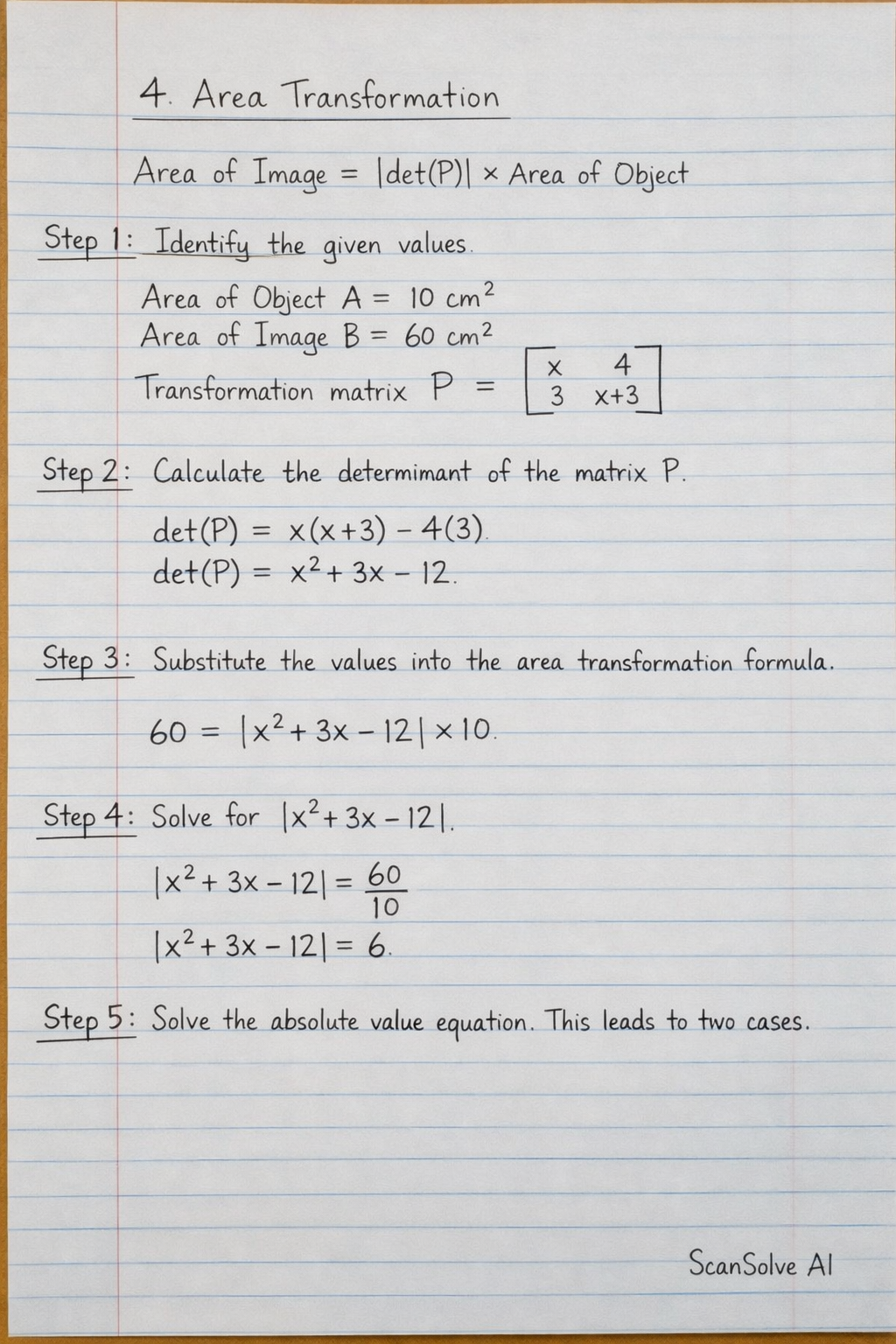
4. Area Transformation
The area of an object is transformed by a matrix PP. The relationship between the area of the object and the area of its image is given by:

Area of Image=∣det⁡(P)∣×Area of Object\text{Area of Image} = |\det(P)| \times \text{Area of Object}
  1. Identify the given values.

    Area of Object A =10 cm2= 10 \text{ cm}^2
    Area of Image B =60 cm2= 60 \text{ cm}^2
    Transformation matrix P=(x43x+3)P = \begin{pmatrix} x & 4 \\ 3 & x+3 \end{pmatrix}

  2. Calculate the determinant of the matrix PP.

    For a 2×22 \times 2 matrix (abcd)\begin{pmatrix} a & b \\ c & d \end{pmatrix}, the determinant is ad−bcad - bc.

    det⁡(P)=x(x+3)−(4)(3)\det(P) = x(x+3) - (4)(3) det⁡(P)=x2+3x−12\det(P) = x^2 + 3x - 12
  3. Substitute the values into the area transformation formula.

    60=∣x2+3x−12∣×1060 = |x^2 + 3x - 12| \times 10
  4. Solve for ∣x2+3x−12∣|x^2 + 3x - 12|.

    ∣x2+3x−12∣=6010|x^2 + 3x - 12| = \frac{60}{10} ∣x2+3x−12∣=6|x^2 + 3x - 12| = 6
  5. Solve the absolute value equation.

    This leads to two cases.

    Case 1: x2+3x−12=6x^2 + 3x - 12 = 6

    x2+3x−18=0x^2 + 3x - 18 = 0

    Factor the quadratic equation:

    (x+6)(x−3)=0(x+6)(x-3) = 0

    This gives two possible values for xx:

    x=−6orx=3x = -6 \quad \text{or} \quad x = 3

    Case 2: x2+3x−12=−6x^2 + 3x - 12 = -6

    x2+3x−6=0x^2 + 3x - 6 = 0

    Use the quadratic formula x=−b±b2−4ac2ax = \frac{-b \pm \sqrt{b^2 - 4ac}}{2a} where a=1a=1, b=3b=3, c=−6c=-6.

    x=−3±32−4(1)(−6)2(1)x = \frac{-3 \pm \sqrt{3^2 - 4(1)(-6)}}{2(1)} x=−3±9+242x = \frac{-3 \pm \sqrt{9 + 24}}{2} x=−3±332x = \frac{-3 \pm \sqrt{33}}{2}

    This gives two possible values for xx:

    x=−3+332orx=−3−332x = \frac{-3 + \sqrt{33}}{2} \quad \text{or} \quad x = \frac{-3 - \sqrt{33}}{2}
  6. Identify the positive values of xx.

    From Case 1: x=3x=3 is positive. x=−6x=-6 is negative.
    From Case 2: 33≈5.74\sqrt{33} \approx 5.74.
    x=−3+332≈−3+5.742=2.742=1.37x = \frac{-3 + \sqrt{33}}{2} \approx \frac{-3 + 5.74}{2} = \frac{2.74}{2} = 1.37 (positive).
    x=−3−332≈−3−5.742=−8.742=−4.37x = \frac{-3 - \sqrt{33}}{2} \approx \frac{-3 - 5.74}{2} = \frac{-8.74}{2} = -4.37 (negative).

    The positive values of xx are 3 and −3+332\boxed{3 \text{ and } \frac{-3 + \sqrt{33}}{2}}.

Was this helpful?

Try one yourself

A new problem that tests the same skill.

Still stuck on this one?

Ask a follow-up, and the answer starts from this question.

Got a different question?Ask your own question
Handwritten step-by-step solution preview

Handwritten Step-by-Step Solution

Get this as a handwritten image on WhatsApp — like a tutor wrote it for you.

Try on WhatsApp