
We read your photo as:
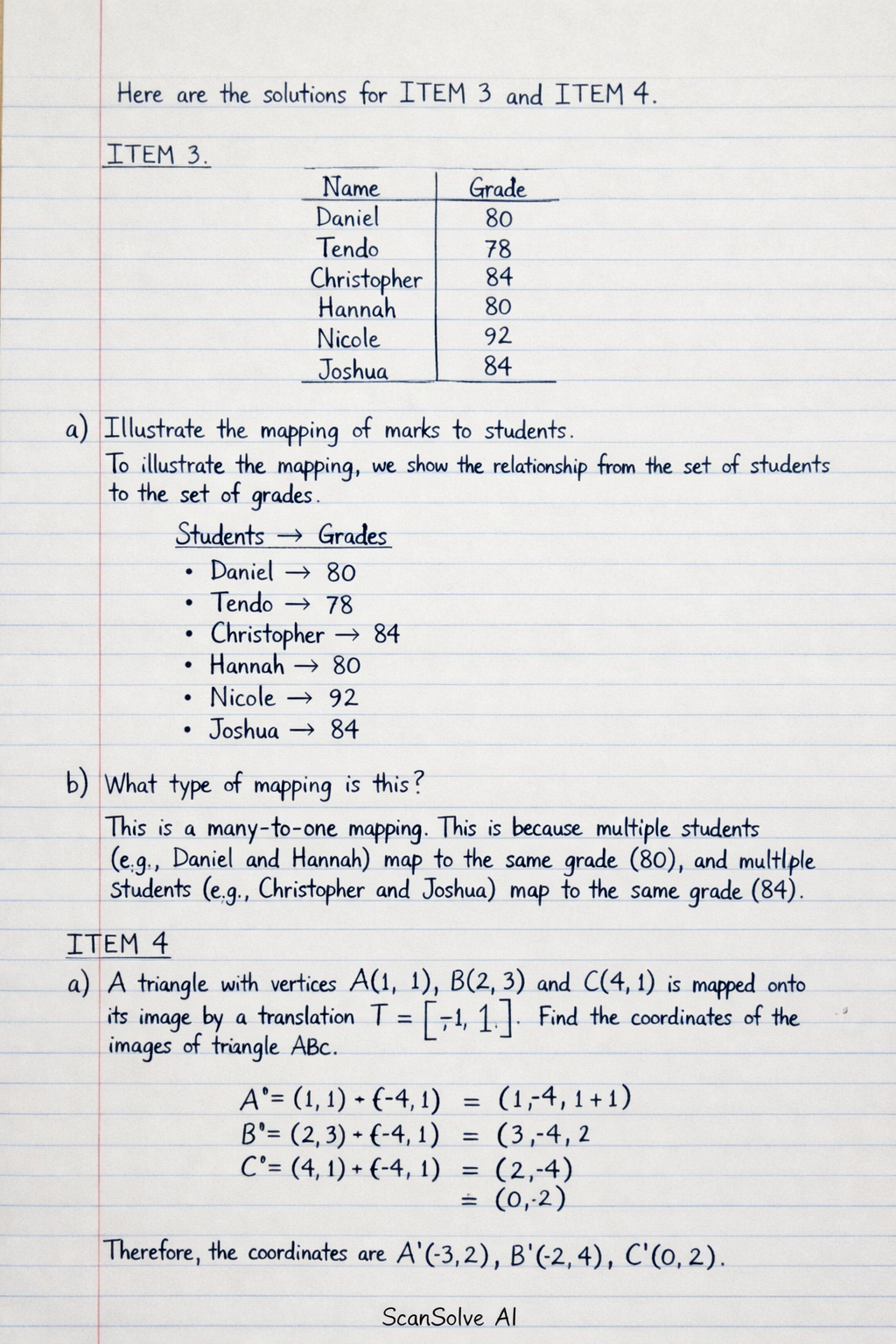
A triangle with vertices A(1, 1), B(2, 3) and C(4, 1) is mapped onto its image by a translation T = [-4, 1]. Find the coordinates of the images of triangle ABC.
ScanSolve AI Answer
Step-by-step solution
7 stepsHere are the solutions for ITEM 3 and ITEM 4.
ITEM 3
Some S.2 students of Taibah international school obtained the following marks in a Math test.
| Name | Grade |
|---|---|
| Daniel | 80 |
| Tendo | 78 |
| Christopher | 84 |
| Hannah | 80 |
| Nicole | 92 |
| Joshua | 84 |
a) Illustrate the mapping of marks to students.
To illustrate the mapping, we show the relationship from the set of students to the set of grades.
Students Grades
- Daniel 80
- Tendo 78
- Christopher 84
- Hannah 80
- Nicole 92
- Joshua 84
b) What type of mapping is this?
This is a many-to-one mapping. This is because multiple students (e.g., Daniel and Hannah) map to the same grade (80), and multiple students (e.g., Christopher and Joshua) map to the same grade (84).
ITEM 4
a) A triangle with vertices , and is mapped onto its image by a translation . Find the coordinates of the images of triangle ABC.
To find the image of a point under a translation , the new coordinates are given by .
Find the image of vertex A.
For and :
Find the image of vertex B.
For and :
Find the image of vertex C.
For and :
b) Evaluate the following. If and , find:
(i)
Multiply the vector by the scalar 2.
(ii)
Calculate $2a$.
From part (i), we know:
Calculate $3b$.
Add the resulting vectors $2a$ and $3b$.
Still stuck on this one?
Ask a follow-up, and the answer starts from this question.
More Mathematics Questions
Handwritten Step-by-Step Solution
Get this as a handwritten image on WhatsApp — like a tutor wrote it for you.
Try on WhatsApp