We read your photo as:

A triangle XYZ has vertices X(2, -1), Y(4, -1) and Z(4, 2). a) Find the coordinates of the image triangle X'Y'Z' after the transformation T1 = [[1, -3], [0, 1]]. b) Find the coordinates of the image t

Mathematics

ScanSolve AI Answer

Answers

2 parts
c

[011−3]\begin{bmatrix} 0 & 1 \\ 1 & -3 \end{bmatrix}

d

15 cm215 \text{ cm}^2

Step-by-step solution

8 steps

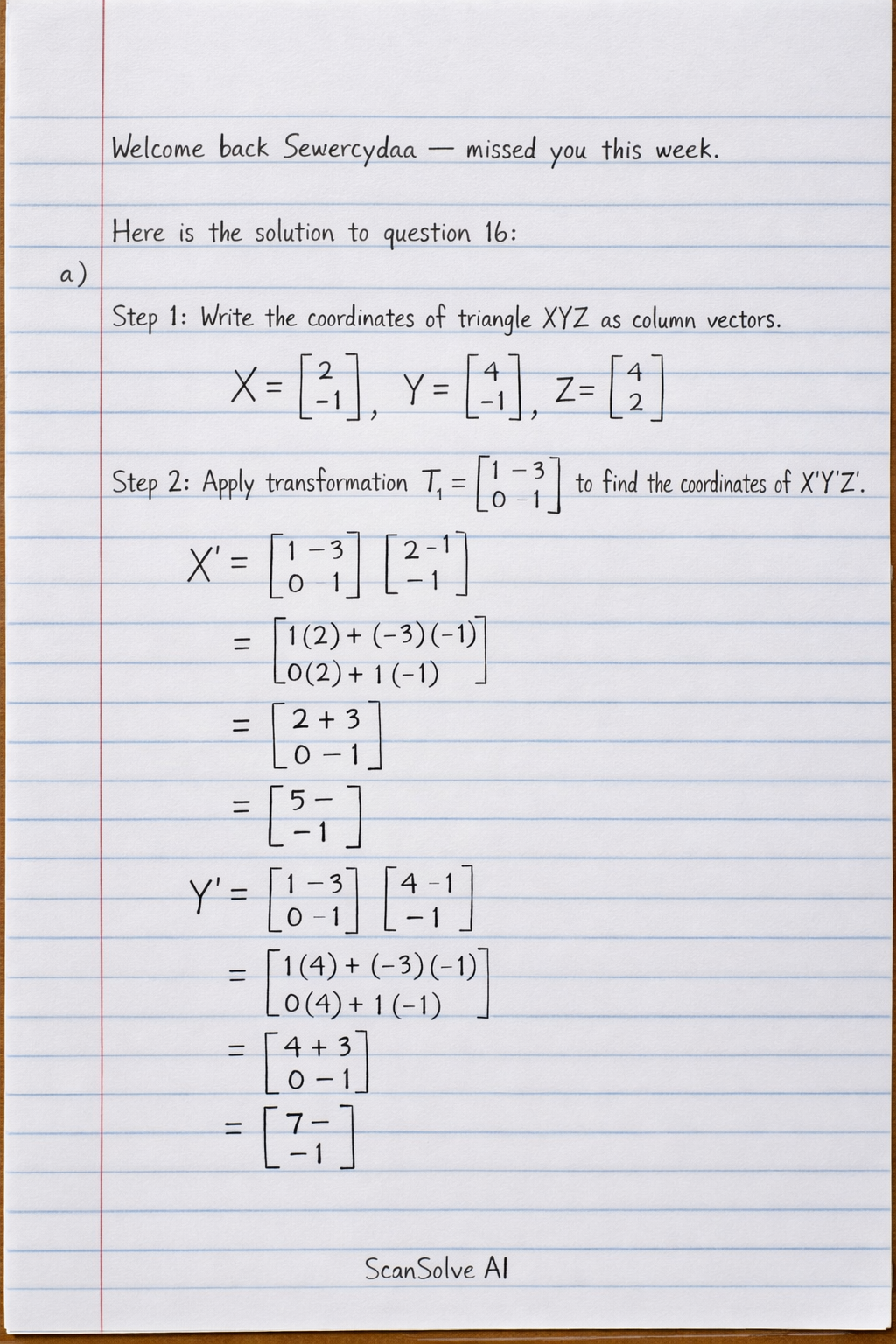
Here is the solution to question 16:

Part a· 2 steps

  1. Write the coordinates of triangle XYZ as column vectors.

    X=[2−1],Y=[4−1],Z=[42]X = \begin{bmatrix} 2 \\ -1 \end{bmatrix}, \quad Y = \begin{bmatrix} 4 \\ -1 \end{bmatrix}, \quad Z = \begin{bmatrix} 4 \\ 2 \end{bmatrix}
  2. Apply transformation T1=[1−301]T_1 = \begin{bmatrix} 1 & -3 \\ 0 & 1 \end{bmatrix} to find the coordinates of X'Y'Z'.

    X′=[1−301][2−1]=[1(2)+(−3)(−1)0(2)+1(−1)]=[2+30−1]=[5−1]X' = \begin{bmatrix} 1 & -3 \\ 0 & 1 \end{bmatrix} \begin{bmatrix} 2 \\ -1 \end{bmatrix} = \begin{bmatrix} 1(2) + (-3)(-1) \\ 0(2) + 1(-1) \end{bmatrix} = \begin{bmatrix} 2 + 3 \\ 0 - 1 \end{bmatrix} = \begin{bmatrix} 5 \\ -1 \end{bmatrix} Y′=[1−301][4−1]=[1(4)+(−3)(−1)0(4)+1(−1)]=[4+30−1]=[7−1]Y' = \begin{bmatrix} 1 & -3 \\ 0 & 1 \end{bmatrix} \begin{bmatrix} 4 \\ -1 \end{bmatrix} = \begin{bmatrix} 1(4) + (-3)(-1) \\ 0(4) + 1(-1) \end{bmatrix} = \begin{bmatrix} 4 + 3 \\ 0 - 1 \end{bmatrix} = \begin{bmatrix} 7 \\ -1 \end{bmatrix} Z′=[1−301][42]=[1(4)+(−3)(2)0(4)+1(2)]=[4−60+2]=[−22]Z' = \begin{bmatrix} 1 & -3 \\ 0 & 1 \end{bmatrix} \begin{bmatrix} 4 \\ 2 \end{bmatrix} = \begin{bmatrix} 1(4) + (-3)(2) \\ 0(4) + 1(2) \end{bmatrix} = \begin{bmatrix} 4 - 6 \\ 0 + 2 \end{bmatrix} = \begin{bmatrix} -2 \\ 2 \end{bmatrix}

    The coordinates of triangle X'Y'Z' are X'(5, -1), Y'(7, -1), Z'(-2, 2).
    (Drawing on a grid is not possible in this format, but these are the coordinates you would plot).

Part b· 1 step

  1. Apply transformation T2=[0110]T_2 = \begin{bmatrix} 0 & 1 \\ 1 & 0 \end{bmatrix} to the coordinates of X'Y'Z' to find X''Y''Z''.

    X′′=[0110][5−1]=[0(5)+1(−1)1(5)+0(−1)]=[−15]X'' = \begin{bmatrix} 0 & 1 \\ 1 & 0 \end{bmatrix} \begin{bmatrix} 5 \\ -1 \end{bmatrix} = \begin{bmatrix} 0(5) + 1(-1) \\ 1(5) + 0(-1) \end{bmatrix} = \begin{bmatrix} -1 \\ 5 \end{bmatrix} Y′′=[0110][7−1]=[0(7)+1(−1)1(7)+0(−1)]=[−17]Y'' = \begin{bmatrix} 0 & 1 \\ 1 & 0 \end{bmatrix} \begin{bmatrix} 7 \\ -1 \end{bmatrix} = \begin{bmatrix} 0(7) + 1(-1) \\ 1(7) + 0(-1) \end{bmatrix} = \begin{bmatrix} -1 \\ 7 \end{bmatrix} Z′′=[0110][−22]=[0(−2)+1(2)1(−2)+0(2)]=[2−2]Z'' = \begin{bmatrix} 0 & 1 \\ 1 & 0 \end{bmatrix} \begin{bmatrix} -2 \\ 2 \end{bmatrix} = \begin{bmatrix} 0(-2) + 1(2) \\ 1(-2) + 0(2) \end{bmatrix} = \begin{bmatrix} 2 \\ -2 \end{bmatrix}

    The coordinates of triangle X''Y''Z'' are X''(-1, 5), Y''(-1, 7), Z''(2, -2).
    (Drawing on a grid is not possible in this format, but these are the coordinates you would plot).

Part c

[011−3]\begin{bmatrix} 0 & 1 \\ 1 & -3 \end{bmatrix}

  1. The single transformation matrix T that maps XYZ to X''Y''Z'' is the product of T2T_2 and T1T_1, in that order (T2T_2 first, then T1T_1 applied to the original object, so T=T2T1T = T_2 T_1).

    T=T2T1=[0110][1−301]T = T_2 T_1 = \begin{bmatrix} 0 & 1 \\ 1 & 0 \end{bmatrix} \begin{bmatrix} 1 & -3 \\ 0 & 1 \end{bmatrix}
  2. Perform the matrix multiplication.

    T=[(0)(1)+(1)(0)(0)(−3)+(1)(1)(1)(1)+(0)(0)(1)(−3)+(0)(1)]T = \begin{bmatrix} (0)(1) + (1)(0) & (0)(-3) + (1)(1) \\ (1)(1) + (0)(0) & (1)(-3) + (0)(1) \end{bmatrix} T=[0+00+11+0−3+0]T = \begin{bmatrix} 0 + 0 & 0 + 1 \\ 1 + 0 & -3 + 0 \end{bmatrix} T=[011−3]T = \boxed{\begin{bmatrix} 0 & 1 \\ 1 & -3 \end{bmatrix}}

Part d

15 cm215 \text{ cm}^2

  1. The area of the image is given by the formula

    Area of image = ∣det⁡(T)∣×|\det(T)| \times Area of object.

  2. Calculate the determinant of the transformation matrix T.

    T=[011−3]T = \begin{bmatrix} 0 & 1 \\ 1 & -3 \end{bmatrix} det⁡(T)=(0)(−3)−(1)(1)=0−1=−1\det(T) = (0)(-3) - (1)(1) = 0 - 1 = -1
  3. Calculate the area of triangle X''Y''Z''.

    Area(X”Y”Z”)=∣det⁡(T)∣×Area(XYZ)\text{Area(X''Y''Z'')} = |\det(T)| \times \text{Area(XYZ)} Area(X”Y”Z”)=∣−1∣×15 cm2\text{Area(X''Y''Z'')} = |-1| \times 15 \text{ cm}^2 Area(X”Y”Z”)=1×15 cm2\text{Area(X''Y''Z'')} = 1 \times 15 \text{ cm}^2 Area(X”Y”Z”)=15 cm2\text{Area(X''Y''Z'')} = \boxed{15 \text{ cm}^2}
Was this helpful?

Try one yourself

A new problem that tests the same skill.

Still stuck on this one?

Ask a follow-up, and the answer starts from this question.

Got a different question?Ask your own question
Handwritten step-by-step solution preview

Handwritten Step-by-Step Solution

Get this as a handwritten image on WhatsApp — like a tutor wrote it for you.

Try on WhatsApp