

This mathematics problem involves applying core mathematical principles and formulas. Below you will find a complete step-by-step solution with detailed explanations for each step, helping you understand not just the answer but the method behind it.
ScanSolve AI Answer
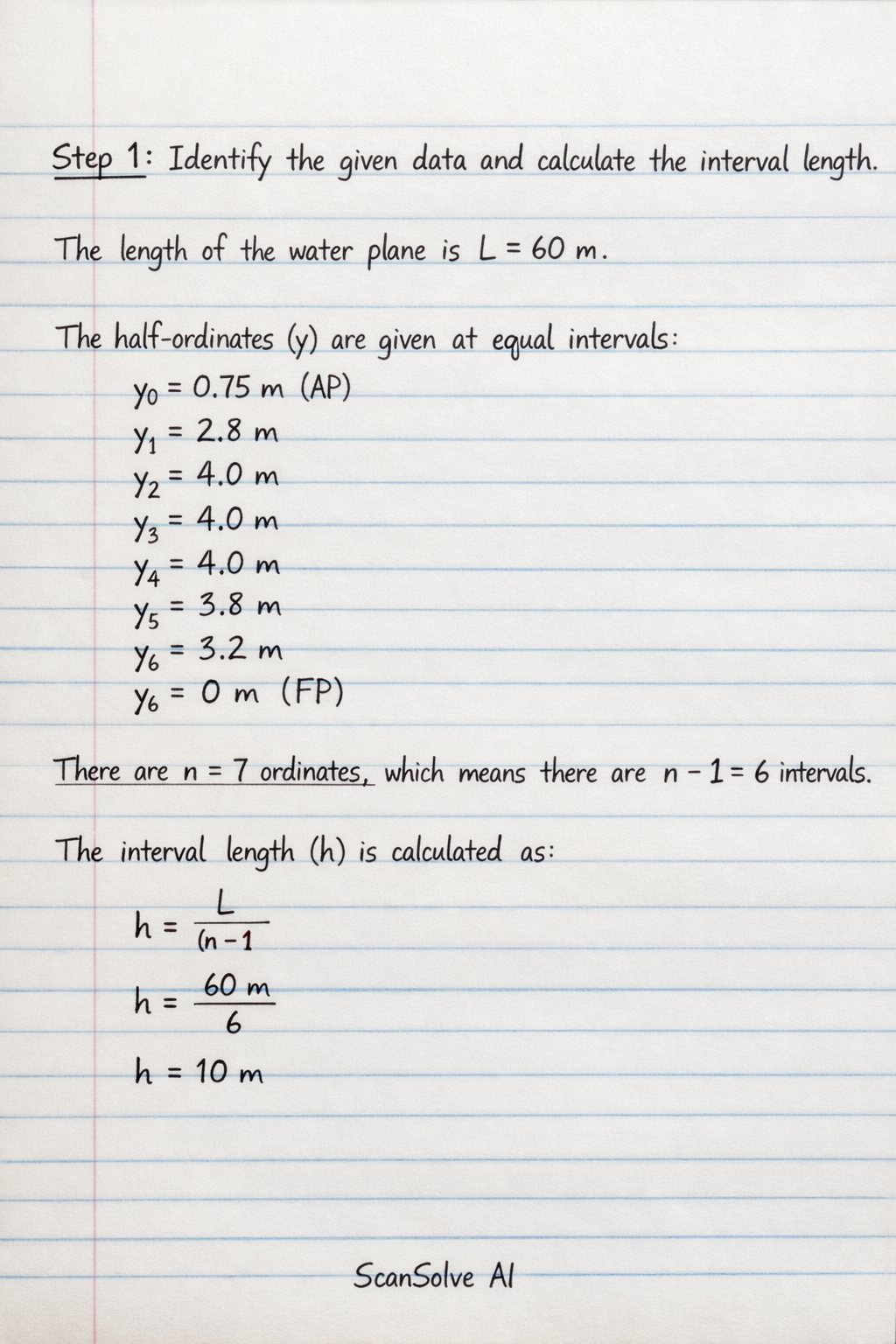
Step 1: Identify the given data and calculate the interval length. The length of the water plane is L = 60 \, m. The half-ordinates (y) are given at equal intervals: y_0 = 0.75 \, m (AP) y_1 = 2.8 \, m y_2 = 4.0 \, m y_3 = 4.0 \, m y_4 = 3.8 \, m y_5 = 3.2 \, m y_6 = 0 \, m (FP) There are n=7 ordinates, which means there are n-1=6 intervals. The interval length (h) is calculated as: h = (L)/(n-1) = 60 \, m6 = 10 \, m Step 2: Apply Simpson's First Rule to find the sum of products. Simpson's multipliers for 7 ordinates are 1, 4, 2, 4, 2, 4, 1. We calculate the product of each half-ordinate and its corresponding Simpson's multiplier: y_0 × 1 = 0.75 × 1 = 0.75 y_1 × 4 = 2.8 × 4 = 11.2 y_2 × 2 = 4.0 × 2 = 8.0 y_3 × 4 = 4.0 × 4 = 16.0 y_4 × 2 = 3.8 × 2 = 7.6 y_5 × 4 = 3.2 × 4 = 12.8 y_6 × 1 = 0 × 1 = 0 The sum of these products (SP) is: SP = 0.75 + 11.2 + 8.0 + 16.0 + 7.6 + 12.8 + 0 = 56.35 a) Determine the area of the water plane. Step 3: Calculate the area of the water plane (A_WP). The area of one side of the water plane (A_half) is given by Simpson's First Rule: A_half = (h)/(3) × SP A_half = 10 \, m3 × 56.35 = (563.5)/(3) \, m^2 The total water plane area (A_WP) is twice the area of one side, since the ordinates are half-ordinates: A_WP = 2 × A_half = 2 × (563.5)/(3) \, m^2 = (1127)/(3) \, m^2 A_WP ≈ 375.666... \, m^2 Rounding to two decimal places: The area of the water plane is 375.67 \, m^2. b) Determine the TPC. Step 4: Calculate the Tons Per Centimeter immersion (TPC). The formula for TPC is: TPC = A_WP × _water100 Assuming the density of freshwater, _water = 1.0 \, tonne/m^3. TPC = 375.666... \, m^2 × 1.0 \, tonne/m^3100 TPC = 3.75666... \, tonnes/cm Rounding to two decimal places: The TPC is 3.76 \, tonnes/cm. That's 2 down. 3 left today — send the next one.