
We read your photo as:
A wheelchair ramp is placed over a set of stairs so that one end is 2 feet off the ground. The other end is at a point that is a horizontal distance of 28 feet away, as shown in the diagram. What is t
ScanSolve AI Answer
Answer
Step-by-step solution
5 stepsOkay, wild, let's solve this ramp problem.
A wheelchair ramp is placed over a set of stairs so that one end is 2 feet off the ground. The other end is at a point that is a horizontal distance of 28 feet away, as shown in the diagram. What is the angle of elevation to the nearest degree?
Identify the known values from the diagram and problem description.
The height of the ramp (opposite side to the angle of elevation) is .
The horizontal distance of the ramp (adjacent side to the angle of elevation) is .
We need to find the angle of elevation, .Choose the appropriate trigonometric ratio.
Since we have the opposite side and the adjacent side relative to the angle , we use the tangent function:
Substitute the known values into the formula.
Solve for using the inverse tangent function.
Calculate the value and round to the nearest degree.
Using a calculator:
Rounding to the nearest degree:
The angle of elevation to the nearest degree is .
Try one yourself
A new problem that tests the same skill.
Still stuck on this one?
Ask a follow-up, and the answer starts from this question.
More Mathematics Questions
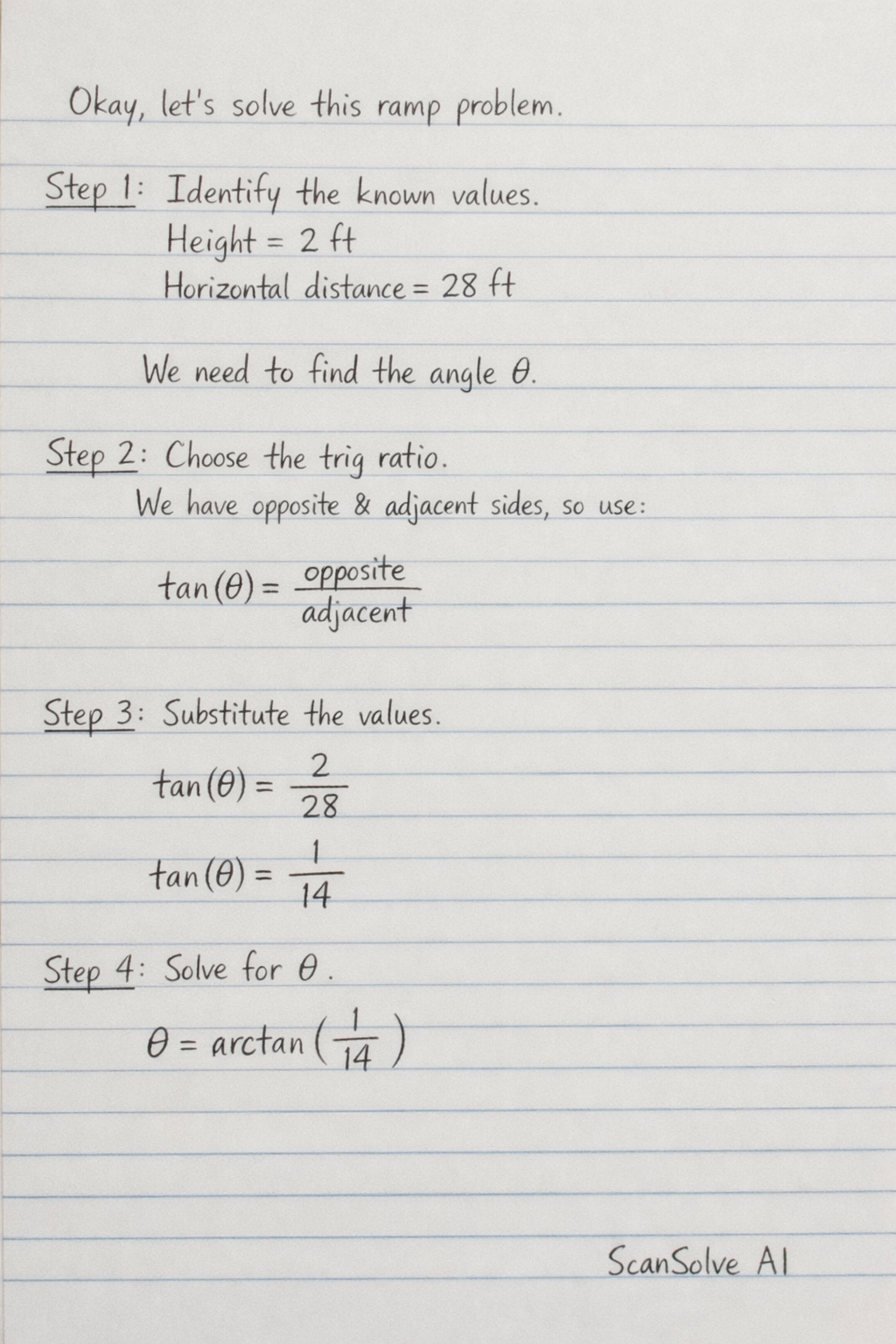
Handwritten Step-by-Step Solution
Get this as a handwritten image on WhatsApp — like a tutor wrote it for you.
Try on WhatsApp