
We read your photo as:
AB is a tangent to the circle with centre 'O' and 'A' is the point of contact. If OB = 5 sqrt2 cm, then prove that riangle AOB is an isosceles triangle. Find the radius of the circle.
ScanSolve AI Answer
This answer stops before the end.
It was cut off when it was first written. Ask ScanSolve this question again for the full working.
Here are the solutions to the questions:
IV. Answer the following questions:
24. AB is a tangent to the circle with centre 'O' and 'A' is the point of contact. If OB = cm, then prove that is an isosceles triangle. Find the radius of the circle.
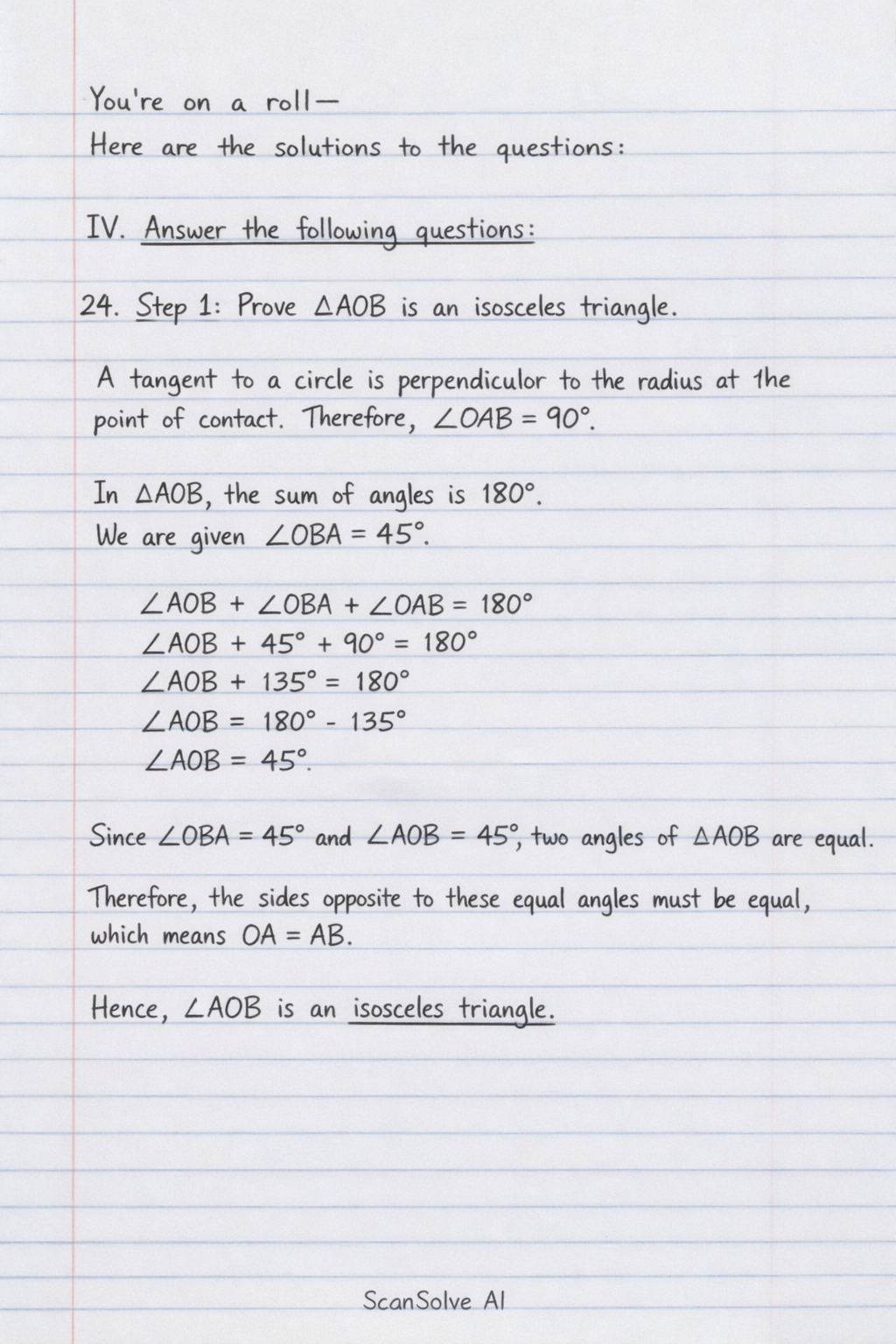
Step 1: Prove is an isosceles triangle.
A tangent to a circle is perpendicular to the radius at the point of contact. Therefore, .
In , the sum of angles is .
We are given (from the diagram).
Since and , two angles of are equal. Therefore, the sides opposite to these equal angles must be equal, which means .
Hence, is an isosceles triangle.
Step 2: Find the radius of the circle.
In the right-angled triangle , we can use trigonometric ratios. We know and cm.
The radius is .
The radius of the circle is .
25. Find the zeroes of the quadratic polynomial and verify the relationship between the zeroes and the coefficients.
Step 1: Find the zeroes of the polynomial.
To find the zeroes, set :
Factor the quadratic expression. We need two numbers that multiply to and add to . These numbers are and 2.
Set each factor to zero:
The zeroes of the polynomial are .
Step 2: Verify the relationship between the zeroes and the coefficients.
For a quadratic polynomial , the sum of zeroes is and the product of zeroes is .
For , we have , , .
Let the zeroes be and .
-
Sum of zeroes:
From coefficients:
The sum of zeroes matches the formula.
-
Product of zeroes:
From coefficients:
The product of zeroes matches the formula. The relationship between the zeroes and coefficients is verified.
26. Prove that "The tangent at any point of a circle is perpendicular to the radius through the point of contact".
Step 1: Set up the proof.
Let a circle have center O and radius . Let AB be a tangent to the circle at point P. We need to prove that the radius OP is perpendicular to the tangent AB, i.e., .
Step 2: Consider a point on the tangent.
Take any point Q on the line AB, other than P. Since AB is a tangent, it touches the circle at only one point, P. This means that any other point Q on the line AB must lie outside the circle.
Step 3: Compare distances.
If Q lies outside the circle, then the distance OQ must be greater than the radius OP.
Step 4: Conclude the proof.
This implies that OP is the shortest distance from the center O to any point on the line AB. In geometry, the shortest distance from a point to a line is always the perpendicular distance.
Therefore, .
Hence, the tangent at any point of a circle is perpendicular to the radius through the point of contact.
27. . In , , and the sides of are in the ratio . If the perimeter of is , then find the measure of sides and angles of .
Step 1: Find the angles of .
The sum of angles in a triangle is .
Step 2: Find the angles of .
Since , their corresponding angles are equal.
The angles of are .
Step 3: Find the sides of .
The sides of are in the ratio . Let the sides be .
Since , the sides of will also be in the same ratio . Let the sides of be .
The perimeter of is given as .
Still stuck on this one?
Ask a follow-up, and the answer starts from this question.
More Mathematics Questions
Handwritten Step-by-Step Solution
Get this as a handwritten image on WhatsApp — like a tutor wrote it for you.
Try on WhatsApp